Hedreich Nichols

hedreich

Shape of You

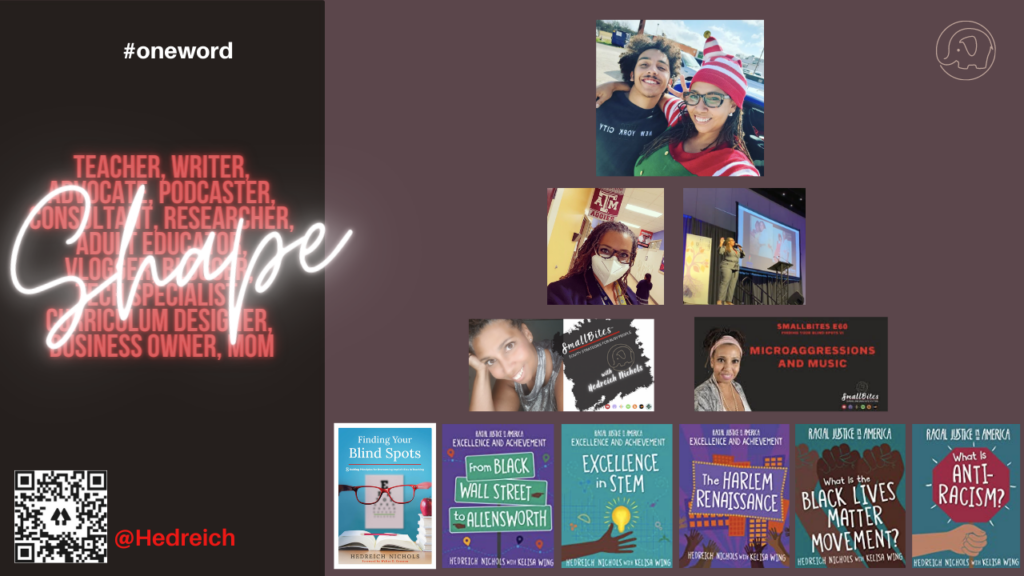
OneWord ’22 graphic. SmallBites returns Monday, January 10th wherever fine podcasts are heard.

Standing at the precipice of the new year has long ceased to feel like some magical new beginning. That’s a good thing. I have not bungled this year. I’m not waiting on the turn of a page so that I can resolutely start anew. What I am doing is taking the wins of the last couple of years and shaping them into a harmonious melding of many hats. If you are a teacher and a parent, you understand being a wearer of many hats.

The thing about wearing many hats is that it can be difficult to identify which hat is The One. Usually that’s because there is no ONE. Could you choose between ‘child’, ‘spouse’, ‘parent’, ‘educator’ or ‘friend’? Each of those hats are vitally important, but they aren’t always on your head all at once. Still, sometimes you stack them, sometimes they sit askew. Sometimes you just want to throw them all down and go hatless.

This evening, as I write the last blog of 2021, I am hatless. It’s one of those rare moments where I can just be. And in this moment, I savor the time to reflect in quiet about my many hats.

Shape Shifter

A template designed by Educator and Youtuber Claudio Zavala led me to define the hats I wear. As I named them, I finalized my one word, ‘shape’. As my role in education and parenting is shifting, I am in the process of reordering my hats. The last two years have been fruitful, yielding 6 books, 65 SmallBites YouTube episodes, 65 hedreich.com blog episodes and 65 SmallBites podcast episodes. Those don’t include courses, guest blogs and articles.

So how do I bring all those hats under one umbrella? Well, that’s my focus this year. A little prioritizing, a little fine tuning the schedule and a little more work-life balance. And this is all worthy of a blog post, why? Because, as usual, I have an ask. In the next few days, I would like each of you multi hat wearers to spend a little time being intentional about which hats need to be worn when, for how long and in what order. By allowing a picture of your priorities to emerge, you’ll be better able to focus on the now and shape your path forward. This is especially true if you are, like many, considering a shift away from the classroom or away from education altogether.

Happy New Year

As you define and re-order your hats, define also what brings you joy, what ameliorates stress and what is good for you. Make choosing yourself a firm priority. All the people around you will be happier if you are balanced and content. How will you do this with the coming year, including COVID and testing season? Only you can say. But I know that if you don’t take a minute to establish your priorities, the year’s stressors will do it for you and you will likely not be pleased with the outcome.

FInally, I’d like to thank you for reading and listening. I hope that by shaping your coming year and beyond, that you’ll continue to have energy to learn, to grow and to make safer, more equitable classrooms and campuses for all students.

Your loyalty is appreciated. See you next year!

Shape of You Read More »

Alles Hat Ein Ende

Watch on YouTube or listen on Anchor, or wherever podcasts are heard.

There’s a song well known in German speaking parts of the world called Alles Hat Ein Ende, Nur Die Wurst Hat Zwei. Translated, that’s “everything has an end, only the sausage has 2”. After over 60 vlog episodes and as many Lagniappe podcast episodes, #SmallBites on YouTube is converting to an all podcast format. I hope you’re as excited about this as I am.

New Day Dawning

After celebrating with friends and family from almost every era of my life on last Friday, it’s time to move on to the next chapter. With Finding Your Blind Spots released to the edu-universe, I find myself busier with consulting and courses, and I want to have time to serve my clients well. Still, my audience is hugely important and you can still expect blogs, resources and answers to your pressing questions on race and identity through social media.

One thing about podcasts is that they usually accompany listeners who are driving. Because of that I will sometimes be extending just a couple of minutes beyond our 5-7m mark to give you even more #SmallBites to chew on. I hope that meets with your approval!

You Are Appreciated!

Beyond that, I would just like to thank you for coming back each week, for listening, for learning and for taking that knowledge back to your classrooms and learning communities. Join me next week for episode 65 when we’ll say our final goodbyes. In the meantime, see below for the 5 most important #SmallBites links and resources.

Small Bites All Time Favorite Friday Five:

When I started #SmallBites, Learning for Justice was still called Teaching Tolerance. This site is the definitive starting place for standards, lessons, articles and resources on race and identity. Whether you are just beginning your journey on classroom diversity and inclusivity, or are well on your way to helping others understand concepts that some find divisive, Learning for Justice is a site that constantly evolves to help you learn more and be better for your students.

The Harvard Implicit Bias tests help you recognize bias and blind spots. And Harvard GSE’s teaching resources provide tools to help you create more inclusive courses, syllabi and to better integrate conversations on race and identity into your daily lessons.

After reading statistics on disparities in school discipline, I can only recommend restorative justice practices as implemented in the San Francisco Unified School District. I have used their model in my own classrooms and watched discipline problems give way deeper relationships and better learning outcomes. Students just need to know we are invested, but it takes a whole team to make the kinds of disciplinary changes that come with consistent campus RJ implementation.

Of course, if you are going to miss #SmallBites Fridays after you’ve revisited the wealth of resources, keep learning with free courses taught by Yale and Harvard professors here. Or, you can read and use the 1619 curriculum (or information from it, if your district allows) in addition to other historical resources, to add multiperspectivity. Finally, with students, use PBS, the Smithsonian and NPS.gov to find a plethora of school resources on history and culture in the US and the world.

See You Soon

Finally, use the 65 episodes of SmallBites to find the above resources and many more that will guide you as you seek to better understand and teach all students.

It has been my honor to serve you with #SmallBites on Youtube. See you on Apple, Spotify and wherever fine podcasts are heard.

Alles Hat Ein Ende Read More »

I Call Your Name


Watch on YouTube or listen on Anchor, or wherever podcasts are heard.

This week’s Friday Five comes in the form of another adapted chart from Finding Your Blind Spots.

Say ThisNot This
Chair, mail carrier, fire fighter, flight attendant, nurse, congressional representative, human beingsChairman, mailman, fireman, stewardess, male nurse, congressman, mankind
Student in a wheelchair, student with a learning disability, students who are neurodiverseHandicapped student, learning disability student, special education students
African American, Black, BIPOC, POCNegro, colored, black, Afro-American
Mexican American, Cuban American, Latinx, Chinese American, Congolese AmericanHispanics (when the culture is known), Latino or Latina, Asians, Africans
Native American or specific tribe name, Indigenous peoples of North America, Inuit, Pacific Islander, AIAN (American Indian and Alaskan Native), API (Asian and Pacific Islander), the term someone self-identifies as (just ask them!)Indian, Eskimo, Hawaiian, Chinese
The full chart can be found in Finding Your Blind Spots, available for preorder now.
Teach me how to say that, please.

Whenever I struggled to read the surname of a student on my roster, I always squealed with delight and asked “Ooohh, where’s your name from??” Teaching middle school, I mostly got the “why you puttin’ me on blast” look. But I usually pressed on and was rewarded, as their voices rose in pride and excitement to meet my own.

Because we live in a world that still prizes assimilation over diversity, it’s important that educators use culturally affirming language as they build relationships with individual students. ‘Labeling’ students in the most celebratory and specific way possible is one way to embrace them.

For example, Wanyepreye would have been ‘Pat’ had he insisted. But, I asked him to teach me how to say his name properly. It wasn’t hard. I also asked which he preferred. He said both. When I asked if I could call him Wanyepreye, he said ‘yeah’.

You see, Wanyepreye is Nigerian American. He is not ‘African’ anymore than Canadians–or us, for that matter, are ‘North Americans’.

Go deeper.

How much do you know about your Hispanic students, your Asian students, your Native American students, your Black students or your students from the LGBTQ community? Culture is not only skin deep. Wanyepreye and I are both Black. But his grandma and my grandma cooked differently, spoke differently, had different cultural experiences growing up. His grandma is Nigerian. Mine was Opelousian, from Louisiana. Those labels convey something unique about each woman that the term Black does not. Mexican or El Salvadorian descriptors mean more than Latinx or Hispanic. How deep do you go when getting to know your students–and coworkers–for that matter?

Don’t just read the label.
  • The student with autism wants to be a lemur scientist in Virginia, and he’s working toward that goal.
  • The student working toward their Eagle in Scouts is hosting a rally for the LG community.
  • The student from Tibet is a part of a local circle dance group that performs nationally.

These kids might just be the Sped kid, the gay guy and the Asian girl. But those are labels that don’t even scratch the surface of who they are.

If you are honest with yourself, how many times in a week do you hear “the gay kid”, “the SpEd kid”, “the African kid”, “the Hispanic kid”, etc.? How often do you label kids that way yourself? How much about those kids do you know, beyond those labels? What about when you read the above labels and think about your own language use. Is it common for you to assign monolithic terms to groups of students (i.e. Blacks and Browns) without considering the cultures of the groups represented? Is it the norm on your campus to assign class jobs and talk about certain community heroes along gender lines?

Person first. Gender neutral. Culture affirming.

Luckily, Purdue Owl‘s writing lab keeps up with person-first, gender neutral, culture affirming terminology. And when Finding Your Blind Spots comes out, you can learn even more. But for now, recognize that our language and labels should always be person first, specific, gender neutral and culture affirming. Choosing a specific, rather than broad, ‘label’ starts you on the road to learning more about your students. And when you show nurses and cowhands of all genders, you open up a world of possibilities for your students.

I have one ask this week. Reflect on what you’ve learned and rethink how labels influence what you think about students. And, to practice here’s a 1 question quiz:

Use the chart and the Purdue resources above to rewrite the following sentence in the most inclusive, specific and affirming terms possible:

The American Indian SpEd kid plays basketball when he doesn’t have tutoring. FYI, the student is non-binary, identifies as “they”, is Chickasaw and has autism.

Feel free to practice for yourself or to answer on the thread on Twitter.

I Call Your Name Read More »

…Do I Fit In?

Watch on YouTube or listen on Anchor, or wherever podcasts are heard.

Small Bites Friday Five 10-8-21:

20-30m – Visit the University of California San Francisco’s Youtube page for a phenomenal selection of videos on belonging, diversity and inclusivity. Start with the “Faces of…” series, featuring diverse student stories in their own words.

15-20m – Listen to this Journey to Belonging podcast with Ilene Winokur entitled “Belonging Before Blooms”. As a matter of fact, bookmark the podcast. She explores the theme of belonging and it’s importance with a variety of inspiring educators from across the globe.

10-15m – Visit the University of California San Francisco’s LGBTQ+ YouTube resource center. The 7 minute introduction video is especially helpful for explaining diverse terms and definitions.

5-10m – Read this “Toolkit for ‘You Belong Here’ article from Learning for Justice” (formerly Teaching Tolerance) on the impact of the student-teacher diversity gap in our nation. Helping diverse students feel a sense of belonging means ensuring that diverse teachers feel a sense of belonging too.

0-5m – The stigma around mental health issues impact how we “other”, so once again, visit the UCSF’s Youtube page to listen to Kristin’s story, a story about anxiety and depression. Reflect on how to better include students struggling with mental health issues, both the readily visible and the invisible ones.

“My Kids”

If you listen to teachers talk about their students, they often refer to “my kids”. I too have often said “my personal kid” to ensure that people know which “my kids” I was talking about. I don’t have any research, but I am willing to bet that not caring if kids fit in or don’t fit in is not common in this profession. Still, when kids are asked whether or not they fit in or not, the answers are all too often less than positive. How can we turn that around?

In Finding Your Blind Spots, the first chapter talks all about how we “other”. “Othering” is what we do when we categorize people as different, as the “them” to our “us”. Othering is not Black or White. It’s not male, female or non-binary. It’s what we do when we come across someone who looks, behaves, thinks or even ‘feels’ different. We other the mom that dresses “too sexy”. We other the guy who doesn’t like sports. We other the person who doesn’t get our jokes. And even though we don’t mean to, we other students in our class who are unlike us (or maybe too much like us) every day.

Be Intentional

I can use all the Big Bad Diversity Words and talk about DEI, the ‘isms”, CRT, race politics, or even a “gay agenda”. Those words usually send people off to rantville in all sorts of political directions. But this space is for educators. And teachers, well, we believe that our kids should feel like they belong, full stop. So when some inflammatory headline threatens to pull you in one direction or another, I am asking you to remember that they are all “your kids”.

Creating classroom and campus spaces that welcome every student every day should be the goal. But like with any goal, reaching it takes intentionality. Besides using the resources above, do the following:

  • Consider taking a few of the Harvard Implicit Bias gamified tests to find your own blind spots.
  • Use the above information to make an action plan based on your personal hidden biases (i.e., refer fewer BIPOC students to the office; learn more about the LGBTQ+ community; make more opportunities for non-male students in STEM courses and clubs, etc.)
  • Look at your roster and pick 2 students with whom your relationship could be better. Have a transparent conversation with them, letting them know that you feel you could get to know each other better. Then, make time to get to know them better. Let them get to know you better as well.
Lead the Way

I am well aware that sometimes, it’s not teachers but students who often make other students feel “othered”. Explicit teaching on kindness and humanity are as necessary as lessons in reading and math. Our kids are watching us. They hear what we say and feel what we don’t say. Your disdain for “the bad kid” becomes theirs. Your barely perceptible annoyance comes across loud and clear to a kid already struggling to fit in. Make it a point to check in with yourself. Admit to yourself how you feel about your kids. Then be intentional about changing anything that might cause a child to feel othered.

When you are intentional about creating a sense of belonging for all your kids, when you teach your kids to do the same for each other, you’ll have a foundational culture shift that changes trajectories for your students. Let’s be intentional about creating a sense of belonging for all our kids.

As Ilene says, belonging before blooms.

…Do I Fit In? Read More »

Tell Me No Lies

Watch on YouTube or listen on Anchor, or wherever podcasts are heard.

Small Bites Friday Five 5-14-2021

20-30m – Watch this video that explains the Truth Commission of South Africa and the process they used to confront racial violence and inequities. Compare and contrast the similarities of the Apartheid system and issues with our own system

15-20m – Read this Andrew Johnson article and watch the accompanying video on critical race theory. Reflect on his definition and compare it to what you’ve heard or read.

10-15m – Read this Phi Delta Kappan article from Antony Farag on why we do students in schools with predominantly White populations a disservice when we do not teach them to explore varied perspectives and experiences.

5-10m – Read this American Bar article from Janel George that explains some of the basics of critical race theory and its implications.

0-5m – Read this article on confirmation bias from VeryWellMind. Remember, you will be tempted to find information on critical race theory that supports what you already believe. If you have some extra time, read articles on CRT written by those who do not espouse your opinion and take note of valid points. Every argument has them.

Doris Day. Farrah Fawcett. Cindy Crawford. Madonna. Then finally Janet, Whitney, Naomi. Finally.

Watching TV with my grandmother and great-grandmother in our multigenerational household meant that I grew up on a LOT of old Hollywood movies. At that time, movie directors were still selling Elizabeth Taylor as a North African and White extras speaking broken English as ‘Indians’. On the screens I grew up watching, people who looked like me were mostly invisible. Even though the doctors I saw were Black, all the pretty young women I knew in my community were black, the lawyers and stage actors I knew were Black, the amazingly talented musicians I knew were Black and the hard-working everyday heroes I knew were Black; the message mainstream media presented to me was that if you were not White, your story, your accomplishments, were not valuable and not worthy of being visible.

When you see don’t see yourself in history, stories and achievements represented in textbooks, magazines and on screen; when you are taught through classical education that the great philosophers and composers were White and mostly from Western European civilizations; you internalize a message of being less than because society constantly tells you who is greater than. That is what “White supremacy” is at its core. It’s not people being mean or even discriminating against others. It’s an acceptance of messaging that values whiteness and white cultures over others. That value—and lack of value for diverse cultures— plays out in a million ways in education, economics, healthcare and other sectors. If you are White, you may not notice. If you aren’t White, it’s your norm. Now, if I were White and reading this, I might read this and feel angry, accused or even feel I was being guilted up about something I have no control over.  

It is not my intention to make anyone feel guilty about the systems that value western White cultures above others. I just hope you can imagine what it’s like for those of us who are from the many great societies that do not get the airplay that White ones do: I want you to think about what it would be like to live, for example, in China where you see Chinese stars and Chinese scientists and Chinese inventors, and where you are taught about the great ancient Chinese societies and philosophers and great Chinese achievement. You, however, are not Chinese. Can you imagine feeling small and insignificant? Can you imagine the energy it takes to develop and maintain your own sense of self-worth, when you rarely see people like you being touted for their contributions? That is what happens when society values one culture over others, when one culture is rated as ‘supreme’. Conversations about White supremacy are not some politically motivated reverse racism. They are simply a struggle for acknowledgement and needed change: non-White stories and cultural achievements have not been valued in the way that White ones have, and that puts us at a disadvantage.

If you are an educator, especially one skeptical of critical race theory or curricula like 1619, I get it. It seems to upend everything you’ve learned. But, as my great-grandma said, what we don’t know can fill a big book. The world was once believed to be flat, but we’ve evolved. Is it possible that knowing the truth about Andrew Jackson and the Trail of TearsJapanese war heroes or the enslaved man responsible for the path that led to vaccine success can help us evolve and make us stronger, better, greater?

I have one ask: Consider how your students feel when they only hear about their historical greatness through the stories told in their homes and at family gatherings. If there is even one student feeling small and insignificant, can you make a difference? Can you be responsible for telling stories that change how students see themselves, which will change learning outcomes and contribute to transforming economic and health outcomes for whole communities? Can you divorce yourself from the rhetoric of critical race theory and just concentrate on the humanity of inclusivity?

Consider the power that you wield as an educator open to evolving as we learn more. The important questions have nothing to do with critical race theory or identity politics. The only important question is, are you willing to do the very best for each student whose life you touch. If you are, start by asking yourself, “who else was there” whenever you teach. By starting on a truth finding mission, you will be able to understand more and begin to reduce the size of that big book my great-grandma talked about. I wish you a wonderful journey of discovery, a journey that will be exceptional in its simplicity and transformational in its impact.

Tell Me No Lies Read More »

This is Me

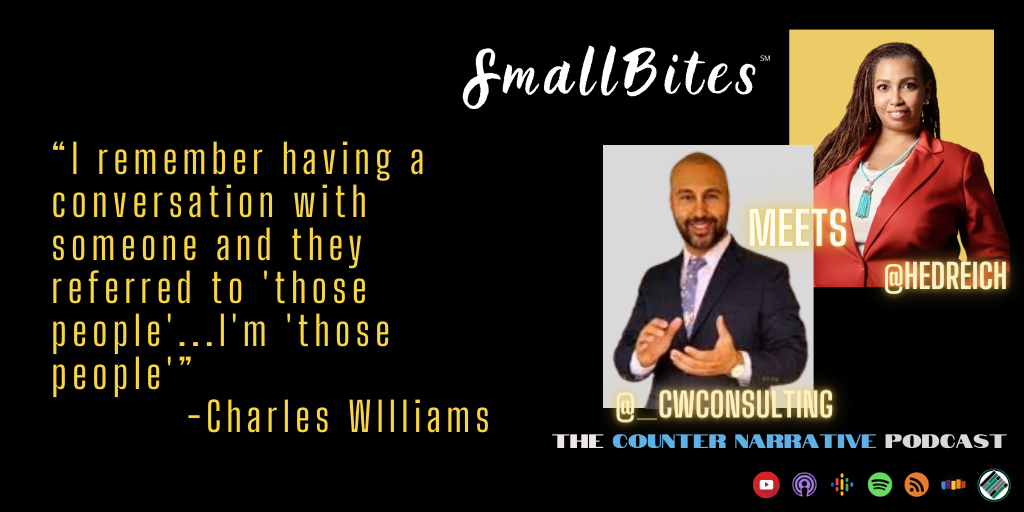
This week, I am excited to announce the launch of the #SmallBites One Question series. This season asks educators about the privilege–and the dark side–of ‘assimilation’. Follow the link to listen to an open, honest conversation on the experiences of a Black Educator teaching in White spaces in my #SmallBites Lagniappe podcast with The Counter Narrative Podcast‘s Charles Williams.

Additionally, am taking off this weekend for the observance of Good Friday and Easter. Please listen to SmallBites Lagniappe: Lead With Love, a message to my Christian friends.

This is Me Read More »

I Like What You Like, You Like What I Like

Watch on YouTube or listen on Anchor, or wherever podcasts are heard.

Small Bites Friday Five 2-26-2

20-30m – Explore this article by David Palank to see how likely it is that halo bias influences your teaching (spoiler alert, a lot). Then choose two strategies to mitigate your own biases, like grading anonymously or ALWAYS using a written rubric. Finally, reflect on a time when the halo effect likely played a part in a decision you made.

15-20m – Start with your youngest learners using this rich well of art and literary projects. Mandisa’s website is designed for toddlers but the projects can be easily scaled up for PK-4.

10-15m – Use this Precious Children article from PBS to help you understand why teaching acceptance is important early on, then prepare at least one of the activities for your class or personal kids and grands. My favorite line, “If your group is not diverse, display images of diversity in your community or in U.S. society.”

5-10m – Review this Nielson Group article that explains halo bias and think about how it affects your teaching.

0-5m –  Write down 5 people you know who you attribute certain traits to. For example, Kevin is tall, he must play basketball; or My co-teacher is really pretty, she must have been popular in high school. Now, write down all the reasons your assumptions might be false.

Did you know that mirroring is a real thing in which people subconsciously mimic the affectations of those they like? And even among invertebrates, there is sexual mimicry in which one sex imitates the other sex to signal interest. If you are a scientist or social scientist, you are probably cringing right now. But for us lay persons, I think the gist is clear. Imitation is more than the sincerest form of flattery, it’s how we align ourselves with those we admire.

If we like someone, we also imitate, or at least buy into, their beliefs and values. And usually, if we believe one thing that they believe, we tend to believe it all. We also tend to minimize or write off any negatives or character flaws. Conversely, if we don’t like someone, we are likely to magnify their faults, disavowing them and whatever they stand for.

We see this play out in politics, but how does this play out in education? Well, in the hundred and one discretionary decisions you make daily, it can affect students in a million and one small and large ways. For example, if you like a student, you might be tempted to round up in grading, if you dislike a student, you may round down, or just not round up. If a student impresses you, you are likely to recommend them for awards, AP courses, write reference letters, etc. If you don’t particularly fancy them, you might write them a college letter, but will it be glowing? The adjectives you choose are more likely to be based on your feelings about the student than on performance or achievement.

We say, know better, do better. But that is more than a notion unless you are committed to being a reflective practitioner in a very real, honest-with-yourself-until-it-hurts way. If you really want to be a change agent and make education better, be willing to start by taking stock of your feelings about each student. Start by reading this article, reflecting on how this bias played out in your classroom today; then make plans to course correct.

That’s how real change begins, with you doing your best for each child in front of you. Make it concrete: Read, reflect, make your own plan to be more intentional in dealing with the students you support now.

I Like What You Like, You Like What I Like Read More »

Never Too Late Pt. II

Watch on YouTube or listen on Anchor or wherever podcasts are heard.

Small Bites Friday Five 2-12-21

20-30m – Explore the resources for teaching media literacy with these non-partisan Civics Renewal Network resources for 6-12. Choose one to use in your next class.

15-20m – Research the critical thinking standards for your content in your state. Teaching civic responsibility, citizenship, communication and critical thinking are connected to every content.

10-15m – Use this resource from Discovering Justice to help you teach principles of community and fairness to your K-5 students. There are also resources there for older students.

5-10m – If you have littles, or older kids with a sense of humor, use Sesame Street videos like these to ease into topics like conflict, feelings or social responsibility. Talk in general about what types of behaviors are not ok and how those behaviors are wrong even if someone we respect is doing them.

0-5m – Use 60 Second Civics for yourself or with your upper grade level students.

Please use this week to read or re-read last week’s blog. Teaching civic responsibility is not political, it’s our duty. Take a closer look at the resources, and I will be watching my Twitter and Insta DMs for any questions you might have.

Never Too Late Pt. II Read More »

My Students Are Not All Okay

I am fortunate to work with a diverse group of really great educators. Some of them have backgrounds similar to my own. Others come from very diverse backgrounds which heightens our ability to tackle problems from all angles. Sometimes, those same differences are food for thought, providing impetus to greater action. When talking to one of my favorite colleagues recently about the equity issues involved in moving learning online, I felt the difference in our backgrounds like a punch in the gut and it brought me here.

I was raised in a single-parent-ish, multi-generational home, one generation out of Houston’s Third Ward public housing. My mom used every extra penny to give me upper middle class exposure. I traded on those experiences to travel the world, even living and teaching in Switzerland for a decade and a half. My circle is a colorful community of friends who sometimes live in very different socio-economic worlds. Although I am in the Venn diagram middle of those worlds, folks on the high earning end don’t always know what life on the other side looks like. I find myself regularly in a room in which people do not know that living paycheck to paycheck is a real thing, without label and latte habits. I have friends who are shocked when I say that 1 in 4 Americans makes less than 40K. Even my friends who work in the trenches to get their students everything they need sometimes don’t know what it’s like to not make rent or eat 2 corndogs a day until your paycheck comes in. My early career as an artist taught me some real lessons about hunger and the gig economy and I have not forgotten them. I ache for people who are about to sacrifice everything so that we can flatten the curve and I fear that we don’t see the urgency of those needs.

I am glad to be a voice that helps uncover equity and access issues that we may not be aware of, especially now, as we push to get our lessons online. I am glad that my background has taught me how to ask questions and get help, for myself, for others. I am glad that I can raise awareness about the precipice that some of our families live on the edge of. I am also afraid that being a voice is not enough.

Now that we are in an economy that is doing a nose dive for many who were already barely making ends meet, what does equity look like? As we work on connecting kids to learning, have we built strong enough relationships so that we can connect kids to resources that will meet their basic needs? Are we making sure that mental health resources, food pantries, rental assistance and community outreach resources are on our Reminds, campus email blasts and even Google Classroom feeds, where appropriate? Do our kids know how to access a suicide or abuse hotline? Can their parents read well enough to fill out complicated forms necessary to access resources that we do send? Do we have basic needs crisis teams on every campus to provide help and additional services?

My kids are not all ok. I’m pretty sure that most of them are, but I am not content with most. Still, I am lucky. I work with an incredible team of caring educators who go the extra mile. I know that, while I don’t know every name and every need, I can call 3 people right now and they can let me know where help is still needed. For that I am thankful.

My challenge this week is for you to slow down on your Zooms and Flipgrids. Talk about Maslow and mental health in your PDs. Make it a priority to check in with your students. Find out who’s alone all day, who is taking care of younger siblings, who is hiding in his room because he’s stressed or afraid. Find out who can’t do meal pick up because their mama’s car broke down. Find out who is not ok and then do something about it. And if your students are all ok, maybe your students or family can donate to a local food pantry or even #stayhome and volunteer online to help those who aren’t.

Here is a list of resources for families in crisis:

  1. COVID-19 Response for Youth Who Are Homeless or in Foster Care
  2. Find Your Local Food Bank
  3.  Disaster Distress Helpline
  4. National Suicide Prevention Lifeline 1-800-273-8255
  5. National Domestic Violence Hotline 1-800-799-7233
  6. Evictions and Foreclosure Moratoriums
  7. Salvation Army
  8. Pausing bills like mortgage, utilities and student loans
  9. E-filing back taxes quickly to get a stimulus check (more straightforward than the IRS site, but from the company Turbotax)

We won’t save every child in our classroom. We couldn’t when we were face to face and that hasn’t changed. But we can make sure that connecting with kids and helping the most vulnerable among us is a priority. For additional resources, see these earlier blog posts and to read up on equity strategies in general, consult my guest blog article on Jennifer Gonzalez’ Cult of Pedagogy.

My Students Are Not All Okay Read More »

On Top of the World

Photo Credit: Anita Porché Garcia Photography

You know that feeling when you’ve hiked up a mountain and you can see clearly for a gazillion miles in all directions? Or maybe the feeling of finally finding your inhaler and being able to breathe freely? If not, you still know where this is going, right? This. Is. That. Place. After doing the phoenix-rebuild, slowly over the last 7 years, I’ve finally gotten to That Place. There have been many celebratory highs over the last almost decade, but all have pointed to higher mountains to be climbed. This time, I can rest on my laurels, at least for a minute!

Introducing Hedreich Nichols, semi-retired musician, 6th grade technology teacher and recent Texas A&M MEd graduate (with a 4.0, no less)! This is where I’d like to insert the Bruno Mars Kiss Myself meme. There is just no way to put, jumpin’-up-and-down-thanking-God/Carlton-dance-to-“Happy”-playing-in-my-head/seeing-Michael-Jackson-Live/dog-rolling-in-grass/Spock-not-being-deaddead-in-III elation, in a sentence. Suffice it to say,  I’m really, really excited and grateful!


On Top of the World Read More »