Hedreich Nichols

Hedreich Nichols

Teaching in the Age of AI: What Schools Are Getting Wrong About Policy and Integration

Every teacher I’ve coached, every district I’ve worked with, and even fellow writers all seem to have questions about AI.

Should students use it? Is it cheating? How do we stop abuse? How do we know what is original work?

Somewhere in nearly every conversation, I find myself wanting to lovingly say:

Friends, we are debating good versus bad while the thing is already here.

In an earlier reflection, The View From Outside the Building, I wrote that “people once worried that airplanes were impossible, calculators would ruin math, Google would destroy thinking, and Wikipedia would singlehandedly collapse civilization as we know it.” Every major technological shift has arrived with resistance, worry, and a healthy dose of “absolutely not.”

This moment feels different, though.

Not because AI is inherently bad, but because for the first time, many students can outsource parts of thinking itself. And that matters. Still, I believe schools are getting one thing fundamentally wrong:

We are treating AI primarily as an academic integrity and compliance issue when it is actually a teaching, assessment, and human development shift.

That distinction matters. Because when schools focus only on catching misuse, the response tends to be surveillance, cheat detectors, restrictions, and fear. In district conversations around policy, I find myself encouraging leaders to pause before rushing into AI detection tools. Aside from accuracy concerns, many of these systems disproportionately flag multilingual learners, neurodivergent students, and students whose writing patterns fall outside a narrow norm. Sometimes it flags plain old good writing. This hyper-vigilance distracts us from a harder but more important question:

What if the assignment is the problem?

If a machine can complete the task with minimal effort, maybe the task deserves a second look.

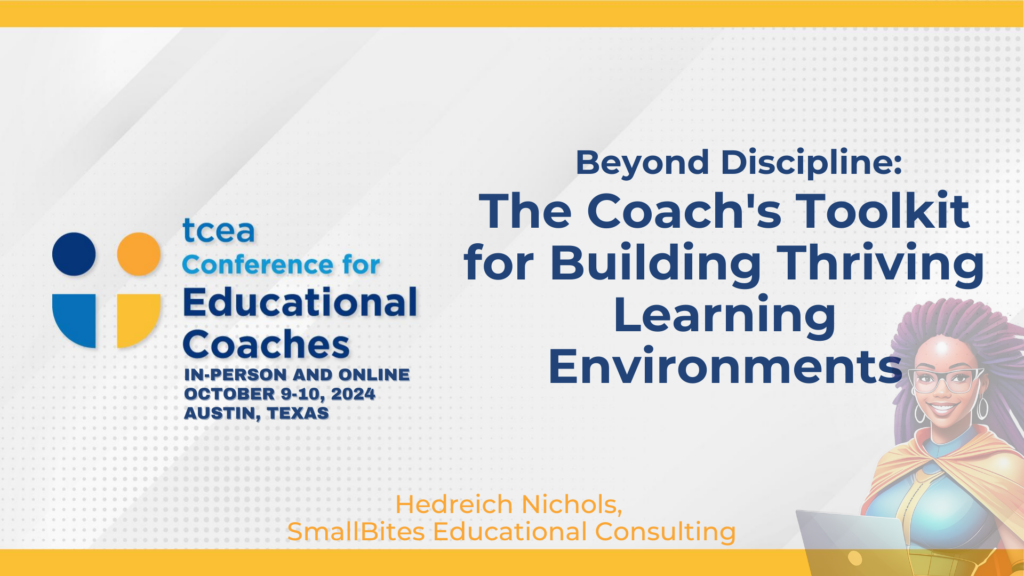
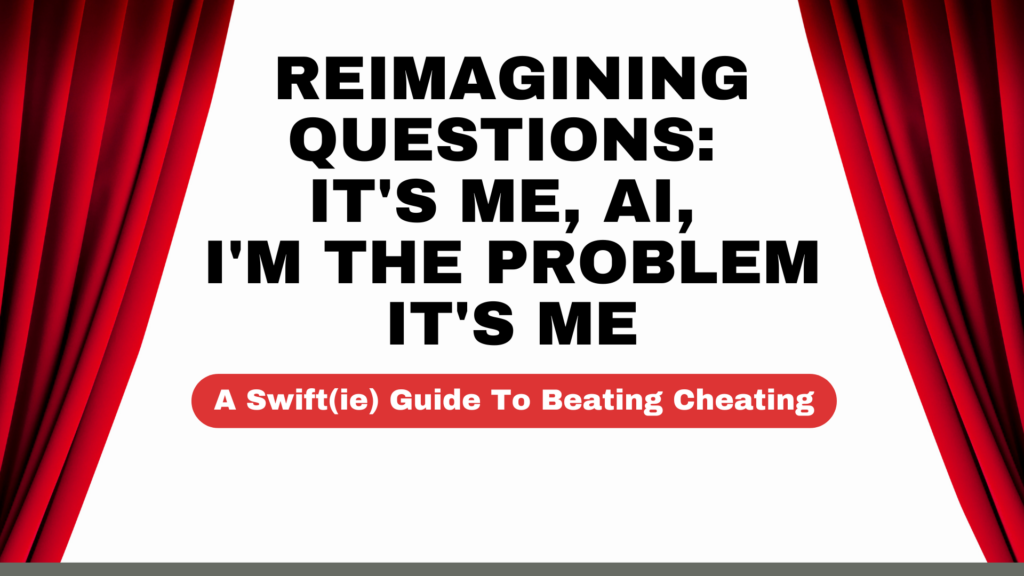
In 2024 at a TCEA conference, I gave a session called It’s Me, AI, I’m the Problem It’s Me: A Swift(ie) Guide to Beating Cheating. The heart of the workshop was simple: instead of fighting AI like it is an invading army, what if we redesigned learning experiences to make thinking more human, creative, collaborative, and difficult to outsource?

Because honestly? Five-paragraph essays and simple recall questions were already struggling before ChatGPT showed up.

Here is where you start.

1. Rewrite questions to invite thinking, not retrieval.

Instead of asking students to repeat information, ask them to compare, defend, challenge, connect, or apply ideas to their own interests and lived experiences. Open-ended prompts are harder to fake and far more engaging.

2. Move beyond passive writing tasks.

Writing is a skill in and of itself, not always the best measure of understanding. Ask students to build, create, debate, perform, teach, or solve a real problem. Performance tasks, project-based learning, and authentic application all matter more now (as if that was ever in question).

3. Bring back talk.

Podcasts, debates, interviews, enriched think-pair-share, Socratic seminar, and panel discussions reveal thinking in ways copied text simply cannot. Oral language matters.

4. Use visual and creative processing.

Sketchnotes, collages, emoji summaries, rebuses, rhythm, rhyme, movement, and multimedia expression deepen learning while supporting students with language processing differences, dyslexia, and multilingual learners.

5. Teach students how to use AI responsibly.

Pretending students will not use AI feels a little like pretending Google never happened. Teach the difference between using AI as a tool and using it as a crutch. Compare sources. Evaluate accuracy. Practice citation. Teach questioning and critical thinking.

Whether we like it or not, students are already walking into an AI-shaped world and the question is not whether AI belongs in schools. The real question is whether schools are willing to rethink what meaningful teaching and learning look like now.

If your district is wrestling with AI policy, assessment redesign, educator concerns, or thoughtful implementation, I’d love to help. Explore professional learning and strategy support here: hedreich.com/services

Teaching in the Age of AI: What Schools Are Getting Wrong About Policy and Integration Read More »


Hedreich in coral dress on rocky beach

What We Don’t Talk About in Educator Wellness

After a milestone birthday this year, I’ve found myself thinking more intentionally about many things: the work I take on, the kind of travel I engage in, the ways we show up in community, and the institutional knowledge we quietly pass along to one another.

And honestly? Nothing says institutional knowledge quite like hormones.

From pregnancy to postpartum to perimenopause and menopause, 100% of women go through profound physiological shifts. Around 77% of us, depending on the study, experience symptoms significant enough to feel like an extreme sport. Brain fog. Sleep disruption. Anxiety. Mood changes. Unexpected climate events at deeply inconvenient moments. Fun.

Yet somehow, in professions dominated by women, we rarely make space to talk about the ways these realities shape everyday wellbeing, leadership, confidence, cognition, or the very real experience of being caught between launching children and supporting aging parents while still showing up to care for our students, our teams, and everyone else.

Can you imagine sitting in your one-on-one with Mr. Renfro explaining why you’ve felt foggy lately? Is there even room in our professional lives to be less than our perfectly composed, unweepy, unsweaty selves?

There should be.

I recently wrote about this very thing for Edutopia. Read more here.

I’m also beginning conversations with schools and organizations through a new offering, Midlife Teaching: The Silent Factor in Educator Wellness, because this journey often begins in our 30s, not just later in life, and maybe it’s time we stopped whispering.

What We Don’t Talk About in Educator Wellness Read More »

When EdTech Changes Faster Than Policy

Are we paying attention?

When my district role shifted closer to the data team years ago, I quietly became a bit of a data nerd.

Not the spreadsheets-for-fun kind. More the What story are these numbers trying to tell us? kind.

As an edtech specialist, I had always cared deeply about implementation. Were teachers actually using the tool? Were students logging in? Was this expensive platform helping learning, or quietly becoming digital wallpaper?

But sitting closer to the data changed me.

Because the story was not always what we hoped it would be.

Sometimes the story was uneven implementation. One campus thriving, another barely touching the product. Sometimes the story was training. Sometimes it was usability. Sometimes the issue was simpler: we had purchased something shiny without really thinking through what good implementation would require.

And then there was another story quietly unfolding underneath all of it.

The agreements.

If you have ever integrated a platform into Schoology, Canvas, Google Classroom, or another LMS, you know the drill. Rosters. Student information. Usage data. Clicks. Time on task. Assessment information. Accommodations. Behavior trends. Learning patterns.

Educational technology has always required data to function well.

But lately, I have found myself sitting with a question that feels more urgent in the age of AI:

What happens to all of this information?

Many of the platforms schools adopted years ago are no longer the same products. Quietly, AI integrations have arrived. Recommendation engines. Predictive analytics. Writing support. Personalization tools. Automated insights.

Meanwhile, many school agreements were written before AI changed the rules of the game.

And if we are honest, most families probably assume school software works a little like checking out a library book. Helpful. Temporary. Safe enough.

But are we asking enough questions?

Who owns student learning data? How long is it stored? Who has access? What changes when products evolve faster than contracts?

To be clear, this is not an anti-technology argument. If anything, my move from music into educational technology happened because I believed deeply in what thoughtful tools could make possible.

I still do.

But maybe loving educational technology means asking harder questions about it.

Because the kids are already logging in.

The question is whether we are paying enough attention.

If your district is navigating AI, student privacy, edtech implementation, or thoughtful purchasing, I’d love to continue the conversation. Explore professional learning and strategy support here.

When EdTech Changes Faster Than Policy Read More »

The View From Outside the Building

For most of my career, my understanding of education came from inside the building.

The classroom. The hallway. The staff meeting that should have been an email. The sixth grader crying in the corner. The teacher quietly buying snacks because somebody came to school hungry again. If you know, you know.

Then, unexpectedly, I stepped outside the building.

In the years since leaving the classroom, I’ve had the privilege of working in educational communications, school culture, AI policy conversations, and most recently with the Center for Outcomes Based Contracting, where districts and providers partner around one deceptively simple idea: if we are spending money to help students, we should know whether students are actually benefiting.

And whew. The view from outside the building is different.

What I have seen has made me both more hopeful and more compassionate.

Schools are carrying a lot right now.

Teachers are navigating classrooms full of students whose lives, identities, worries, and needs often look very different from our own. Leaders are balancing shrinking patience, stretched budgets, and communities that sometimes feel divided by politics, conflict, fear, and uncertainty. Somewhere in the middle of all of this, schools are also trying to make sense of artificial intelligence, student data privacy, third-party sharing agreements, screen monitoring tools, and what good teaching even looks like in a world where information is no longer scarce.

Honestly? It is a lot.

But here is the thing stepping outside the building taught me: most educators are trying really hard to do right by kids.

In district conversations around AI, I watched leaders wrestle with important questions. How do we protect students without over-policing them? How do we guard against misuse without turning schools into surveillance spaces? How do we move beyond “gotcha” tools and instead help students think critically, ask better questions, and demonstrate learning in richer ways?

Interestingly enough, none of this feels entirely new.

People once worried that airplanes were impossible, calculators would ruin math, Google would destroy thinking, and Wikipedia would singlehandedly collapse civilization as we know it. Yet here we are.

Maybe the question is not whether change is coming. It always does.

Maybe the better question is: How do we stay human while we navigate it together?

For me, that question is part of why I shifted from music into educational technology years ago. I saw both the struggle and the possibility.

And after stepping outside the building for a while, I find myself more convinced than ever that the heart of this work has never really changed.

Kids still need good humans.

Educators still matter.

And schools are still one of the most hopeful places we have.

The View From Outside the Building Read More »

The Bridge: One Mom’s Journey Beyond Parenting and Teaching

Where I’ve Been: A Pause in Consulting and Podcasting
When I last blogged, I promised an update to those who have followed my podcast and consulting calendar regularly. This one’s for you! Stepping down the pace and amount of consulting I was doing has been a natural part of this phase of both life and career, and although this isn’t directly connected to education, it is deeply relevant for so many in the profession that the lessons are worth passing on.

The Bridge Between Full Time Motherhood and Teaching, and What’s Next
The bridge referred to in the title is the journey between full-time parenthood and what comes next. After years in the sanctuary of motherhood—and the classroom—I’ve stepped back into the wild and found it familiar, thrilling, and a little terrifying–after the initial shock and trauma of it all! This phase is about hard-passing on “empty nester syndrome,” opting instead to embrace the sound of my own wings. It’s about finding my rhythm beyond the structure of school schedules, afternoon practices, weekend concerts, and games. It’s about honoring the quiet grief of gently closing the door on nearly half a lifetime—and opening a portal to rediscover joy, purpose, and the wild parts of myself I’d carefully tucked away.

What Happens After You Retire from Teaching (and Full-Time Parenting)
In the lifetime since my last SmallBites episode, I have released my son onto the free range and retired from the classroom. Finding my identity outside of what I do for young humans has been… challenging, to say the least. The first time I stood in the store and realized I didn’t need a gallon of milk, I had a breakdown. They didn’t have a half-gallon of my favorite brand and I melted down into tears right there in the dairy section. I wish I could say that was the only moment like that, but that would dishonor my coworkers, who patiently let me burst into tears at the falling of some dust speck–sized reminder of my dreamy, rose-colored parenting days. “Hard-passing on ’empty nest syndrome'” does not mean hastily switching gears. It means diving headlong to the grief connected with letting go and finding yourself adrift, and then anew.

Strategy 1: Build a Support System for Your Transition
That brings me to my first strategy: find supportive community and let them know you might be struggling a little. If you are a woman, this time probably comes with some hormonal shifts as well, so having safe-space people becomes even more important—because, good luck with stemming the flow of those tears! Accepting that emotional part of processing the change is also central to this evolution, or at least it has been for me. From senior year to about 18 months after he went to the Army, there were lots of feelings. I didn’t shy away from them. But I also didn’t shy away from dipping my toe back into the water of self-discovery. I found a backup brand of milk I like, then a second. I found that solo travel in places without a kids’ club was ahh-mazing. I also discovered the air fryer—my kitchen bestie, second only to my espresso maker.

Strategy 2: Real Self-Care for Teachers and Mothers in Transition
I’ve found that I enjoy painting my own nails and sipping glittery, handcrafted cocktails while wearing a nourishing face mask. Who knew the internet was full of recipes for both! Which brings me to strategy 2: practice self-care. There should really be no time in life where you don’t take time to breathe, stretch, dance, read, or just be. While I know that can be almost impossible when you’re balancing a family and career, consider it as important as filling up the car. To serve others well, you have to keep your own tank full. What fills your bucket? What brings you joy? It can be as simple and cost and calorie conscious as finding animals in the clouds. Whatever feeds your soul, make time for it.

End-of-Year Teacher Tip: Try a Self-Care Palooza with Students
If you are in the classroom or developing curriculum, consider writing in a self-care palooza. Talk to students about regulating emotions and taking time to power down, especially after the oft anxiety riddled testing season. Have them research, develop, and share self-care routines—or even set up classroom wellness stations, as your school guidelines allow.

From the Classroom to Consulting: Still in the K–12 Space
For me, this time away from the frenzy of 7-day-a-week consulting, writing, parenting, and teaching has been time well spent. I have needed the time to process the last two decades that were centered around family, and launch this season where I get to know the hopes, dreams, likes, and loves of this really cool person—me.

And while I enjoy making more time and space for me, I am still deeply a part of the educational sector. Co-hosting a morning show with Alice Keeler at HA! UnmutED, we start the week Mondays at 7:50, talking about classroom and district concerns. I still share my K–12 institutional knowledge through school culture and AI consulting, coaching, and articles in online publications like Edutopia and TESPA. And since teacher retirement, I am especially enjoying telling the story of the Center for Outcomes Based Contracting, an educational nonprofit that transforms the way K–12 providers and districts partner, centering measurable student outcomes from procurement and contracting through implementation. Finally, my books are a great source of evergreen knowledge for history buffs and those who want to create more human-centered classrooms.

Rewilding After Teaching: Rediscovering Identity and Purpose
But back to this bridge I mentioned—this crossing over, if you will. As I emerge from the wandering, feeling-my-way phase, I’m starting to hear the sound of my own wings again—lighter now, more certain. No longer tethered to the regimented rhythms of teaching and mothering, I’m stepping more solidly into a vision of who I am becoming. Not just after, but because of those seasons. The rewilding isn’t loud—it’s quiet, rooted, and deeply alive.

It’s messy. It’s magic.
And I’m back.

P.S. If you’re a fellow educator, parent, or human in transition—feel free to share this with someone else on the journey. Let’s normalize what comes after the classroom and the kitchen table.

The Bridge: One Mom’s Journey Beyond Parenting and Teaching Read More »

I’mmmm Baaaack!

For those of you who have followed SmallBites for a while, you probably noticed that the break after last season has lasted longer than usual. I’ll update you in long version at some point, but for now, suffice it to say, that I took advantage of a needed break.

That time away from this work made room for new vision and new focus. This new season brings my work in the edtech sector to the forefront, with Edutopia articles on teachers shaping the use of AI, and crafting District and school AI policy. There is also an important read on classroom level device management and care (since many classes are now virtually computer labs) and one on teaching respectful online communication and media literacy–especially important for students and teachers alike during an election year.

I’ve also found time to learn from and work with an amazing organization, The Center for Outcomes Based Contracting. The Center for OBC, a part of the Southern Education Foundation, is doing transformative work with districts and their vendor partners to ensure that federal dollars spent on instructional materials are used effectively as determined by student success.

Finally, I have still been working with groups and organization to improve teacher efficacy, student outcomes and of course, guide educators to creating a better sense of belonging for all. This week, joining TCEA’s coach’s conference will find me doing exactly that in sessions like It’s ME, AI, I’m the Problem it’s Me and The Coach’s Toolkit for Building Thriving Learning Environments. There’s still time to register and make it to the virtual conference, even if you can’t make it to Austin.

I’mmmm Baaaack! Read More »

(Teacher-Tired) Educator Encouragement

The saying goes, “there’s no tired like teacher tired.” Teachers have exhausting schedules, and if you’ve ever time stamped a teacher day, you’ll know that a teacher day is simply impossible to get through in a day. That feeling is not confined to the classroom. For those of us who have deeply held beliefs about what a student-centered school environment looks like, feels like and ignites learning like, education can be tough, whatever the role.

I am humbled at how incremental the change is in the grand scheme of things. That humility makes me want to cry into a glass of milk. That humble place is also a place of remembering: “⁠⁠Define Your Why⁠⁠“, as author and educator ⁠⁠Barbara Bray⁠⁠ says. Either I believe that I can be an agent of change one small bite at a time, or I don’t. The system needs to change, that’s why I do what I do. And so, I’ll dry my tears and start over. Because futility and hopelessness are just not an option.

Care for a few ideas to help get you through? Read on.

Encouragement from @DorisASantoro – Rise up with strategies and information on burnout vs. teacher demoralization in this ⁠Edweek article⁠ that helps you understand what you’re dealing with and how to deal with it.

Encouragement from @PlanBookCom – Rise up, if you’ve decided that burnout is where you’re heading, with these ⁠strategies from PlanBook⁠ and don’t be afraid to reach out for help.

Encouragement from @Angela_Watson – Rise up and Say goodbye to Teacher Tired with this ⁠article and resources from Angela Watson⁠. I learned about her 40 hour work week resources from Cult of Pedagogy. Some resources are paid, but even the free ones will revolutionize the way you spend your time.

Encouragement from @weareteachers – Rise up and giggle. Sometimes, laughter is the best medicine, and we teachers are a funny lot! ⁠Start here⁠ then follow them on Twitter and Instagram. Cause, when you run out of tears, sometimes all you can do is laugh.

Encouragement from M.L. Brown – If laughter and strategies no longer work, rise up with this ⁠Medium article⁠ from an educator who decided that enough was enough. For those who have made that decision, let’s be supportive, knowing that sometimes, enough really is enough.

Note: This episode is an edited rebroadcast of SmallBites LIVE: Fighting Feelings of Futility

(Teacher-Tired) Educator Encouragement Read More »

Be a Better Teacher in <45 Hours Weekly

Wellness in educational spaces has become a trend that, while important, often falls flat in practice.That may be because teachers and administrators tend to forget that they have to actually make use of the time and tools given. Refilling your proverbial cup is the only way to ensure personal success and success for those in your charge. Less really is more and you CAN be a better teacher in less than a 45 hour work week.

Good quality teaching is dependent on you being consistently rested and regulated for the classroom day; and good quality teaching is foundational to providing equitable learning experiences for all your students. Similarly for administrators who balance many different types of duties daily, being well-rested and well-regulated is key to building a campus culture conducive to academic, emotional, and social success.

Consider using the ⁠8-8-8 rule ⁠and an ⁠Eisenhower matrix⁠ to prioritize tasks. The 8-8-8 rule divides your day into 8 hours of work, 8 hours of sleep and 8 hours of personal time spent on self-care, friends, family, hobbies, etc. An Eisenhower matrix can help you decide whether a task has to be done now, can be scheduled for later or delegated. With practice, these tools will become a natural part of your daily planning.

Rules to Live By

Once you have a general idea of how you will prioritize your tasks, do these 5 things to ensure that you get the most out of your day without constantly working over a healthy capacity:

1. Decide how many hours you will work in a week. And then keep to it. My magic number was 45.

2. Delegate. Empower students. Have them manage the objective board, attendance, station timers and anything else that will give them a sense of ownership and responsibility.

3. Co-create with your students. For example, using student created review and test prep materials on Edpuzzle or Quizlet can build student confidence, skill, and capacity; and save you teacher time.

4. Stop using paper. Using an LMS like Google Classroom (or Canvas or Schoology if your district is so inclined) saves time and resources. Copier broken? Out of paper? No name papers? Make-up work? Put it all online. ⁠Create digital worksheets⁠. Better yet, pay a niece, nephew or other older tech savvy student in your circle to do it for you. The time you take to do this ONCE will save you time all year so you can use you planning time to plan–and maybe even go to the restroom.

5. Go outside. This seems like a waste of time BUT ⁠⁠research⁠⁠ tells us that natural light boosts concentration, mood, energy and helps alleviate eye fatigue and headaches that come with florescent and computer screen lighting. 

Putting in long hours can feel rewarding, but if you aren’t being smart about balancing that work time with other activities, you’ll suffer and so will the students and staff you serve. If you love what you do and love who you are doing it for, love them enough to practice work-life balance in earnest. Yes, some ‘important’ things may go undone, they sometimes do. But rest and recharging do not belong on the “do it tomorrow” list. Ever.

Be a Better Teacher in <45 Hours Weekly Read More »

Nostalgic Narratives vs. Native American History

As we approach November when the country highlights the histories of Indigenous Peoples of North America, it’s fitting that Martin Scorsese’s Killers of the Flower Moon, based on the book by David Grann, calls our attention to the heinous crimes committed against the Native American community. In contrast to the narratives many of us have grown up with that cast the “Injuns” and “Red Man” as savages and bad guys, this movie highlights the deception and murder, as well as the racial jealousy that we’ve begun to see in Black historical films, but that are still new themes in films featuring Native American Narratives.

The fact is, if you grew up learning “…Columbus sailed the ocean blue…” or singing the famed Disney line, “Why does he ask you ‘how’?” then there are probably a lot of nostalgic moments involving beloved relatives that are hard to let go of. And thinking of heroic leaders as the same people who forcibly removed and killed millions of people to get their land is difficult to process. But if we want to grow and be better as a nation, process it we must. Doing the next right thing starts with acknowledging and teaching truth to the next generations.

Here are resources to help you further explore narratives that should have been amplified long ago:

  1. Watch The Osage Murders from the 2022 PBS Short Film Festival⁠⁠ ⁠to hear the story of the Osage murders told from the Osage perspective.
  2. ⁠Explore and support cultural endeavors⁠ in Native American Communities by listening, watching reading or donating.
  3. ⁠Watch movies and clips ⁠written and produced by indigenous voices.
  4. Find out what Nation originally lived on the land you live on at ⁠https://native-land.ca/⁠.
  5. ⁠Join the Smithsonian’s National Museum of the American Indian and Teaching for Change⁠ for a day of online conversation, curriculum highlights, and ideas exchange. If you can’t, explore the other links and resources on Smithsonian’s NMAI site.

It’s never easy seeing the dark side of someone we esteem. But if we are truly to love our nation, it has to include loving all of her. In November, take the chance to get to know America’s origin story. As usual, all the resources are filled with resources, so you have more than enough to discover with your team, your students or even your family. Finally, here’s a short read from Edutopia that you can share in a newsletter or morning email.

I wish you a great month of discovery and learning.

Nostalgic Narratives vs. Native American History Read More »

Wars and Rumors of Wars

Listen to SmallBites wherever great podcasts are heard.

The emotional work of teaching can be heavy on a good day, when all is generally right with the world. But on a day when students have had a weekend filled with real time clips of children in war-torn countries and friends running from bullets at state fairs, your upbeat Monday morning “How was everybody’s weekend?!” might devolve into a discussion that quickly takes you out of your depth.

Students are much more aware these days and with so many information outlets, older children with 24 hour access to phones can be confronted with more than just the latest dance videos on their “for you” pages. With the Ukrainian-Russian war, and now the Palestinian-Israeli war in heavy rotation in every media outlet, even the sunniest student may be feeling a bit overwhelmed.

Handling Bad News

Nothing sells like bad news and today’s youth are consumers of information they have very little context for. The same can be true for adults. How do we explain wars, murders, tragedies, especially those tragedies in which our inhumanity towards one another is on full display? And how do we convince young people that we are safe and the world is a great place when all the messages and media images say otherwise?

As a teacher, it can be almost impossible to know what to say to students struggling with the hard realities of life, when we can barely understand and process them ourselves. Still, when our students come to us, bothered by things beyond the classroom, we have to respond. Here are 5 small bites to support you this week and any time bad news lands on your classroom’s proverbial doorstep:

Five Small Bites

1.  If you’re upset by events, don’t be afraid to admit that you don’t always understand why things happen the way they do and that you are bothered by them too.

2. Don’t support laws (or politicians) that keep children from trying to make sense of the world through current event conversations in the classroom. Civic education includes civil discourse.

3. Support teachers with neutral, unbiased talking points and ⁠conflict resolution strategies ⁠for when conversations get heated.

4. Make time in class and in pacing guides for journaling or reflection. With older kids, talk about the messages from young people around the world telling their truths on social media about the war.

5. Teach media literacy. Use ⁠All Sides Media⁠ or look at ⁠headlines from different countries⁠ to get a broad perspective and corroborate stories from popular news outlets.

Finally, you don’t have to have all the answers. Listen, show empathy and above all, take care of your own mental health so that you can respond with equanimity. Trade late-night doom scrolling for other pastimes and be kind to yourself and others around you. We may not be able to change world events, but we can brighten our own corner of the world.

Wars and Rumors of Wars Read More »