Hedreich Nichols

Hedreich Nichols

Shape of You

OneWord ’22 graphic. SmallBites returns Monday, January 10th wherever fine podcasts are heard.

Standing at the precipice of the new year has long ceased to feel like some magical new beginning. That’s a good thing. I have not bungled this year. I’m not waiting on the turn of a page so that I can resolutely start anew. What I am doing is taking the wins of the last couple of years and shaping them into a harmonious melding of many hats. If you are a teacher and a parent, you understand being a wearer of many hats.

The thing about wearing many hats is that it can be difficult to identify which hat is The One. Usually that’s because there is no ONE. Could you choose between ‘child’, ‘spouse’, ‘parent’, ‘educator’ or ‘friend’? Each of those hats are vitally important, but they aren’t always on your head all at once. Still, sometimes you stack them, sometimes they sit askew. Sometimes you just want to throw them all down and go hatless.

This evening, as I write the last blog of 2021, I am hatless. It’s one of those rare moments where I can just be. And in this moment, I savor the time to reflect in quiet about my many hats.

Shape Shifter

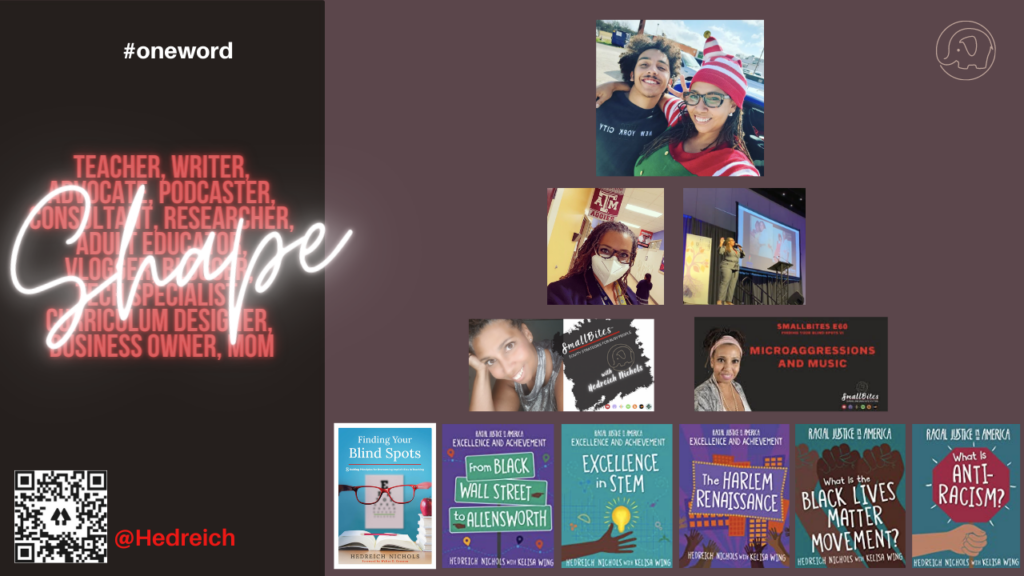
A template designed by Educator and Youtuber Claudio Zavala led me to define the hats I wear. As I named them, I finalized my one word, ‘shape’. As my role in education and parenting is shifting, I am in the process of reordering my hats. The last two years have been fruitful, yielding 6 books, 65 SmallBites YouTube episodes, 65 hedreich.com blog episodes and 65 SmallBites podcast episodes. Those don’t include courses, guest blogs and articles.

So how do I bring all those hats under one umbrella? Well, that’s my focus this year. A little prioritizing, a little fine tuning the schedule and a little more work-life balance. And this is all worthy of a blog post, why? Because, as usual, I have an ask. In the next few days, I would like each of you multi hat wearers to spend a little time being intentional about which hats need to be worn when, for how long and in what order. By allowing a picture of your priorities to emerge, you’ll be better able to focus on the now and shape your path forward. This is especially true if you are, like many, considering a shift away from the classroom or away from education altogether.

Happy New Year

As you define and re-order your hats, define also what brings you joy, what ameliorates stress and what is good for you. Make choosing yourself a firm priority. All the people around you will be happier if you are balanced and content. How will you do this with the coming year, including COVID and testing season? Only you can say. But I know that if you don’t take a minute to establish your priorities, the year’s stressors will do it for you and you will likely not be pleased with the outcome.

FInally, I’d like to thank you for reading and listening. I hope that by shaping your coming year and beyond, that you’ll continue to have energy to learn, to grow and to make safer, more equitable classrooms and campuses for all students.

Your loyalty is appreciated. See you next year!
Shape of You Read More »

Patriot Games

Watch on YouTube or listen on Anchor, or wherever podcasts are heard.

While going through some memorabilia, I ran into my US constitution poster. I usually keep the pocket version handy. But this one is the inexpensive replica one with the big calligraphed We the people. That first sentence is the one that I’d like to highlight:

We the People of the United States, in Order to form a more perfect Union…

E Pluribus Unum

Union. Unity. Unite. United. All of these words come from the Latin ‘unus’-one. You know it in another form from our Great Seal and our money. E Pluribus Unum-out of the many, one. That was the motto selected in 1776 by John Adams, Ben Franklin and Thomas Jefferson. Our founding fathers declared that unity was to be woven into the fabric of our nation. But somehow, along the way, we’ve fought to keep national reverence of our founding fathers in tact while wholly disregarding their original intent-unity.

How can a house divided stand? On both sides, people are fighting to ‘establish justice’. But what does justice look like? Depending on who you ask, the answer will, of course, be different. So how do we reach common ground? How do we build bridges instead of walls? Here are three thoughts to guide the process of establishing more unity in our communities.

1. We all can’t have our way.

If we realize that our way is just that, our way, we can work on letting others have their way. Everyone around us does not have to believe what we believe, think what we think or even behave the way we do. We keep ourselves and others safest when we stay in our own lane, both on the road and in life. There are enough like-minded souls to commune with without attacking those who are looking to build their own communities.

2. The other guy may be at least partially right.

While we may be convinced that our way is absolutely right, it may not be right for everyone. We can compromise on immigration, abortion, climate action and even what we do about issues of identity and equity. The truth is, there is no absolute solution to any of those problems. For example, murder is a punishable offence, most everyone would agree. However, soldiers kill common enemies, homeowners kill robbers, executioners kill those convicted of crimes and these are all considered justifiable. Absolutes rarely exist without exceptions and we can find common ground when we find and accept those exceptions. Some exceptions may line up with our beliefs, some we may not like so much. Still, compromise is necessary. That works best when we, in humility, acknowledge that we may not be 100% right even 50% of the time.

3. Patriotism involves commitment to democracy.

Democracy and patriotism go hand in hand. Consider that in 2016, many were unwilling to accept the presidential election results because Hillary Clinton won the popular vote. Since our country’s presidential elections are decided by our electoral college, the popular vote has no bearing. Donald Trump became everyone’s president in 2016, without dispute. Then, in 2020 more than 50 lawsuits trying to prove voter fraud in the last presidential election were dismissed by the courts and Joe Biden became everyone’s president. In a democracy we vote. That means that someone always has to take the loss. That’s how democracy works. Either we accept the rules of democracy or we become something completely incongruent with the ideals set forth in our founding documents.

Ask Yourself…

What can you let go of? What hotly debated topic are you willing to see from someone else’s vantage point? If you personally concede your opinion to someone else, might there be a gain for the greater good? What if we refuse to feel threatened or become irate when our neighbor thinks or opines differently unless it directly affects us?

My guess is, if you reflect over those questions and let go of even one issue that you irately post about online, we could begin to lay a foundation for bridges instead of walls. My ask this week is that you think about what unity and patriotism really mean. If John, Ben and Tom could envision it in a document we still hold dear, let’s consider working toward that more perfect union by using the three thoughts above as a measuring stick for our conversations, posts and actions. Do it as if your children are watching, because they are.

Patriot Games Read More »

Alles Hat Ein Ende

Watch on YouTube or listen on Anchor, or wherever podcasts are heard.

There’s a song well known in German speaking parts of the world called Alles Hat Ein Ende, Nur Die Wurst Hat Zwei. Translated, that’s “everything has an end, only the sausage has 2”. After over 60 vlog episodes and as many Lagniappe podcast episodes, #SmallBites on YouTube is converting to an all podcast format. I hope you’re as excited about this as I am.

New Day Dawning

After celebrating with friends and family from almost every era of my life on last Friday, it’s time to move on to the next chapter. With Finding Your Blind Spots released to the edu-universe, I find myself busier with consulting and courses, and I want to have time to serve my clients well. Still, my audience is hugely important and you can still expect blogs, resources and answers to your pressing questions on race and identity through social media.

One thing about podcasts is that they usually accompany listeners who are driving. Because of that I will sometimes be extending just a couple of minutes beyond our 5-7m mark to give you even more #SmallBites to chew on. I hope that meets with your approval!

You Are Appreciated!

Beyond that, I would just like to thank you for coming back each week, for listening, for learning and for taking that knowledge back to your classrooms and learning communities. Join me next week for episode 65 when we’ll say our final goodbyes. In the meantime, see below for the 5 most important #SmallBites links and resources.

Small Bites All Time Favorite Friday Five:

When I started #SmallBites, Learning for Justice was still called Teaching Tolerance. This site is the definitive starting place for standards, lessons, articles and resources on race and identity. Whether you are just beginning your journey on classroom diversity and inclusivity, or are well on your way to helping others understand concepts that some find divisive, Learning for Justice is a site that constantly evolves to help you learn more and be better for your students.

The Harvard Implicit Bias tests help you recognize bias and blind spots. And Harvard GSE’s teaching resources provide tools to help you create more inclusive courses, syllabi and to better integrate conversations on race and identity into your daily lessons.

After reading statistics on disparities in school discipline, I can only recommend restorative justice practices as implemented in the San Francisco Unified School District. I have used their model in my own classrooms and watched discipline problems give way deeper relationships and better learning outcomes. Students just need to know we are invested, but it takes a whole team to make the kinds of disciplinary changes that come with consistent campus RJ implementation.

Of course, if you are going to miss #SmallBites Fridays after you’ve revisited the wealth of resources, keep learning with free courses taught by Yale and Harvard professors here. Or, you can read and use the 1619 curriculum (or information from it, if your district allows) in addition to other historical resources, to add multiperspectivity. Finally, with students, use PBS, the Smithsonian and NPS.gov to find a plethora of school resources on history and culture in the US and the world.

See You Soon

Finally, use the 65 episodes of SmallBites to find the above resources and many more that will guide you as you seek to better understand and teach all students.

It has been my honor to serve you with #SmallBites on Youtube. See you on Apple, Spotify and wherever fine podcasts are heard.

Alles Hat Ein Ende Read More »

The Rest is Still Unwritten

Watch on YouTube or listen on Anchor, or wherever podcasts are heard.

Small Bites Friday Five 12-03-21:

This week, in honor of my own book launch, I am recommending 5 books that would make great stocking stuffers for you or the educators in your life.

Define Your Why, by Barbara Bray, will take you on an inward journey so that you can capture the joy of really doing what you love.

Once you define your why, you can get more intentional with your teaching and learning routines with Be Awesome on Purpose from Bonnie Nieves.

Of course, being intentional in the classroom should mean impact outside the classroom. Environmental Science by James Fester and Jorge Valenzuela provides strategies and tools to help teachers amplify student voice through authentic, project based learning.

When guiding students through project based learning modules, asking the right questions is key. Connie Hamilton’s Hacking Questions will provide you with the tools you need to step off the stage and get students to efficiently and strategically problem solve.

Finally, if you’re into banned books, get a copy of What is Anti-Racism , a kind of allyship 101 book that covers where race came from and how to fight against racism, even if marching is not your thing. It was written for children but it’s for everyone.

Books Making Impact

These books, the authors in particular, have all brought something special to my practice. And as an educator, growing into an applied researcher has broadened my horizons and impacted what I can do for and with my students immensely. Now that I have written my own book on teaching and learning strategies, I can only hope that the information will impact your teaching as these educators have impacted mine.

My wish for this book is that it strikes a chord with people looking to become more inclusive as well as with those sitting in a mandatory book study. With that wish, I tuck myself into bed.

Be sure to look out for a special edition post after I reflect over tomorrow’s book launch. And meanwhile, join in on December’s 31 days of positivity challenge (#31DP). Details below.

How do you eat an elephant? One #smallbite at a time.

The Rest is Still Unwritten Read More »

Put a Little Love in Your Heart

Watch on YouTube or listen on Anchor, or wherever podcasts are heard.

This week, I’m asking you to do something each day in December, so, no additional reading or researching. I am, however, posting 5 podcasts with phenomenal educators that you can listen to and learn from.

Learn from this podcast with author Barbara Bray and save accompanying living document as a reference to learn more about creating inclusive classrooms and campuses.

Listen to this conversation between Hedreich and Sheldon Eakins of Leading Equity to learn more about what Critical Race Theory is and isn’t.

In this Cult of Pedagogy podcast, Hedreich and Jennifer Gonzales talk about the ways we try, but sometimes miss, when we are working to create more culturally responsive spaces.

Listen to Elissa Frazier’s Designed to Thrive Podcast in which we talk about grace and how to come together to to create more welcoming campus spaces for all.

Watch this informative book chat with Melody McCallister as we have a genuine conversation about inviting everyone to have a genuine conversation on race.

A few months ago, I talked to my good friend and phenomenal educator, Jorge Valenzuela. I was having an “ouch before it hurts” moment, pre-stressing about criticism that I knew was forthcoming, especially after Finding Your Blind Spots dropped. Well, the book won’t be officially released until next weekend, but the criticisms have come early.

There were only 2, but neither talked about my work, just my ignorance, my ineptness and the fact that a place in hell is reserved for me. Interestingly enough, I had already planned this week’s Smallbites before I read those posts. This post extends a conversation I had with Tom Schimmer. We talked of how disagreements so often become visceral, personal attacks. We are both saddened that being nice seems to have gone out of style.

If You Can’t Say Something Nice…

If we look at codes of conduct and classroom rule anchor charts, being kind is a common theme. But one look at social media tells me we think that obviously only goes for kids. That’s unfortunate. Limited studies, like this one from Pitt’s Center for Research on Media, Technology and Health, link social media use with depression and anxiety in adults. Various studies cite diverse reasons for the link, but I am sure one causal factor is the negative venting that has become so popular.

What do you do when you see someone voice a strong opinion that doesn’t line up with your own? Do you engage? Do you move on? Or maybe do you close the app on your phone and do something more constructive?

More importantly, what do your students and families see you doing? Are you modeling kindness, civility and respect? Or do you shoot the virtual finger, going off on a rant of your own? My one ask is that you reevaluate how you react when you read something triggering.

Let It Go

The best thing about social media is, you can simply walk away. Or you can choose to write something peaceful that deescalates. Sentence stems like “I respect your point of view”, I can see why you feel that way” or even “I’m afraid I don’t agree, but thanks for sharing your viewpoint” can all build bridges–or at least not burn them. And one choice you can always make is to simply keep scrolling. You do not need to answer everything and for at least the next 31 days, I hope you won’t.

No Negativity Challenge

This December let’s make a pact: Use the month to post something positive daily. Pick a platform, send out your post and tag 3 people. Your post could be a quote, the view from your porch, work from your kids at school or even your dog’s pic. Maybe we can retrain our brains not to be so reactionary. Maybe we can help others do the same. Do I think this will fix all that’s broken in the world? Of course not. But I do think we can be more intentional about the words we choose. And I know that intentionality will be good for the young people we teach. Join me?

Put a Little Love in Your Heart Read More »

500 Years

Watch on YouTube or listen on Anchor, or wherever podcasts are heard.

Thanksgiving was never attached to Plymouth Rock in my house, the women who raised me knew too much truth to celebrate what was the beginning of the end for so many. We cooked, we were thankful. Yesterday, I cooked, I am thankful. I am also in solidarity with those who mourn this month.

Seek Diverse Perspectives about the US Origin Story

This week, I will leave you to find your own truth; about Thanksgiving, about our nation’s origin story. Try to find one new truth or one new voice to amplify. See you next week for the launching of Finding Your Blind Spots-Eight Guiding Principles for Overcoming Implicit Bias!

Here is my most recent article from Edutopia featuring Indigenous narratives and stories, many from Indigenous people. These stories are helpful for teachers and learners seeking historical accuracy.

Below are links to explore and stories to be heard about the over 60 million people who were here long before Europeans came; and this week’s Small Bites features the names of indigenous voices to learn from on social media, plus a groovy Spotify playlist to help you decolonize your drive-time.

Delve into native American culture in many forms at https://www.powwows.com/native-music-radio/

Explore and support cultural endeavors at https://www.firstpeoplesfund.org/

View Native American films and filmmakers telling their stories at https://visionmakermedia.org/native-american-heritage-month/

Enjoy this rabbit hole, a melange of resources from the comedic to the academic, including an Indigenous Peoples Day toolkit for teachers at https://illuminatives.org/indigenouspeoplesday2020/

Support Indigenous Artists

NOTE: Special Thanks to Rhonda Head, the award winning Cree mezzo soprano on this week’s #SmallBites. You can find out more about her on rhondahead.com, @Rhonda_Head on Twitter, or RhondaVHead on Instagram. Her music, including her latest Christmas single, can be purchased on iTunes.

Reposted from November 2020

500 Years Read More »

Play That Funky Music

Watch on YouTube or listen on Anchor, or wherever podcasts are heard.
SmallBites Friday Five (songs) 11-12-21:

Use this week to learn about microinsults found in songs. Here are five you might use to spark reflection. It should be noted, unless you have older students and a group accustomed to discussing controversial topics, these are not necessarily G rated lyrics or themes. Please review them before using them in any academic setting. The songs are listed in order from least to most school appropriate.

Brown Sugar by the Rolling Stones

In The Summertime by Mungo Jerry

Illegal Alien by Genesis

Kung Foo Fighting by Carl Douglas

Mexico by James Taylor

Oohhh That’s My Jam

When I look at the above songs, each of them is attached to a memory from my youth. I think about how innocently I rocked out to each of them. Now, I listen and I think, what would it be like if I rocked out in a class with my students of Mexican and Asian descent? What if I taught my girls about sending “no noodles” and then played In the Summertime. Would they pick up on the subtle threat to girls from poor backgrounds? WOuld they still find me credible if they did?

Am I saying that all these artists are cringeworthy and to be cancelled? No, absolutely not. While some lyrics, for me, cross a line, others are more parody than mean spirited. Still, how would a Mexican student in a mostly White school feel if “Mexico” or “Illegal Alien” were played? Or imagine a lone White student in band having to hear “Play that funky music White boy” as his walk on song when he entered the band hall?

Everyone Does Not Feel the Same

Students may not all be offended and I don’t think burning albums is the solution. However, taking a closer look at what we read, watch and listen to will provide us with opportunities to learn. Are lyrics misogynistic? Are racist stereotypes portrayed through the songs or videos?

Once again, before you throw the records on the fire: I am not advocating that the artists be vilified. I am simply saying that cultural awareness is called for. I have danced to Brown Sugar, and while I cringe now, it simply shows that we can all learn and grow.

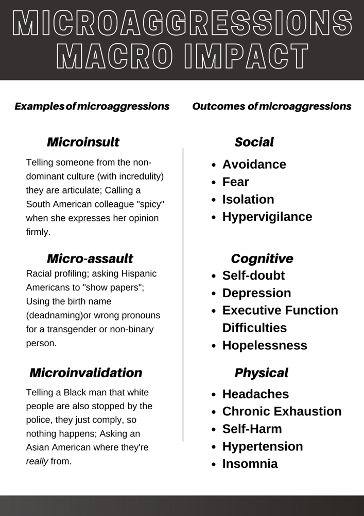
As you grow and make different choices, use the graphic below to identify the consequences of little unintended slights.

Play That Funky Music Read More »

Cry Freedom

Watch on YouTube or listen on Anchor, or wherever podcasts are heard.

20-30m – Read this article Business Insider article from Shayanne Gal , Andy Kiersz , Michelle Mark , Ruobing Su , and Marguerite Ward curating 26 charts that explain some of the current issues and consequences that stem from racism. Visit the hyperlinked articles and their hyperlinks to gain understanding for the very real present day problems caused by anti-Black sentiment.

15-20m – Read the above Business Insider article and visit at least 2 of the hyperlinks. Or, continue the journey above.

10-15m – Learn about the catch 22-ish balancing act between Plenary Power and Self Determination in the ongoing fight for Native American rights in the US in this Minority Rights Group International article on Native Americans.

5-10m – If you only have 5-10 minutes, read about Anti-Mexican racism in this History.com article. Be sure to read to the end. You don’t want to miss learning about Sylvia Mendez. Like Ruby Bridges, she too is still alive and can be found on social media platforms.

0-5m – If time is tight, think about one person you know who does not look or identify like you do. Reflect on whether or not their life experiences are more like yours or unlike yours.

Southlake School District and Banned Books

Hearing about the Southlake school district’s plan to ban any diversity issues saddened me. Finding myself on a Texas politician’s banned book list gave me a myriad of other feelings. Both incidents made me realize that, as a country, we are not in line with our forefathers’ vision. If we pledge that our country should be one nation with “liberty and justice for all”, how can we also refuse to shine a light on the things that move us toward that “more perfect union” goal?

If I can’t talk about being born in a Negro hospital or being the first generation of post Jim Crow children in America, does that mean that those things never happened? And if I ignore that part of my history–of OUR history–does that negate the ravaging effects of those inequitable systems?

Silence and Inaction Are Not an Option

Racism is not something we have the luxury of ignoring. Talking about it does not divide us, but refusing to talk about it will continue to be the wall that keeps us from ever reaching our potential as a nation. Just like a husband and wife experience childbirth from very different vantage points, so do diverse peoples in this country have different stories to tell.

In the chapter of Finding Your Blind Spots on Bias and Cultural Expression, I talk about practicing acceptance. How can we practice acceptance if we are unwilling to hear the truths of another?

Stories matter. Acceptance matters. Liberty and justice for each of us matters. Keep doing what you can to respectfully civilly and empathetically shine a light on the truths that impact us all. Because truth–or the lack thereof–impacts us all.

Cry Freedom Read More »

You Could Get With This– or You Could Get With That

Watch on YouTube or listen on Anchor, or wherever podcasts are heard.

Small Bites Friday Five 10-29-21:

20-30m – Hang out on the National Park Service’s Telling All Americans’ Stories website (although you could spend hours on NPS.gov going on history adventures). Afraid of pushback for telling diverse stories? Consider having your classes do research on the history of regions, cities or even neighborhoods.

15-20m – If you think teaching about places is a more neutral way to enrich curriculum, mine the nps.gov site on “National Historic Landmarks in your community and across the nation” for content and context.

10-15m – If you are reading online publications with your classes, consider magazines like the Smithsonian’s “American Indian” which build present day context and cultural literacy. (Note, the moniker ‘American Indian’ is still an official US designation in legal documents and is used in certain settings. In the classroom setting, acknowledge national heritage–Cree, Choctaw, Caddo, etc.– when referring to your students)

5-10m – If you only have 5-10 minutes, look through “American Indian” and bookmark 2 or 3 articles to explore with your classes during November, Indigenous Peoples month.

0-5m – If you don’t have much time, take a couple of minutes to think about what you might not know and how you can make time to keep building cultural literacy when you are busy.

Every time I thought about the “SohCahToa” teacher in California who has sadly been vilified and shamed by her peers all across the country, I wondered how she must be getting along. This was not ‘Karen’ and the Scary Black Man birdwatcher in Central Park. This was someone who made a mistake–a very insensitive, unlearned mistake. And she won’t be the last to do so.

Learning gaps

We’ve all been taught a one-sided version of history and that’s a problem. The things I teach on through my work I have learned mostly through extensive research as an adult. Once I realized that there was more to the story, I began to dig. But like that teacher, I didn’t always know what I didn’t know. I was 16 and a high school senior before I realized that the Confederate army was not fighting for me.

While riding home from school one day when I was a young girl, our car
stopped next to a truck at the traffic light. The truck was standard issue
for the area—big mud terrain tires, a gun rack, and a red flag with white stars and
crossed blue bars in the window. I said to my mom that I wanted one of those flags
for my room. She and a friend from work who was also in the car laughed. I pressed
on, insisting that the flag was cool and would match my Americana theme. They
froze, exchanging a look of incredulity. They asked me one question: “Do you know
what that is?”

-Finding Your Blind Spots, Hedreich Nichols

Now, if I, a Black person, born in a Negro hospital, missed the fact that the Stars and Bars were not flying for me and that in actuality it was them “D*mn Yankees” who were fighting for my freedom, how can we expect someone who probably has not been touched by racism to get how wrong the whole SohCahToa thing was?

Complicity?

That teacher is a symptom, not the problem. What she did and didn’t learn–what we all did and did not learn–is the problem.

Look through your social media pages. How many of our friends regularly post pictures of diverse groups of friends? Further, churches, schools and neighborhoods are still often segregated. Lastly, what we are fed online ensures that our filter bubbles are pretty air tight. Don’t see this as an accusation. It’s simply our harsh, segregated reality.

Making Way for Change

So what’s the plan? What do we change to move toward real integration (because we want to, not because we have to)? How do we keep learning when our plates are already overflowing? What educational and legislative shifts are needed to keep these incidents from happening time and time again?

  • Diversify your own circle.
  • Don’t stop learning. Use the resources here and on reputable sites to broaden your cultural knowledge base.
  • Ask your students whose narratives are centered and whose stories are missing. Ask them if they know why certain stories might be missing. STAY NEUTRAL. Let student led discussions land where they may.
  • Use your voice to advocate for legislative change–or to fight against it.

It’s easy to look at someone else’s behavior and see how bad it is. It’s much harder to change our own behavior. Again, let’s do the hard thing–one small bite at a time.

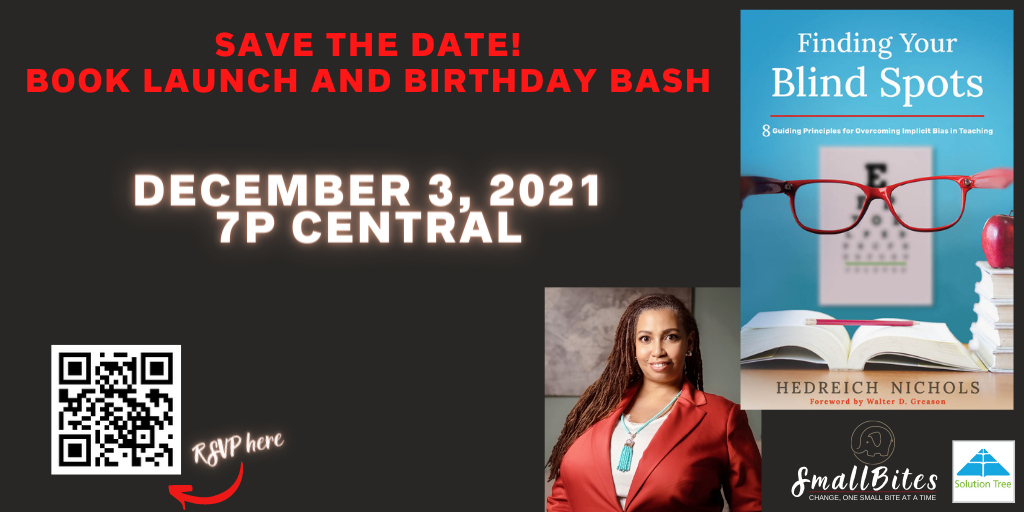
NOTE: If you are enjoying the preview of Finding Your Blind Spots, please join me for my birthday bash and book launch on December 3rd. RSVP below.

You Could Get With This– or You Could Get With That Read More »

SmallBites Lagniappe: SohCahToa and THAT Teacher

Oh so NOW you’re mad? You want to try, judge and jail a teacher for being ‘racist’? You want to say with surety she did all that stuff we saw in the video with malicious intent? 

Was it bad? Yes. Was it an offensive and insensitive display mocking the sacred traditions of a community this country has already taken from over and over again? Yes. But before we go casting stones:

Could we have made the same mistake?

Have you ever watched a Western?

Did you watch Pocahontas without having conversations about the real daughter of chief Wahunsenacawh? 

Have you ever celebrated Columbus Day or Thanksgiving without telling your children and students the truth about the Taino and Powhatan?

On the flip side, have you ever organized or even participated in a protest against legislation that restricts multiperspectivity in classrooms?

Have you voted in every local election and researched stances of the candidates who sit on your school boards?

Are you willing to teach truth even if it means losing your job?

Between ignorance and appropriation

The teacher in California made a really bad mistake, one I wish she’d had the education not to make. But: let he who never celebrated Halloween with a “hula girl”, an “Indian”, a “hobo”, or a “gypsy” cast the first stone (fyi, all inappropriate terms and costumes). As an applied researcher, I spend countless hours learning things I should have learned in 18 years of schooling. Unfortunately, like this teacher, the education I got did not arm me with the cultural capital and historical truths to be knowledgeable and empathetic towards diverse populations.

It’s easy to feel self-righteous because you know how wrong and hurtful this is; but it’s much harder to do the work to ensure that everyone in this country understands that this is wrong and hurtful. 

Now’s the time to do the hard work and leave the stone casting to those pretending to care.

What you can do

Find out about your local politics here.

Find out how to contact your elected officials here.

Find an organization and get involved here.

SmallBites Lagniappe: SohCahToa and THAT Teacher Read More »