As we highlight diverse stories for Women’s History Month, it’s important to discuss with your students why we have the need for a Women’s History month at all. It is also important to highlight not only the strides women have made, but also the gains still needed, particularly economic and career gains.
While I am not a fan of cultural and heritage months, they offer an immense opportunity to open discourse with your students on cultural and gender norms. There is history and then there is African American History, Women’s History, Native American History, Asian American History, all as seeming adjuncts to just plain old, regular history, which continues to be largely dominated by figures who are male and of British and Middle European descent (White).
This month–and during every cultural month–be sure to discuss the need for such months and why multiperspectivity is not the norm and why everyone’s stories are not woven into one great big beautiful tapestry called history.
For classroom resources and lessons on the world’s global goals for gender equality, visit the World’s Largest Lesson.
For Census Bureau stats and facts on women in STEM, click here.
To read the good news on home ownership by women from Urban Wire, click here.
Get a gender wage gap overview from the Center for American Progress here.
This week, I got to speak with educators in my second home and was reminded that people are interested to know what I do now. So I’m interrupting the regularly scheduled programming to have a conversation with 3 friends and educators about my work as a writer and consultant. The podcast is in two languages and describes my work as a consultant and author seeking to give every student a voice and create change one small bite at a time.
In case you don’t know, SmallBites is important because it gives educators a context for the devisiveness around identity politics in the country and across the globe. It helps others recognize that everyone’s journey is not the same and that prejudicial treatment because of color, culture and identity still exists, especially in classrooms. My work through SmallBites, in particular Finding Your Blind Spots, provides educators with a framework to mitigate the behaviors and biases that creep into our work, making us less effective at building the kinds of relationships that improve academic and mental health outcomes for our students.
Diese Woche habe ich mit Pädagogen in meiner zweiten Heimat gesprochen und wurde daran erinnert, dass einige Leute in der Schweiz daran interessiert sind, zu erfahren, was ich jetzt mache. Also unterbreche ich das regelmäßig geplante Programm, um mich mit 3 Freunden und Pädagogen über meine Arbeit als Autor und Berater zu unterhalten. Der Podcast ist in zwei Sprachen und beschreibt meine Arbeit als Berater und Autor, der versucht, jedem Studenten eine Stimme zu geben und einen kleinen Bissen nach dem anderen zu verändern.
Falls Sie es nicht wissen, SmallBites ist wichtig, weil es Pädagogen einen Kontext für die Abwege in der Identitätspolitik im Land und auf der ganzen Welt gibt. Es hilft anderen zu erkennen, dass die Reise nicht für alle gleich ist und dass es immer noch Vorurteile aufgrund von Hautfarbe, Kultur und Identität gibt, insbesondere in Klassenzimmern. Meine Arbeit durch SmallBites, insbesondere Finding Your Blind Spots, bietet Pädagogen einen Rahmen, um die Verhaltensweisen und Vorurteile zu mildern, die sich in unsere Arbeit einschleichen und uns weniger effektiv beim Aufbau von Beziehungen machen, die die schulischen und psychischen Ergebnisse unserer Schüler verbessern.
Special thanks to Monika Burges, Simon Gisler and Irene Siegrist for taking out time from their schedules to conduct this interview.
Besonderer Dank gilt Monika Burges, Simon Gisler und Irene Siegrist, die sich die Zeit genommen haben, dieses Interview zu führen.
Black History Month is over, but the need to elevate the stories and achievements of Black Americans to their rightful place in American history books and curricula is still in its infancy. In actuality, history has been dominated by the achievements of White Males to the exclusion of many other important voices, stories and heroes.
Remember the old adage, know better, do better? When I found out butter was better than margarine and olive oil was better than both, I began to use my oils in different settings, but all have a place in my cupboard. Likewise, now that we know Beethoven and Bach are not the only classical composers, van Gogh and Dali are not the only famous artists and Newton and Einstein weren’t the only scientists, I can go looking for the achievements of people from diverse communities so that my students who are not white or male can see themselves reflected and know that the world is theirs for the taking.
Representation Matters
It’s important for my Black kids to know they can be more than rappers and athletes, so I make sure they see Mae Jemison and Bryan Williams. My Hispanic kids may not see themselves as artists so I make sure they know Frieda Kahlo—and that Picasso was Spanish. My White kids may also not know that Newton, Einstein, Beethoven and Bach all had countries and heritages that may be similar or dissimilar to their own. Newton was English, Einstein Jewish, Beethoven and Bach German. Side by side, Germans, Jews and the English may all have similar amounts of melanin, but culturally they are quite different, even having fought on different sides of great wars.
Since navigating teaching truth in schools these days is akin to navigating a minefield, perhaps we should instead look at Google and ask our students why the representation of any search for famous_____ yields largely males of European descent. Their answers might surprise you.
Why is “White” “White”?
We can also ask them how WWII enemies came to be one cultural group. If we’re going to amplify diverse voices, let’s have a talk about what diversity really means, whose narratives are missing and whose narratives continue to play a starring role. I wouldn’t be surprised if they ask you why everyone’s story should not be told.
Goodbye Black History, Hello History
Meanwhile, as we close out one more Black History Month, remember that stories matter, representation matters. Do what you can to make sure your kids learn truth. Unlike Harriet Tubman and Dr. Martin Luther King Jr., who were deemed subversive in their day but proclaimed heroes by history, those who seek to silence truth may not be remembered so kindly. As much as you can, be on the right side of history.
For a look at ‘whiteness’ and ethnic groups in America, go here.
If I babysat a math PhD who married a Math PhD, one of 4 Black Math PhD graduates from University of Mississippi, I will do well on the GRE when it’s time to get my own PhD, right?
Probably not. But am I honored to know young math movers and shakers who can be role models for my students? AB SO LUTELY.
A lot of the Black History resources I have shared this month point us not so much to a sepia past, but a bright and colorful future, with more young people from the Black community making great strides in maths and sciences. Exposing your students and children to these role models will broaden their horizons in a way that no look at the past can. While knowing our past is hugely important, people doing great things now will give them templates to reach new heights in the future.
I actually planned to talk about entertainer extraordinaire, Cab Calloway, but a little thing like my low-key childhood shero got in the way.
I remembered the name of the first Black female writer, Ida B. Wells from my childhood. I decidedly did not remember that she was so much more than just a journalist! She was a teacher, an advocate, a fierce leader who refused to be content with the status quo. I think of women like Patrisse Cullors,Sara Parker Remond and others like them; women who at great personal cost have advocated for civil rights only to be misunderstood and vilified. You see, Harriet Tubman did not have a cheering fan club either.
Only when we look back in time, when we see our mistakes and inhumanity towards others, do we set those powerful women in their rightful place as civil rights leaders, as leaders for all of us, who push us toward the as yet elusive ‘liberty and justice for all’.
As I read more of Ida’s story, I thought about my books on Krause’s banned book list. Is that my cross? Will there be more indignities to bear? Will more people write that “there is a place in hell for people like me” because I try to ensure a more inclusive society in my small way?
I’m sure that Ida only did what was in her heart. She sought a fair and free society for people who looked like her. Now, 130 years on, her vision is still in danger, the stories of Ida and women like her, being erased. While that makes me sad, it also emboldens me. Although there are those who want to turn back the clock to a time when diverse stories were yet unknown, you can’t put the cat back in the bag. I’m heartened to know that
if Ida did it;
if Sara did it;
if Patrisse did it;
I can do it too. Teachers, we can do it too. #TeachTruth
This week is part two of the SmallBites Black History series. It could aptly called “Beyond the Struggle”. When I think of June and Pride celebrations, there is so much joy. Yes, there is talk of Stonewall and the fight for human rights, but there is a joy that we are missing in February. I believe that comes from the focus on our civil struggle and a lack of knowledge about the many achievements of people from the African diaspora in America.
Let Your Students Do the Sleuthing
I invite everyone to take time, this month especially, to celebrate all that Black Americans have accomplished in the face of insurmountable odds. Did you know that most enslaved people were freed with no education, no restitution and no path to transition from enslavement to freedman in a hostile environment? And yet, there have been notable achievements in every sector, achievements that are not widely known. Since this month is dedicated to Black History, allow your students to research Black business owners, scientists, writers, inventors, choreographers, educators, politicians, generals, etc. Discuss who they find and allow your students to take the lead. I’m hoping that will be acceptable even in today’s climate. There is so much to celebrate and Black achievement in the US is so much deeper than Civil Rights and Soul food.
Who Wants to Join Me??
If you do find someone especially interesting to celebrate, I’d love to interview one or two Black History super sleuths this month for SmallBites. Message me at 5smallbites@bluewin.ch.
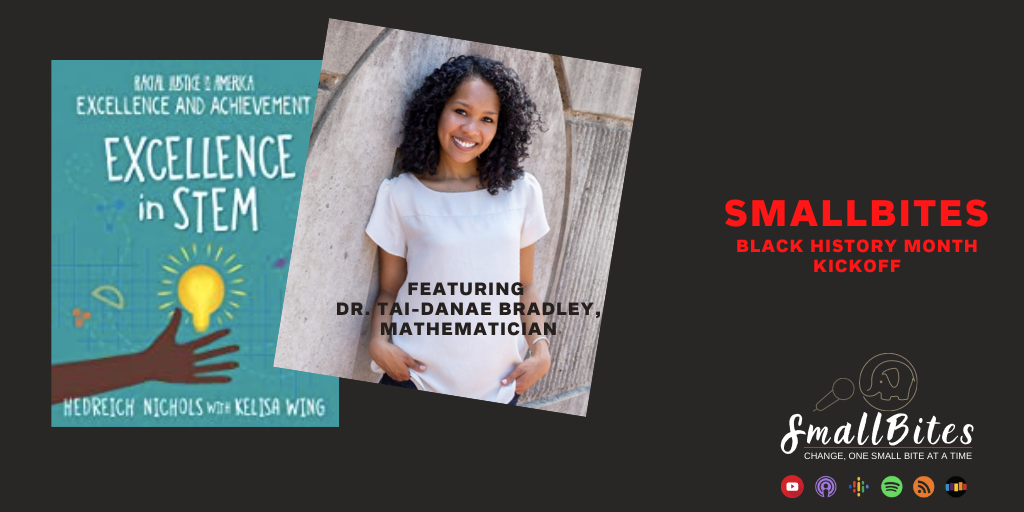
With book bans sweeping the country, I felt the need to record some of the words I’ve written, just in case. Cherry Lake publishing has released a phenomenal Black Achievement series, designed by Kelissa Wing, just in time for Black History Month. I am honored to have written 3 titles, one of which I’ll preview here.
More Than ‘Black Girl Magic’
In this episode, you’ll hear about Dr. Tai-Danae Bradley who looks more like a girl-next-door Instagram model than any mathematician I was ever introduced to in school. Reading her blog and watching her Youtube videos was actually interesting for me–a confirmed anti-mather! The greatest thing about introducing living (Black) American heroes is that your students can see themselves reflected in the here and now. These are people your students can follow on Twitter and Instagram, which makes their achievements feel much more relevant than our normal content connections to old dead people. Not that old dead people aren’t great, but who wants to grow up to be dead and then famous? Certainly not your students who see instafame on the regular.
I’ll be previewing other lesser known Black History heroes in the coming weeks, but I hope you’ll do some research on your own with your students to discover other American stories beyond Martin and Rosa. I hope also, that you will consider investing in books that highlight those stories. As you consider what choices you make for your class library and how much say the state has in those choices, make sure you invest in literature you feel is valuable. And as always, remember to vote your conscience, not only in national but also upcoming local elections. Our democracy depends on it.
Over the past few weeks, I have awakened daily to the news of new humans in the classroom. Now, if you’ve taught a while, you’ll remember when “new humans in the classroom” meant meeting a fresh-faced new group in August or September of each year. Now, it means new humans teaching in the classrooms. Well, teaching is relative. As long as the children are attended, we’re good. Hey Rick Grimes, got a few minutes??
Education: In The Beginning
You see, when free public education was conceived centuries ago, it was designed to cement a unified version of American pride and way of life after the Revolutionary War. Later, after the industrial revolution and, more importantly, after women entered the workforce in large numbers, it evolved as a cost effective way to provide social services and keep our GDP growing.
Under the flag of education we have designed a system that cares for, feeds, assesses and entertains students for most of the waking day while parents work. Working parents means more money flows into and through the economy. Or at least, that’s how it was before COVID. After shut downs crippled and even killed off businesses, the right people must have cried foul: Schools MUST be kept open at any cost. Of course, “virtual learning doesn’t work” was the tagline. ‘Learning loss’, especially ‘in our most vulnerable populations’ was a big problem. Quality learning face to face with teachers, that’s what we needed to do for our kids.
GDP Maintenance vs. Learning Loss Mitigation
Fast forward, more COVID, so much so that schools are suddenly closing on an emergency rolling basis. And in order to prohibit that? Creative thinkers everywhere are getting warm bodies into classrooms to keep schools open. The learning loss needs of fall have given way to the economic needs of winter and the other Big Lie is now lain bare. Learning loss is not and never was the real concern.
The US does not have the number 1 GDP in the world for no reason. We have been ruthless in prioritizing profit, this is no different. Schools are necessary to the economy. Now you, as a teacher, are most likely in this job for the kids. And if you really want the best for them, here are three things you need to do THIS WEEK to prioritize academic needs:
PRIORITIZE VALUING THEIR TEACHER. Decide that if anyone can stand in your class to teach and get bonuses and special permissions, you deserve bonuses and special permissions too. Get together with other teachers and decide what kinds of monetary and non-monetary bonuses would best support the valuable work you do.
Stop giving your employer money. If you’re working 10+ hours more than your contract calls for, you’re investing in a system that does not value prioritizing you or education. Make needed changes, start here with the 40h teacher work week. The information on Jennifer Gonzales’ podcast is a good beginning.
Write your school board members and show up to meetings. Use your voice, do your research and vote in local elections. Better yet, run for office. If that’s not something you want to do, campaign for a teacher who will.
Mostly, we have work to do. Our students need more resources than we can give and it’s time that education gets a bigger slice of the economic pie. Valuing the job you do is a big part of that. Not only are you an educator, you are an essential part of the largest GDP in the world. Start valuing yourself, and ensure that others do too.
Note: This OpEd is designed as a thought provoking, rather than research based, informative article.
It was not so very long ago that Senator Jesse Helms of North Carolina led the charge against this Martin Luther King Jr. holiday that we now celebrate. Today, that congressional fight has largely faded from memory as we celebrate the powerful words Dr. King spoke. In Selma. In Detroit. In Washington. From the many great speeches: I have a dream…; Now is time to make real the promise of democracy… so many great words flood our social media threads on this day. We remember the greatness but forget what he fought for. Dr. King’s marches began because of segregation and voting rights. This past year, the rights he fought for have been under attack like no time since he began the fight.
In 2021, the state legislative push to restrict access to voting was not only aggressive — it was also successful. Between January 1 and December 7, at least 19 states passed 34 laws restricting access to voting. More than 440 bills with provisions that restrict voting access have been introduced in 49 states in the 2021 legislative sessions. These numbers are extraordinary: state legislatures enacted far more restrictive voting laws in 2021 than in any year since the Brennan Center began tracking voting legislation in 2011. More than a third of all restrictive voting laws enacted since then were passed this year. And in a new trend this year, legislators introduced bills to allow partisan actors to interfere with election processes or even reject election results entirely.
Unfortunately, the momentum around this legislation continues. So far, at least 13 bills restricting access to voting have been pre-filed for the 2022 legislative session in four states. In addition, at least 152 restrictive voting bills in 18 states will carry over from 2021.
Liberty and Justice for All?
Who are we? Are we really who our founding documents say we are, or are we only patriots when it serves us? Gerrymandering, redrawing districts and attempted coups make me afraid of what that answer might be.
How will you honor the memory of a man who believed in the America we could be? My ask this week is that you spend some time reading the article on voter suppression from the Brennan Center, and that you contact your congressional representatives. After that, ask at least 3 friends to do the same. If you’d like additional information on voting rights and redistricting (wtheck do we do that for anyway??), head to Ballotpedia and use the dropdown menu on the left.
You Can Make a Difference
Although we teach all to often only about the great speeches in schools, Dr. King’s legacy is far greater than the words he spoke. MLK was not just a Nobel prize winner, not just a man of great words. He was a man of action, arrested 29 times and finally assassinated, shot in the face at the age of 39 for leading the nation into the constitutional promiseland of liberty and justice for all. He was a true patriot who gave his life for his country. If you want to honor his legacy, skip the quote post and instead, post a copy of your protest letter. That would be a celebration worthy of a King.
This episode is dedicated to Sidney Poitier, the first actor I remember seeing who looked like me, may he rest in peace.
I don’t remember when it happened, but somewhere along my journey, I lost my taste for ‘classic’ movies. As much as I loved curling up together with my grandmom to watch old Hollywood movies, and as much as those memories warm me, the movies themselves no longer hold the same enchantment. Without using Google, the only big stars I remember who looked like me in mainstream movies were Butterfly McQueen, Lena Horne and Sidney Poitier. As a matter of fact, the cartoons and sitcoms were similarly populated, until Norman Lear came along, with mostly Americans of European descent. Since that was my norm, I never really knew what I was missing.
She missed–without knowing what she missed…
The old adage “you can’t miss what you never had” could not be further from the truth. Just as childhood trauma leaves scars to be reckoned with in later life, the lack of representation in my childhood smacks me in the face quite often. Scooby-Doo? Where were the diverse actors. After school cartoons? Same question. And hollywood ‘classics’? Well, geez, we couldn’t even get a Black Cleopatra.
Amazon Prime for the Win!
This year, that smack in the face came as I settled in to watch some of my childhood favorites for Christmas. My invisibility weighed heavily on me, cast a pall over my downtime–until Amazon Prime Video breathed new life into the phrase “Christmas Classics”. I found myself in romcom heaven with Black protagonists doing all the kitchy stuff people do in romantic comedies. And they were doing it in falling snow and red and green Christmas lighted backdrops. My little girl’s heart found what it had missed!!
Representation Matters
Everytime a child sees themselves reflected in the classroom around them, they stand up a little taller, knowing that their place in the world is secure. And everytime children see the world as a place rich in diversity, they develop a little more empathy, understanding and respect for differences. That’s a win for us all.
The next time someone tells you that culturally responsive teaching is a bad or dangerous thing, share this blog with them. Responding positively and with inclusivity to the diverse populations that make up our nation isn’t indoctrination, it’s just good teaching.