Hedreich Nichols

Hedreich Nichols

Equity Is More Than an Initiative

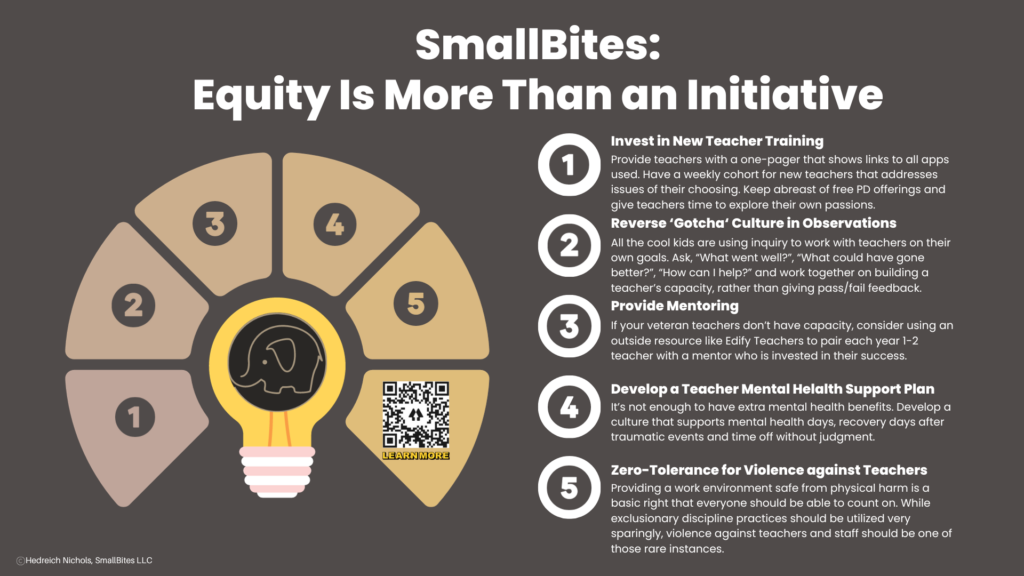
Equity is about academic outcomes not box checker initiatives.

As the opposition to educational change grows, especially when talking about issues like learning gaps, teacher retention and inclusive environments, it’s left to teachers in the trenches to help shape our future. That burden is immense, as seen in the droves of teachers experiencing burn-out and leaving the profession in years 1-5. The sector’s lack of healthy, well supported and experienced teachers especially impacts our most vulnerable students, who often lack access to tenured, experienced teachers in the classroom.

Equity initiatives have pushed the thinking on what it means to create safe, inclusive spaces in schools. However, the impact of these initiatives has not yet shown up in the form of academic gains. My answer to this is to use SmallBites to provide more support for the classroom, which is where equitable access has never really been equitable.

Follow the podcast, connect with me on social media or host me for professional development on your campus. But mostly, listen and reflect on what ‘equity in education’ means. It’s not another PD or training module. It’s in how we show up for the students who need us most; and that starts with equitable access to good teaching.

Here are 5 learning links so you can dive deeper into today’s topic.

1. ⁠Teacher Choice Boards⁠⁠ from Edthena (They are a competitor, but the article is great, as is the template.)

2. ⁠More Support, Less Gotcha⁠, learn more in my interview with Kevin Leichtman.

3. ⁠Mentors Can Be Hired⁠ from companies like Edifying Teachers

4. ⁠Provide Real Mental Health Support⁠, this EdWeek article can help.

5. ⁠Restorative Practice Is Not Just “Keep ‘Em In School Regardless”. ⁠ Learn more in part one of this 3 part SmallBites Series on restorative practice.

⁠Find Links and Additional Resources on Hedreich.com⁠

Equitable Educational Access Instead of Box Checker Initiatives

Equity Is More Than an Initiative Read More »

SmallBites Summer Resources

If you are reading this, whether you have a signed contract at your old school, a contract that signals new beginnings in a new position or even a new beginning that has nothing to do with education, you survived the year (or are at least nearing the finish line)! Students and staff have looked to you for guidance and gotten it. No matter what you forgot to do or even how you fell short; you spent your days trying to make the future a little better for us all.

Teachers, We Are Grateful For You!

I for one, am grateful for each and every person who has risked going into a school building to help serve the families of our communities. In case no one has told you, you are appreciated.

As you begin your summer break, I would like to extend my gratitude for your loyalty and provide you with a top 5 list for summer break. Each episode has its own resources, so don’t forget to check out the show notes and share it with a friend or two:

The Lost Cause: The Original School Indoctrination

Three Things Districts Can Do to Promote Teacher Retention

SmallBites meets Cult of Pedagogy: An Exercise for Teachers

Bias helped Jeffrey Dahmer Kill

I Like What You Like, You Like What I Like; A SmallBites Video on Halo Bias

After summer, SmallBites will be concentrating on fundamental practices of classroom culture and teacher workload strategies. Educators who teach in underserved community often struggle in these two areas for a myriad of reasons. We will discuss those areas and look at supporting strategies in the coming school year as a part of a larger take on educational equity. Further, you’ll have the opportunity to do some in depth learning in cohorts, so be on the lookout for that information on Twitter, Linkedin and wherever you get your social content.

Thank you again for being a part of the SmallBites Journey. We’re in this together.

SmallBites Summer Resources Read More »

The PI in AAPI Part III

Episode Description

In this final full week of #AAPIHeritage month, you still have time to learn about the PI in AAPI with your students, families or just for yourself. Read the part I blog, check out the resources in part II and add the resources below to your cache.

What you can listen to (beware, the Jawaiian sound is addictive).

What you can watch.

What you can read.

How you can ‘vacation’ virtually.

How you can support and conserve from where you are.

About our guest:

Kecia McDonald is not a PI, she is an EL resource teacher and longtime resident on the Big Island. You can follow her on ⁠Instagram⁠, ⁠LinkedIn ⁠or ⁠Twitter⁠.

The PI in AAPI Part III Read More »

The PI in AAPI

Although I hate the fact that we celebrate certain cultures only during certain months, I acknowledge that so much of the country sees diverse Americans as adjuncts, and with no group is that as profound as with Pacific Islanders. Admittedly, it is the group of Americans that I know least about, so I’m excited to learn, and to share my new knowledge with you.

As I talk with educator Kecia McDonald, I realize how little I know about our nation’s 50th state. Let’s start with the most famous word, Aloha. So much more than a salutation, the Aloha Spirit brings each person to the self and is the foundation for projecting positive feelings to others. Starting with the word Aloha, one can immediately see that what most Mainlanders know about Hawaii has been reduced to eliminate a depth, beauty and almost hallowedness that seems to flow throughout the island–if you’re looking closely enough.

My next big line of inquiry–as a person of color–has been, “who are all the brown people?” So much diversity! Resisting the urge to run up to people asking, “what are you” (CRINGE), I could luckily rely on my friend Kecia to learn more about our nation’s #1 most diverse county. What fun it was learning names of cultural groups I have never encountered. Polynesian peoples from Enewetak, Bikini, Rongelap, Kwajalein, Majuro, Yap, Chuuk, Pohnpei, and Kosrae enrich the culture of the Hawaiian islands. For me, learning these new words, a few new (for me) cultural hallmarks and traditions, as well as geography and migration stories has been an incredible way to spend time and further anchor my work.

As you listen, here are some resources to deepen your knowledge and to help you, your families and your students build cultural literacy, especially around the PI in AAPI.

The PI in AAPI Read More »

The Original School Indoctrination

After this week’s CrazyPLN Twitter Chat, led by the incredibly knowledgeable “Constitution Lady”, Linda R. Monk J.D., I began to look more closely at the verbiage in various state censorship and “anti-woke” laws and book bans. While researching the often vaguely worded laws, it occurred to me that the general consensus is that there is an attack on the way things have always been, based on a systematic point of view that grants “history” and “the way things have been” a pass on the kinds of scrutiny that books and courses adding diverse voices to our narratives are under today.

That pass has been given to a national narrative that deserves scrutiny. A good place to start would be the Lost Cause and the United Daughters of the Confederacy. These decedents of Confederate soldiers and officers wanted to build a narrative that cast their loved ones in a positive light. Understandable, as many agree that it’s not proper to “speak ill of the dead”. However, sometimes truth has to come out to validate the narratives of those harmed.

“Happy Slaves” and Other Popular Historical Myths

I was taught in elementary school that Slaves were happy and that they found Christianity because of their benevolent masters. I don’t know any girl of 9 or 10, or any woman of any age who would happily be raped by and bear children for a man not of her own choosing, with no right of refusal. As a lighter skinned Black woman, this historical trauma is in my genes. And while I do not see myself as a victim, I do have a right to have my truth, the truth of my ancestors, told.

When those indoctrinated by the national narrative shaped by the desire to elevate a myth above truth, it is indoctrination. When laws seek to silence that truth, it is a harmful and cancerous core that will haunt us all until we finally deal with it openly, transparently.

This week, after you’ve listened, delve into the resources below. They present a picture of yesteryear’s indoctrination and today’s so-called indoctrination. I hope, even if you are skeptical, that this knowledge will help you see that indoctrination is in the eye of the beholder and that every American story deserves to be told as a part of our national narrative.

The Original School Indoctrination Read More »

Implicit Bias, Childhood ‘Othering’ and Mass Shootings

What do you think when you see a “big Black guy’? Do you immediately feel a sense of danger? When you see Hispanic Americans, do you immediately think they are ‘bad actors’? And what about White people? Do you think of them as racist and uncaring, or maybe just top of the food chain? Depending on who you are, any of these messages could have been a part of your upbringing. The way those messages stealthily inform our interactions is called implicit bias. It’s what we think about others when we aren’t thinking about what we think about others. Tall blondes, jocks, men in suits; those are also groups of people we often have preconceived notions about. Preconceived notions could keep the tall blonde and the athlete out of AP classes, it could give the man in a suit access to privileges that may or may not be earned.

How is VIolence Connected to Implicit Bias

Preconceived notions got Ralph Yarl, a Black teenager, shot by an 85 year old who feared for his life “because of the boy’s size”. It should be noted that the boy was neither tall nor particularly large in stature. Yarl was at the wrong house to pick up his siblings and posed no threat. Still, he was shot in the head through a locked glass door. And then shot again.

This is what implicit bias does. It makes us react to threats that don’t exist. It’s the reason why Blacks die in traffic stops at a disproportionate rate. It’s the reason George Floyd died–the officer said he was a big guy and they had to control him. It’s the reason people with accents are assumed less academically able and the reason Helen Keller was assumed to be “dumb”.

What do you think about others when you’re not consciously aware of what you are thinking? What ideas do you have about social, cultural or religious groups that may prevent you reacting to people from those groups unfettered by preconceived notions? Here are 20 pages of Finding Your Blind Spots that will help you identify some of your own biases. Within those pages are also a few action steps.

Ralph Yarl could have been my son. Thankfully, he is still alive. But he won’t be the last victim of implicit bias. What can you do? How can you help? Reflect, act. Reflect for all the kids that experience a more dangerous reality because of bias. Act because the world needs us to be better humans.

Implicit Bias, Childhood ‘Othering’ and Mass Shootings Read More »

My Son, the Military and Education

Only a few short hours ago, I said goodbye to my son as he left to begin his career as a proud member of the US Army. Only yesterday I watched him make a wish as he blew out candles with the same family that was there at his very first birthday. Today he is entrusted with fighting for the freedoms of this land. And as I record this episode of SmallBites, my heart is with my son, but my mind comes back to the freedoms he will be fighting for. Do we represent the freedoms set forth in our foundational documents? When my son fights to defend democracy alongside the children of other mothers, will it be the democracy of one nation under God with liberty and justice for all?

I sadly read about the loss of our full democratic status in the world and it troubles me–even more so now that my only son will be fighting to defend that democracy. So this week, in honor of my son, in honor of all of those who fight for the freedoms we believe in, I have a reflection and, of course, an ask.

Banned Books, Banned Stories, Banned Rights

Reflect on whether or not the rights of some students are limited when we ban stories, conversations, books, and curriculum because it may reflect ideals unlike our own.

Read this Cast article on Universal Design for Learning, the brain and representation. Scientifically, representation really does matter.

If, as you read, you want to share, please connect with me on Twitter, LinkedIn or Instagram using #SmallBites. I would love to hear your thoughts.

My Son, the Military and Education Read More »

No Hate Like Christian Love

Note: Today’s Easter episode is a special edition specifically for Christian educators. While the episode offers great guiding questions to all educators, scriptures are used as a foundation for this episode.

“There’s no hate like Christian love” is an all too common phrase these days. And as I get ready for my Easter morning church service, I feel shame at what the face of the Christian community has become. I found myself hesitating in using the word “we” when I said Christians. It saddens me that a pillar of my upbringing no longer feels like something to be proud of. I know many others who are believers–loving, accepting ones–who feel the same. This is for us as well.

A Message to Christian Educators

How can educators make campuses a place of healing and wholeness? What actions do we need to take to ensure that no one feels condemned, that everyone feels accepted (not just John 3:16, but John 3:17 as well)? Why do we take actions that have the opposite affect on our campuses and in our communities? Particularly, for those of us who are “of the household of faith”, do we model love or are we volcanoes of condemnation erupting over everything we don’t agree with? Do our actions and words, like lava, destroy and disrupt? Or do they, bring healing and love even in the darkest situations?

WWJD (iykyk)? For those celebrating Easter as the Resurrection, let’s use this time of revival to rethink our actions and ideologies. If they don’t bring light and love, we are a part of the problem. Use the guiding questions in this week’s episode and let’s all work to change the current face of Christianity by being carriers of love, grace and healing in our classrooms, on our campuses and in our communities.

No Hate Like Christian Love Read More »

More Pie with AI

Remember the old adage, “what you see is what you get”? Well, that phrase is officially from a bygone era. Now what you see may be what you get, but what you’re getting may not be real. With AI tools becoming less expensive and more accessible, deepfakes are increasingly finding their way into our media feeds.

Trump, Politics and AI Deepfakes

Consider the recent Donald Trump deepfake arrest video. According to a March 24th Atlantic article, it has been viewed over 5 million times. How many of those 5 million people thought it was real? How many of those people even know to be aware of AI generated images, videos and news?

As educators, we have an incredible opportunity to help our students be better critical thinkers. In addition to last week’s SmallBites episode on media bias, we can help our students–and staff–to be aware of high quality deepfakes. For those of us who like the information in long form, here is Todd C. Helmus’ Rand Corporation article, “Artificial Intelligence, Deepfakes, and Disinformation, A Primer”. And for those who want to get right to the solution, MIT Media Lab’s “Detect DeepFakes: How to counteract misinformation created by AI” is for you. And for those looking for a great media literacy warm-up or bell ringer, here’s a practice site from the above MIT article that you can use to help your students learn to recognize deepfakes.

For more information or to book a keynote or session with Hedreich, click here.

More Pie with AI Read More »