Hedreich Nichols

#smallbites

I’m A Teacher, You’re A Teacher…

Over the past few weeks, I have awakened daily to the news of new humans in the classroom. Now, if you’ve taught a while, you’ll remember when “new humans in the classroom” meant meeting a fresh-faced new group in August or September of each year. Now, it means new humans teaching in the classrooms. Well, teaching is relative. As long as the children are attended, we’re good. Hey Rick Grimes, got a few minutes??

Education: In The Beginning

You see, when free public education was conceived centuries ago, it was designed to cement a unified version of American pride and way of life after the Revolutionary War. Later, after the industrial revolution and, more importantly, after women entered the workforce in large numbers, it evolved as a cost effective way to provide social services and keep our GDP growing. 

Under the flag of education we have designed a system that cares for, feeds, assesses and entertains students for most of the waking day while parents work. Working parents means more money flows into and through the economy. Or at least, that’s how it was before COVID. After shut downs crippled and even killed off businesses, the right people must have cried foul: Schools MUST be kept open at any cost. Of course, “virtual learning doesn’t work” was the tagline. ‘Learning loss’, especially ‘in our most vulnerable populations’ was a big problem. Quality learning face to face with teachers, that’s what we needed to do for our kids.

GDP Maintenance vs. Learning Loss Mitigation

Fast forward, more COVID, so much so that schools are suddenly closing on an emergency rolling basis. And in order to prohibit that? Creative thinkers everywhere are getting warm bodies into classrooms to keep schools open. The learning loss needs of fall have given way to the economic needs of winter and the other Big Lie is now lain bare. Learning loss is not and never was the real concern. 

The US does not have the number 1 GDP in the world for no reason. We have been ruthless in prioritizing profit, this is no different. Schools are necessary to the economy. Now you, as a teacher, are most likely in this job for the kids. And if you really want the best for them, here are three things you need to do THIS WEEK to prioritize academic needs:

  1. PRIORITIZE VALUING THEIR TEACHER. Decide that if anyone can stand in your class to teach and get bonuses and special permissions, you deserve bonuses and special permissions too. Get together with other teachers and decide what kinds of monetary and non-monetary bonuses would best support the valuable work you do. 
  2. Stop giving your employer money. If you’re working 10+ hours more than your contract calls for, you’re investing in a system that does not value prioritizing you or education. Make needed changes, start here with the 40h teacher work week. The information on Jennifer Gonzales’ podcast is a good beginning.
  3. Write your school board members and show up to meetings. Use your voice, do your research and vote in local elections. Better yet, run for office. If that’s not something you want to do, campaign for a teacher who will.

Mostly, we have work to do. Our students need more resources than we can give and it’s time that education gets a bigger slice of the economic pie. Valuing the job you do is a big part of that.  Not only are you an educator, you are an essential part of the largest GDP in the world. Start valuing yourself, and ensure that others do too.

Note: This OpEd is designed as a thought provoking, rather than research based, informative article

I’m A Teacher, You’re A Teacher… Read More »

Invisible for Christmas

This episode is dedicated to Sidney Poitier, the first actor I remember seeing who looked like me, may he rest in peace.

I don’t remember when it happened, but somewhere along my journey, I lost my taste for ‘classic’ movies. As much as I loved curling up together with my grandmom to watch old Hollywood movies, and as much as those memories warm me, the movies themselves no longer hold the same enchantment. Without using Google, the only big stars I remember who looked like me in mainstream movies were Butterfly McQueen, Lena Horne and Sidney Poitier. As a matter of fact, the cartoons and sitcoms were similarly populated, until Norman Lear came along, with mostly Americans of European descent. Since that was my norm, I never really knew what I was missing.

She missed–without knowing what she missed…

The old adage “you can’t miss what you never had” could not be further from the truth. Just as childhood trauma leaves scars to be reckoned with in later life, the lack of representation in my childhood smacks me in the face quite often. Scooby-Doo? Where were the diverse actors. After school cartoons? Same question. And hollywood ‘classics’? Well, geez, we couldn’t even get a Black Cleopatra.

Amazon Prime for the Win!

This year, that smack in the face came as I settled in to watch some of my childhood favorites for Christmas. My invisibility weighed heavily on me, cast a pall over my downtime–until Amazon Prime Video breathed new life into the phrase “Christmas Classics”. I found myself in romcom heaven with Black protagonists doing all the kitchy stuff people do in romantic comedies. And they were doing it in falling snow and red and green Christmas lighted backdrops. My little girl’s heart found what it had missed!!

Representation Matters

Everytime a child sees themselves reflected in the classroom around them, they stand up a little taller, knowing that their place in the world is secure. And everytime children see the world as a place rich in diversity, they develop a little more empathy, understanding and respect for differences. That’s a win for us all.

The next time someone tells you that culturally responsive teaching is a bad or dangerous thing, share this blog with them. Responding positively and with inclusivity to the diverse populations that make up our nation isn’t indoctrination, it’s just good teaching.

Invisible for Christmas Read More »

Shape of You

OneWord ’22 graphic. SmallBites returns Monday, January 10th wherever fine podcasts are heard.

Standing at the precipice of the new year has long ceased to feel like some magical new beginning. That’s a good thing. I have not bungled this year. I’m not waiting on the turn of a page so that I can resolutely start anew. What I am doing is taking the wins of the last couple of years and shaping them into a harmonious melding of many hats. If you are a teacher and a parent, you understand being a wearer of many hats.

The thing about wearing many hats is that it can be difficult to identify which hat is The One. Usually that’s because there is no ONE. Could you choose between ‘child’, ‘spouse’, ‘parent’, ‘educator’ or ‘friend’? Each of those hats are vitally important, but they aren’t always on your head all at once. Still, sometimes you stack them, sometimes they sit askew. Sometimes you just want to throw them all down and go hatless.

This evening, as I write the last blog of 2021, I am hatless. It’s one of those rare moments where I can just be. And in this moment, I savor the time to reflect in quiet about my many hats.

Shape Shifter

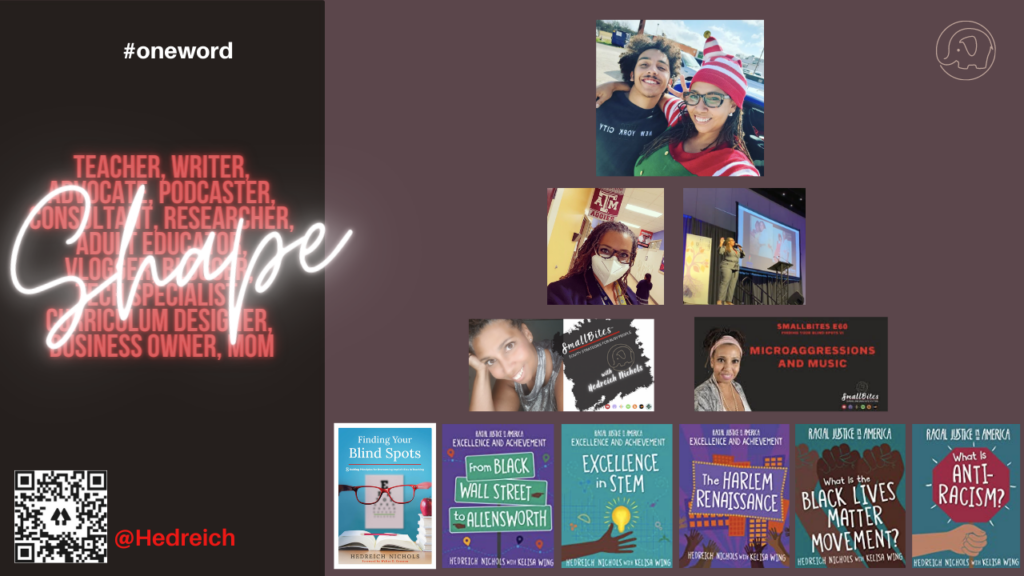
A template designed by Educator and Youtuber Claudio Zavala led me to define the hats I wear. As I named them, I finalized my one word, ‘shape’. As my role in education and parenting is shifting, I am in the process of reordering my hats. The last two years have been fruitful, yielding 6 books, 65 SmallBites YouTube episodes, 65 hedreich.com blog episodes and 65 SmallBites podcast episodes. Those don’t include courses, guest blogs and articles.

So how do I bring all those hats under one umbrella? Well, that’s my focus this year. A little prioritizing, a little fine tuning the schedule and a little more work-life balance. And this is all worthy of a blog post, why? Because, as usual, I have an ask. In the next few days, I would like each of you multi hat wearers to spend a little time being intentional about which hats need to be worn when, for how long and in what order. By allowing a picture of your priorities to emerge, you’ll be better able to focus on the now and shape your path forward. This is especially true if you are, like many, considering a shift away from the classroom or away from education altogether.

Happy New Year

As you define and re-order your hats, define also what brings you joy, what ameliorates stress and what is good for you. Make choosing yourself a firm priority. All the people around you will be happier if you are balanced and content. How will you do this with the coming year, including COVID and testing season? Only you can say. But I know that if you don’t take a minute to establish your priorities, the year’s stressors will do it for you and you will likely not be pleased with the outcome.

FInally, I’d like to thank you for reading and listening. I hope that by shaping your coming year and beyond, that you’ll continue to have energy to learn, to grow and to make safer, more equitable classrooms and campuses for all students.

Your loyalty is appreciated. See you next year!

Shape of You Read More »

Alles Hat Ein Ende

Watch on YouTube or listen on Anchor, or wherever podcasts are heard.

There’s a song well known in German speaking parts of the world called Alles Hat Ein Ende, Nur Die Wurst Hat Zwei. Translated, that’s “everything has an end, only the sausage has 2”. After over 60 vlog episodes and as many Lagniappe podcast episodes, #SmallBites on YouTube is converting to an all podcast format. I hope you’re as excited about this as I am.

New Day Dawning

After celebrating with friends and family from almost every era of my life on last Friday, it’s time to move on to the next chapter. With Finding Your Blind Spots released to the edu-universe, I find myself busier with consulting and courses, and I want to have time to serve my clients well. Still, my audience is hugely important and you can still expect blogs, resources and answers to your pressing questions on race and identity through social media.

One thing about podcasts is that they usually accompany listeners who are driving. Because of that I will sometimes be extending just a couple of minutes beyond our 5-7m mark to give you even more #SmallBites to chew on. I hope that meets with your approval!

You Are Appreciated!

Beyond that, I would just like to thank you for coming back each week, for listening, for learning and for taking that knowledge back to your classrooms and learning communities. Join me next week for episode 65 when we’ll say our final goodbyes. In the meantime, see below for the 5 most important #SmallBites links and resources.

Small Bites All Time Favorite Friday Five:

When I started #SmallBites, Learning for Justice was still called Teaching Tolerance. This site is the definitive starting place for standards, lessons, articles and resources on race and identity. Whether you are just beginning your journey on classroom diversity and inclusivity, or are well on your way to helping others understand concepts that some find divisive, Learning for Justice is a site that constantly evolves to help you learn more and be better for your students.

The Harvard Implicit Bias tests help you recognize bias and blind spots. And Harvard GSE’s teaching resources provide tools to help you create more inclusive courses, syllabi and to better integrate conversations on race and identity into your daily lessons.

After reading statistics on disparities in school discipline, I can only recommend restorative justice practices as implemented in the San Francisco Unified School District. I have used their model in my own classrooms and watched discipline problems give way deeper relationships and better learning outcomes. Students just need to know we are invested, but it takes a whole team to make the kinds of disciplinary changes that come with consistent campus RJ implementation.

Of course, if you are going to miss #SmallBites Fridays after you’ve revisited the wealth of resources, keep learning with free courses taught by Yale and Harvard professors here. Or, you can read and use the 1619 curriculum (or information from it, if your district allows) in addition to other historical resources, to add multiperspectivity. Finally, with students, use PBS, the Smithsonian and NPS.gov to find a plethora of school resources on history and culture in the US and the world.

See You Soon

Finally, use the 65 episodes of SmallBites to find the above resources and many more that will guide you as you seek to better understand and teach all students.

It has been my honor to serve you with #SmallBites on Youtube. See you on Apple, Spotify and wherever fine podcasts are heard.

Alles Hat Ein Ende Read More »

I Call Your Name


Watch on YouTube or listen on Anchor, or wherever podcasts are heard.

This week’s Friday Five comes in the form of another adapted chart from Finding Your Blind Spots.

Say ThisNot This
Chair, mail carrier, fire fighter, flight attendant, nurse, congressional representative, human beingsChairman, mailman, fireman, stewardess, male nurse, congressman, mankind
Student in a wheelchair, student with a learning disability, students who are neurodiverseHandicapped student, learning disability student, special education students
African American, Black, BIPOC, POCNegro, colored, black, Afro-American
Mexican American, Cuban American, Latinx, Chinese American, Congolese AmericanHispanics (when the culture is known), Latino or Latina, Asians, Africans
Native American or specific tribe name, Indigenous peoples of North America, Inuit, Pacific Islander, AIAN (American Indian and Alaskan Native), API (Asian and Pacific Islander), the term someone self-identifies as (just ask them!)Indian, Eskimo, Hawaiian, Chinese
The full chart can be found in Finding Your Blind Spots, available for preorder now.
Teach me how to say that, please.

Whenever I struggled to read the surname of a student on my roster, I always squealed with delight and asked “Ooohh, where’s your name from??” Teaching middle school, I mostly got the “why you puttin’ me on blast” look. But I usually pressed on and was rewarded, as their voices rose in pride and excitement to meet my own.

Because we live in a world that still prizes assimilation over diversity, it’s important that educators use culturally affirming language as they build relationships with individual students. ‘Labeling’ students in the most celebratory and specific way possible is one way to embrace them.

For example, Wanyepreye would have been ‘Pat’ had he insisted. But, I asked him to teach me how to say his name properly. It wasn’t hard. I also asked which he preferred. He said both. When I asked if I could call him Wanyepreye, he said ‘yeah’.

You see, Wanyepreye is Nigerian American. He is not ‘African’ anymore than Canadians–or us, for that matter, are ‘North Americans’.

Go deeper.

How much do you know about your Hispanic students, your Asian students, your Native American students, your Black students or your students from the LGBTQ community? Culture is not only skin deep. Wanyepreye and I are both Black. But his grandma and my grandma cooked differently, spoke differently, had different cultural experiences growing up. His grandma is Nigerian. Mine was Opelousian, from Louisiana. Those labels convey something unique about each woman that the term Black does not. Mexican or El Salvadorian descriptors mean more than Latinx or Hispanic. How deep do you go when getting to know your students–and coworkers–for that matter?

Don’t just read the label.
  • The student with autism wants to be a lemur scientist in Virginia, and he’s working toward that goal.
  • The student working toward their Eagle in Scouts is hosting a rally for the LG community.
  • The student from Tibet is a part of a local circle dance group that performs nationally.

These kids might just be the Sped kid, the gay guy and the Asian girl. But those are labels that don’t even scratch the surface of who they are.

If you are honest with yourself, how many times in a week do you hear “the gay kid”, “the SpEd kid”, “the African kid”, “the Hispanic kid”, etc.? How often do you label kids that way yourself? How much about those kids do you know, beyond those labels? What about when you read the above labels and think about your own language use. Is it common for you to assign monolithic terms to groups of students (i.e. Blacks and Browns) without considering the cultures of the groups represented? Is it the norm on your campus to assign class jobs and talk about certain community heroes along gender lines?

Person first. Gender neutral. Culture affirming.

Luckily, Purdue Owl‘s writing lab keeps up with person-first, gender neutral, culture affirming terminology. And when Finding Your Blind Spots comes out, you can learn even more. But for now, recognize that our language and labels should always be person first, specific, gender neutral and culture affirming. Choosing a specific, rather than broad, ‘label’ starts you on the road to learning more about your students. And when you show nurses and cowhands of all genders, you open up a world of possibilities for your students.

I have one ask this week. Reflect on what you’ve learned and rethink how labels influence what you think about students. And, to practice here’s a 1 question quiz:

Use the chart and the Purdue resources above to rewrite the following sentence in the most inclusive, specific and affirming terms possible:

The American Indian SpEd kid plays basketball when he doesn’t have tutoring. FYI, the student is non-binary, identifies as “they”, is Chickasaw and has autism.

Feel free to practice for yourself or to answer on the thread on Twitter.

I Call Your Name Read More »

I Like What You Like, You Like What I Like

Watch on YouTube or listen on Anchor, or wherever podcasts are heard.

Small Bites Friday Five 2-26-2

20-30m – Explore this article by David Palank to see how likely it is that halo bias influences your teaching (spoiler alert, a lot). Then choose two strategies to mitigate your own biases, like grading anonymously or ALWAYS using a written rubric. Finally, reflect on a time when the halo effect likely played a part in a decision you made.

15-20m – Start with your youngest learners using this rich well of art and literary projects. Mandisa’s website is designed for toddlers but the projects can be easily scaled up for PK-4.

10-15m – Use this Precious Children article from PBS to help you understand why teaching acceptance is important early on, then prepare at least one of the activities for your class or personal kids and grands. My favorite line, “If your group is not diverse, display images of diversity in your community or in U.S. society.”

5-10m – Review this Nielson Group article that explains halo bias and think about how it affects your teaching.

0-5m –  Write down 5 people you know who you attribute certain traits to. For example, Kevin is tall, he must play basketball; or My co-teacher is really pretty, she must have been popular in high school. Now, write down all the reasons your assumptions might be false.

Did you know that mirroring is a real thing in which people subconsciously mimic the affectations of those they like? And even among invertebrates, there is sexual mimicry in which one sex imitates the other sex to signal interest. If you are a scientist or social scientist, you are probably cringing right now. But for us lay persons, I think the gist is clear. Imitation is more than the sincerest form of flattery, it’s how we align ourselves with those we admire.

If we like someone, we also imitate, or at least buy into, their beliefs and values. And usually, if we believe one thing that they believe, we tend to believe it all. We also tend to minimize or write off any negatives or character flaws. Conversely, if we don’t like someone, we are likely to magnify their faults, disavowing them and whatever they stand for.

We see this play out in politics, but how does this play out in education? Well, in the hundred and one discretionary decisions you make daily, it can affect students in a million and one small and large ways. For example, if you like a student, you might be tempted to round up in grading, if you dislike a student, you may round down, or just not round up. If a student impresses you, you are likely to recommend them for awards, AP courses, write reference letters, etc. If you don’t particularly fancy them, you might write them a college letter, but will it be glowing? The adjectives you choose are more likely to be based on your feelings about the student than on performance or achievement.

We say, know better, do better. But that is more than a notion unless you are committed to being a reflective practitioner in a very real, honest-with-yourself-until-it-hurts way. If you really want to be a change agent and make education better, be willing to start by taking stock of your feelings about each student. Start by reading this article, reflecting on how this bias played out in your classroom today; then make plans to course correct.

That’s how real change begins, with you doing your best for each child in front of you. Make it concrete: Read, reflect, make your own plan to be more intentional in dealing with the students you support now.

I Like What You Like, You Like What I Like Read More »

Dirty Laundry

Watch on YouTube or listen on Anchor, or wherever podcasts are heard.

Small Bites Friday Five 2-19-21

20-30m – Watch Jay Smooth’s Media Literacy crash course that delves into media strategies, our reactions to those tricks and our biases. Watch them all if you have time. If not, watch #2, #4 and #5. These are great for you, but can also be watched with a class. 

15-20m – Read this Parent’s Guide to Media Literacy from the National Association for Media Literacy and Education (NAMLE). It features sample questions for analyzing media like who made it, why was it made and how might different people interpret it. It’s also in Spanish and even Greek, if you need it.

10-15m – Reflect on the information in the above document and jot down any personal tweaks you need to make in your own media consumption. Then consider send your favorite section or even a class sketchnote of your favorite section home to parents.

5-10m – Review this Time For Kids resource for use with younger students, or this Media Smarts Break the Fake resource that includes 4 easy ways to fact check and share with friends and family.

0-5m –  Learn the words dorsolateral prefrontal cortex and watch this Above the Noise video on the brain and fake news to learn how to circumvent the way our brains react to news. Probably best with 6-12th graders he says BS (the letters, not the words) in the video. Ooohhhh…

Something dark in human nature makes us like to watch others suffer. The lions and the Christians in the Coliseum; shoot ’em ups; shocking and bad news; social media rants. America’s Funniest Home Videos and even the rash of prank Tiktoks indulge our darker side, give us the opportunity to assure ourselves that we are not as bad off as those we ridicule.

Media takes advantage of that. A message is always crafted by one person with an agenda. From the early days of yellow journalism to today’s polarized news outlets, someone crafts messages to manipulate the masses. We don’t think of our democracy as being ruled by the messages of propaganda, but considering how polarized we are and how news is as much opinion, analysis and editorial content as anything else, we should think again. So much content is needed to fill up the current 24 hour thirst for dirty laundry that we have gotten used to opinion pieces being front page news and incendiary headlines being fact.

The only thing I would like you to do this week is to watch 5 minutes of news daily from an outlet you don’t usually watch. Refrain from making negative comments or judgments. Research what you hear, if you like. But work on tweaking your own media consumption habits so that when you teach civics and citizenship–which should happen daily– you will be able to teach your students to think critically, not to think like you.

Dirty Laundry Read More »

We Are One (The Pre-election Edition)

Small Bites Friday Five 10-30-20:

K-3 – Here are fully fleshed out election day lesson plans from Colorful Pages.

K-12 – No time to devote to a full-blown plan? Use this sample ballot, also from Colorful Pages, to host your own election. Vote for candidates or something fun like vanilla or chocolate ice cream. Talk about why there are only two choices. (No time to copy? Put it on the screen and let kids make their own.)

3-8 – Ask your students if they know that women could not always vote. Watch this 3-minute video that helps explain why. 

K-12 – When you think about your classes, which of your students isn’t connected to the group? Make a point to connect with them one on one. Exchange some personal fun fact and really listen when you ask how they are.

Educators – Make it a point to have a bedtime, preferably no later than 10:30, no exceptions.

Earlier this week, I did a session for Rethinking Learning with Barbara Bray. We talked about strategies on how to have empathy with ‘others’. Others are people who think or look different than us and our friends. Once we stopped recording, talk turned more specifically to the upcoming election and how every ‘we’ in the country is sure that every ‘they’ in the country is destroying the American way of life.

The problem with that way of thinking is, we and they are us. This isn’t our team against the other team. This is one team, one nation indivisible.

What happens Wednesday? How do we heal the bitter divide and seek to understand that, in this case, there really are very fine people on both sides?

Tuesday night, one side will cheer, one side will hang their heads. But on Wednesday, after the best man wins, even if we don’t all agree that he is the best man, we have to shake hands and move forward. I personally will have a difficult time losing. I will be like the woman I mentioned in this week’s episode of #SmallBites. I may cry, and even if I don’t I will wonder what will become of our country. Because, while there are, at least in this case, some fine people on both sides, some is a long way off from all or even many.

If my side loses, I will wonder what will become of my country because those who are not fine people terrify me with their vision for our country that excludes so many and divides us all. And yet…

…I will log into my Zoom on Wednesday and tell my students that we will be OK. I will pull up a list of controversial elections all over the world and show them how many of those countries survived and even thrived in the wake of change, sometimes even bad change.

I will remind my kiddos that an election does not make or break a country, its citizens do. I will remind them that we are the only fine people who really decide the fate of a nation.

I will remind myself too.

We Are One (The Pre-election Edition) Read More »

Peaceable Kingdom

Small Bites Friday Five 09-11-20

20-30m – Listen to the podcast Whiteness Visible part 2 from the Teaching While White website to gain perspective on various stories and viewpoints taught as history.

15-20m – Read how our country’s reckoning with race affects students—in their own words, also from the TWW website.  

10-15m – Comb through the Center For Restorative Practice resources for a rich selection of materials for SEL and culturally responsive culture building.   

5-10m – Watch this PBS Black Folks Don’t episode to find out about the complicated history of Black people and the medical community.

0-5m – Watch students talk about their first experiences with racism and reflect on what you can do to make sure other children don’t keep having those experiences.  

BONUS: If you are looking for an excellent set of quality resources on the manifold, oft untold stories of Americans, visit the Pulitzer Center’s educational programming page.

On the anniversary of one of the most devastating attacks on American soil, I cannot help but think about how hatred causes so much pain. I can’t help but think about the loss that mothers, husbands and children endured because of hatred. I can’t help but think that even though we know that nothing good comes of it, we so often choose to hate.

Love and hate are not feelings, they are verbs. If you say you feel love but your actions don’t back that up, it’s not love. If you say you hate no one but spend your time relentlessly attacking those who think, believe or look differently, you may want to redefine what hatred really means.

The destructive forces of overt and covert hatred are ripping our nation apart because of our refusal to reckon with our origin story. Our nation is great but our greatness is in peril because we refuse to confront our flaws in order to fully realize that greatness.

Some of the the saddest moments for me in recent history have been watching our nation’s status as a full democracy erode when our country was downgraded to a flawed democracy. The UN has warned us about racist rhetoric and admonished us about criminal justice reform.

My patriotic soul wails. WE are the protectors of democracy. WE are the ones who issue human rights sanctions and warnings. And now, WE are the nation being warned. We don’t need foreign terrorists to destroy us. Our hatred is as powerful and destructive as any terrorist act.

This morning, I had the honor of speaking for the New York Public Library’s back to school kickoff. I was asked what we should do in our libraries, classrooms, lives, to dismantle systematic racism. My reply was simply that we can’t–unless we do it one brick at a time. We can’t change the system until we change ourselves, our families, our own spheres of influence. We can’t do it until we confront our flaws with the purpose of being better.

As we remember the incredible loss at the hands of terrorists, the best possible way to honor loss of life, whether through wars or acts of terrorism, is to finally reckon with the hatred and incongruence woven through our nation’s fabric.

In support of our nation’s greatness, we have to confront our past together, no matter how painful. As Benjamin Franklin said, we must “join or die”. If we don’t, we won’t need outsiders to bring destruction.

Peaceable Kingdom Read More »

(#TeacherTurnout) Tuesday

#SmallBites e10 LIVE! Watch the latest episodes on my YouTube channel.

Small Bites Friday Five 08-14-20:

20-30m – Sort through resources at NEA’s Black Lives Matter at School site and choose activities for the coming school year.

15-20m – Watch episodes 3, 4 and 5 of Small Bites. Use the info to make an impact on Tuesdays (see below).

10-15m –Listen to the brilliant young voices of the Social Justice Poets on NEA’s Youtube channel.  

5-10m – Paste your latest 10 social media posts into WorditOut.com to get a snapshot of what’s important to you. Use the information for crafting your Tuesday message.

0-5m – Introducing #TeacherTurnout Tuesday. Make Tuesday your day to let elected officials know what they are doing well and what they can do better.

If there is one unifying theme in my blog and in #SmallBites, it’s social action. There can be no equity without action. There can be no inclusion without each one of us pushing for social justice. Maybe your pushing is marching with a sign. Maybe your pushing is ordering a novel by an author not on the “classics” list. Maybe your pushing for social justice is coming here to read and listen until you feel brave enough to step out.

Whatever your brand of pushing for equity is, it’s for sure easier when we do it together. The loud ones and the quiet ones. The ones who have been at the party forever and the ones who just arrived.

Tuesday is our chance. You’re on social media anyway, so whatever your platform of choice is, make Tuesday your day to tell elected officials how they are excelling or how they need to change to better meet the needs of the communities they serve. Educators wear so many hats, we have our fingers on the pulse of our communities in a way that no politician ever could, so here’s my ask:

Every Tuesday, send a post, tweet, email, letter or make a call to an elected official. It can be someone local, state or national. We may not all agree on what’s going right and what’s going wrong, but if nothing else, COVID has shown us that our voices are too often not taken into consideration even when things directly affect us.

Using the hashtag #TeacherTurnout, let’s make sure that our voices are heard and that the people we elect know that we are a creative, powerful, force to be reckoned with, unafraid to stand up for what we believe in.

(#TeacherTurnout) Tuesday Read More »