Hedreich Nichols

SEL

Shape of You

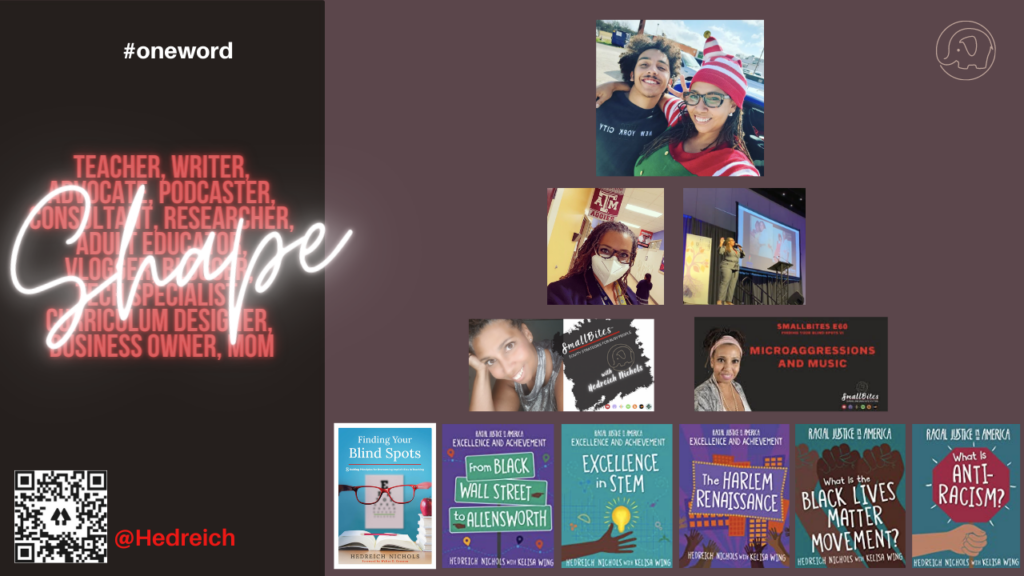
OneWord ’22 graphic. SmallBites returns Monday, January 10th wherever fine podcasts are heard.

Standing at the precipice of the new year has long ceased to feel like some magical new beginning. That’s a good thing. I have not bungled this year. I’m not waiting on the turn of a page so that I can resolutely start anew. What I am doing is taking the wins of the last couple of years and shaping them into a harmonious melding of many hats. If you are a teacher and a parent, you understand being a wearer of many hats.

The thing about wearing many hats is that it can be difficult to identify which hat is The One. Usually that’s because there is no ONE. Could you choose between ‘child’, ‘spouse’, ‘parent’, ‘educator’ or ‘friend’? Each of those hats are vitally important, but they aren’t always on your head all at once. Still, sometimes you stack them, sometimes they sit askew. Sometimes you just want to throw them all down and go hatless.

This evening, as I write the last blog of 2021, I am hatless. It’s one of those rare moments where I can just be. And in this moment, I savor the time to reflect in quiet about my many hats.

Shape Shifter

A template designed by Educator and Youtuber Claudio Zavala led me to define the hats I wear. As I named them, I finalized my one word, ‘shape’. As my role in education and parenting is shifting, I am in the process of reordering my hats. The last two years have been fruitful, yielding 6 books, 65 SmallBites YouTube episodes, 65 hedreich.com blog episodes and 65 SmallBites podcast episodes. Those don’t include courses, guest blogs and articles.

So how do I bring all those hats under one umbrella? Well, that’s my focus this year. A little prioritizing, a little fine tuning the schedule and a little more work-life balance. And this is all worthy of a blog post, why? Because, as usual, I have an ask. In the next few days, I would like each of you multi hat wearers to spend a little time being intentional about which hats need to be worn when, for how long and in what order. By allowing a picture of your priorities to emerge, you’ll be better able to focus on the now and shape your path forward. This is especially true if you are, like many, considering a shift away from the classroom or away from education altogether.

Happy New Year

As you define and re-order your hats, define also what brings you joy, what ameliorates stress and what is good for you. Make choosing yourself a firm priority. All the people around you will be happier if you are balanced and content. How will you do this with the coming year, including COVID and testing season? Only you can say. But I know that if you don’t take a minute to establish your priorities, the year’s stressors will do it for you and you will likely not be pleased with the outcome.

FInally, I’d like to thank you for reading and listening. I hope that by shaping your coming year and beyond, that you’ll continue to have energy to learn, to grow and to make safer, more equitable classrooms and campuses for all students.

Your loyalty is appreciated. See you next year!
Shape of You Read More »

I Call Your Name


Watch on YouTube or listen on Anchor, or wherever podcasts are heard.

This week’s Friday Five comes in the form of another adapted chart from Finding Your Blind Spots.

Say ThisNot This
Chair, mail carrier, fire fighter, flight attendant, nurse, congressional representative, human beingsChairman, mailman, fireman, stewardess, male nurse, congressman, mankind
Student in a wheelchair, student with a learning disability, students who are neurodiverseHandicapped student, learning disability student, special education students
African American, Black, BIPOC, POCNegro, colored, black, Afro-American
Mexican American, Cuban American, Latinx, Chinese American, Congolese AmericanHispanics (when the culture is known), Latino or Latina, Asians, Africans
Native American or specific tribe name, Indigenous peoples of North America, Inuit, Pacific Islander, AIAN (American Indian and Alaskan Native), API (Asian and Pacific Islander), the term someone self-identifies as (just ask them!)Indian, Eskimo, Hawaiian, Chinese
The full chart can be found in Finding Your Blind Spots, available for preorder now.
Teach me how to say that, please.

Whenever I struggled to read the surname of a student on my roster, I always squealed with delight and asked “Ooohh, where’s your name from??” Teaching middle school, I mostly got the “why you puttin’ me on blast” look. But I usually pressed on and was rewarded, as their voices rose in pride and excitement to meet my own.

Because we live in a world that still prizes assimilation over diversity, it’s important that educators use culturally affirming language as they build relationships with individual students. ‘Labeling’ students in the most celebratory and specific way possible is one way to embrace them.

For example, Wanyepreye would have been ‘Pat’ had he insisted. But, I asked him to teach me how to say his name properly. It wasn’t hard. I also asked which he preferred. He said both. When I asked if I could call him Wanyepreye, he said ‘yeah’.

You see, Wanyepreye is Nigerian American. He is not ‘African’ anymore than Canadians–or us, for that matter, are ‘North Americans’.

Go deeper.

How much do you know about your Hispanic students, your Asian students, your Native American students, your Black students or your students from the LGBTQ community? Culture is not only skin deep. Wanyepreye and I are both Black. But his grandma and my grandma cooked differently, spoke differently, had different cultural experiences growing up. His grandma is Nigerian. Mine was Opelousian, from Louisiana. Those labels convey something unique about each woman that the term Black does not. Mexican or El Salvadorian descriptors mean more than Latinx or Hispanic. How deep do you go when getting to know your students–and coworkers–for that matter?

Don’t just read the label.
  • The student with autism wants to be a lemur scientist in Virginia, and he’s working toward that goal.
  • The student working toward their Eagle in Scouts is hosting a rally for the LG community.
  • The student from Tibet is a part of a local circle dance group that performs nationally.

These kids might just be the Sped kid, the gay guy and the Asian girl. But those are labels that don’t even scratch the surface of who they are.

If you are honest with yourself, how many times in a week do you hear “the gay kid”, “the SpEd kid”, “the African kid”, “the Hispanic kid”, etc.? How often do you label kids that way yourself? How much about those kids do you know, beyond those labels? What about when you read the above labels and think about your own language use. Is it common for you to assign monolithic terms to groups of students (i.e. Blacks and Browns) without considering the cultures of the groups represented? Is it the norm on your campus to assign class jobs and talk about certain community heroes along gender lines?

Person first. Gender neutral. Culture affirming.

Luckily, Purdue Owl‘s writing lab keeps up with person-first, gender neutral, culture affirming terminology. And when Finding Your Blind Spots comes out, you can learn even more. But for now, recognize that our language and labels should always be person first, specific, gender neutral and culture affirming. Choosing a specific, rather than broad, ‘label’ starts you on the road to learning more about your students. And when you show nurses and cowhands of all genders, you open up a world of possibilities for your students.

I have one ask this week. Reflect on what you’ve learned and rethink how labels influence what you think about students. And, to practice here’s a 1 question quiz:

Use the chart and the Purdue resources above to rewrite the following sentence in the most inclusive, specific and affirming terms possible:

The American Indian SpEd kid plays basketball when he doesn’t have tutoring. FYI, the student is non-binary, identifies as “they”, is Chickasaw and has autism.

Feel free to practice for yourself or to answer on the thread on Twitter.

I Call Your Name Read More »

Imagine

Twitter Chat Bitmoji Intro (3)

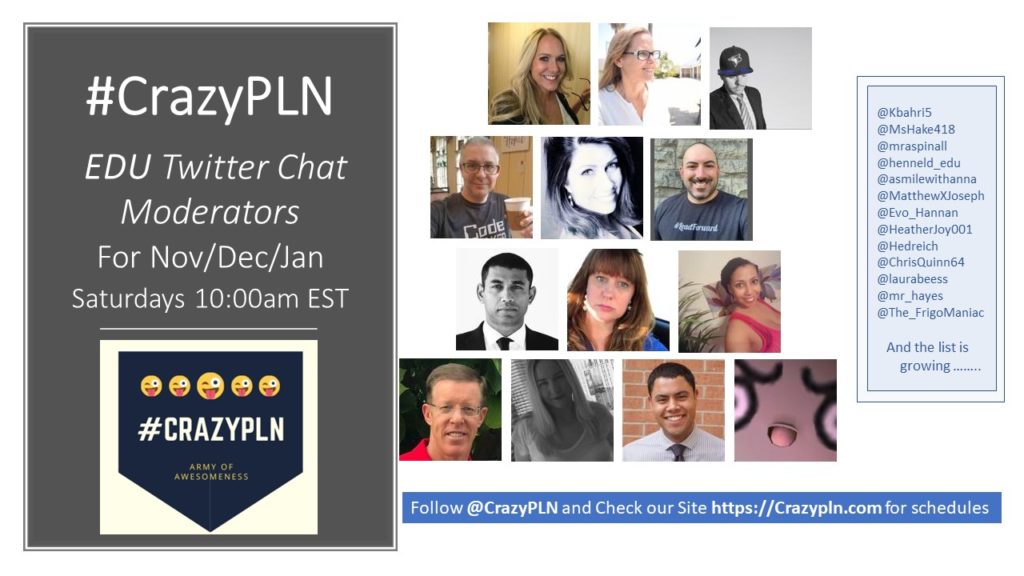
For those who know me from Twitter, you may know that I am a member of a group of educators that host the popular Saturday morning #CrazyPLN chat. One of this week’s questions was, “What’s your greatest fear about reopening in fall?” That one gave me pause. I have been reading about various district fall plans and contingencies much like Kermit sipping tea, as very much the outsider. Today’s question tapped me on the shoulder and reminded me that this coming fall, fraught with all of it’s challenges, is my world and the world of people I care about. My students will rely on me to provide calm, consistency, courage, communication and care–my 5 Cs of education in the Covid era. It’s hard to do that if I am freaking out–which after this morning’s discourse, I kinda was.

The inequities are being unearthed (for those for whom they were still earthed) and those who control the purse strings are having to consider making decisions based on human need and the fact that, if we are to remain a first world country, we have to decide how to be capitalists and care for the most vulnerable among us. With minority communities being hit hardest by Corona mortality, digital inequities, job loss and food insecurity, 30-40% of the country will suffer lasting, life trajectory altering consequences related to Covid-19. Again, that’s only minority communities. White households experienced a 10% jump in unemployment and our country’s overall employment rate is 14.7%.

While the families represented in our school buildings are suffering, the education sector layoffs have already started with some larger districts predicting 15-25% revenue loss, according to the Washington Post.

Then there is the social distancing piece of the puzzle, with the average square footage per classroom woefully inadequate to allow 6 feet of distance between students, if they even want to be distant. Because, you know, kindergartners never touch each other or their teachers and no one in secondary ever has a boyfriend or girlfriend in school. Add to all that the scarcity of sanitation supplies and toilet paper and…and…honestly, thinking of it all gave me the sweats and a headache.

But then I remembered that this situation, with all it’s uncertainty, is also rife with opportunities and rewards. Spoiler alert, fall will not look like any school opening we’ve ever known and that’s really not a bad thing. Yes, I miss the certainty of knowing just what it will look like, but I am ecstatic that we have to re-imagine the institution of education and its role in our society. I am calmed by the front line workers I know who invest deeply in their students, all while battling their own fears. If we concentrate on those 5 Cs–calm, consistency, courage, communication and care, I can imagine us fighting like heck to get our students to an even better place than they would have been if we’d maintained the status quo. I’m not so much of a naïf that I believe we will magically emerge stronger and better like a Tiktok #dontrush challenge. There will be painful loss, change and more than a few missteps on the way to getting it right. But I do know that if we could transform our whole existing system to an online one within days, we can emerge from any dust with a new vision for educating children that reflects the people and society we are now.

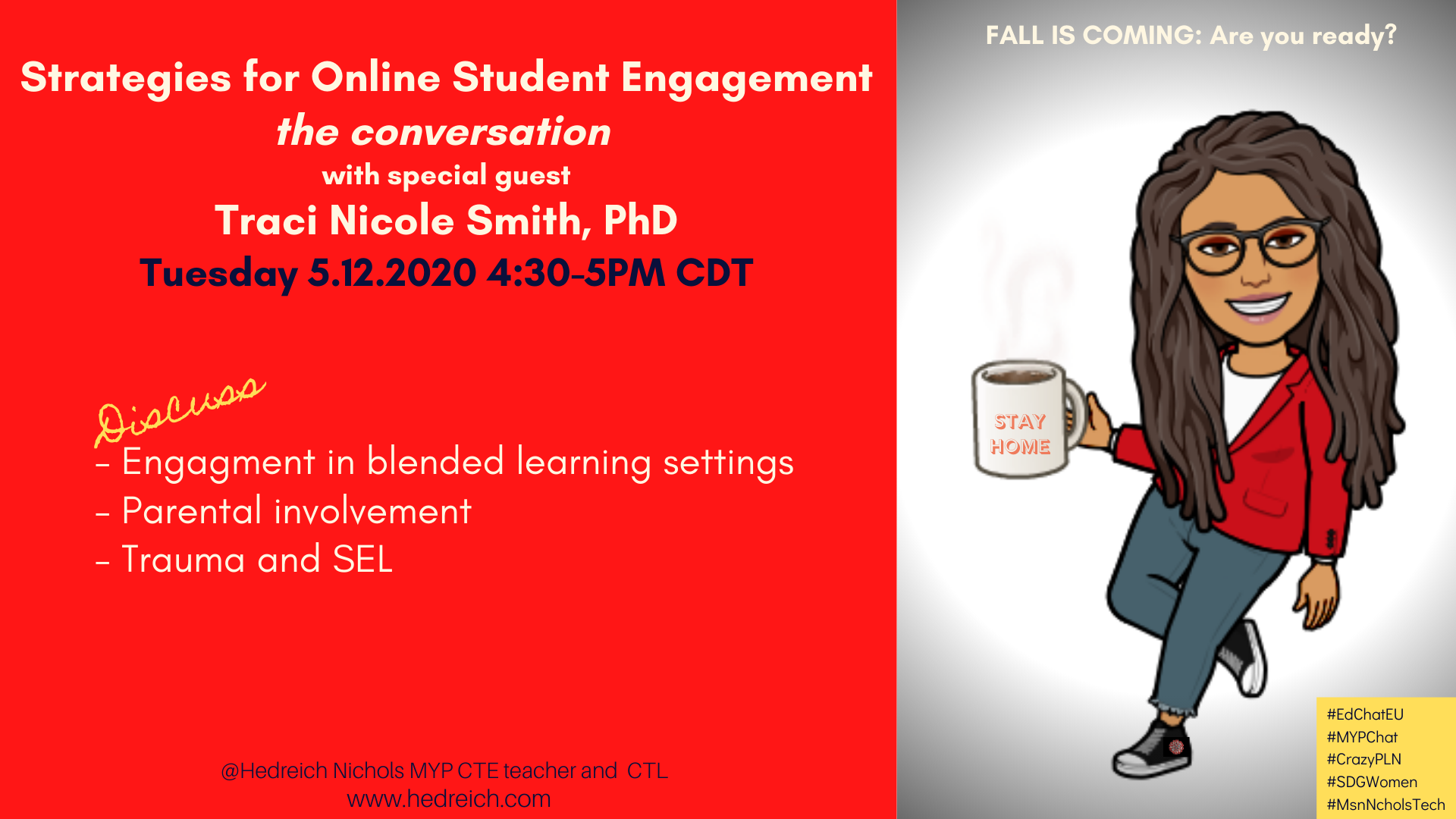
What we’ve been doing hasn’t been working for a long time and now, we have the opportunity do better. Now we’ll have to do better, lean in, try new things. If you’re not sure what new things, read the post below, “From A Distance” for some ideas. Or, I’ll be hosting a virtual learning session Tuesday at 4:30 with the incredible Traci Nicole Smith, PhD to talk about how we can better connect. Join us!

Imagine Read More »

Salt Of The Earth

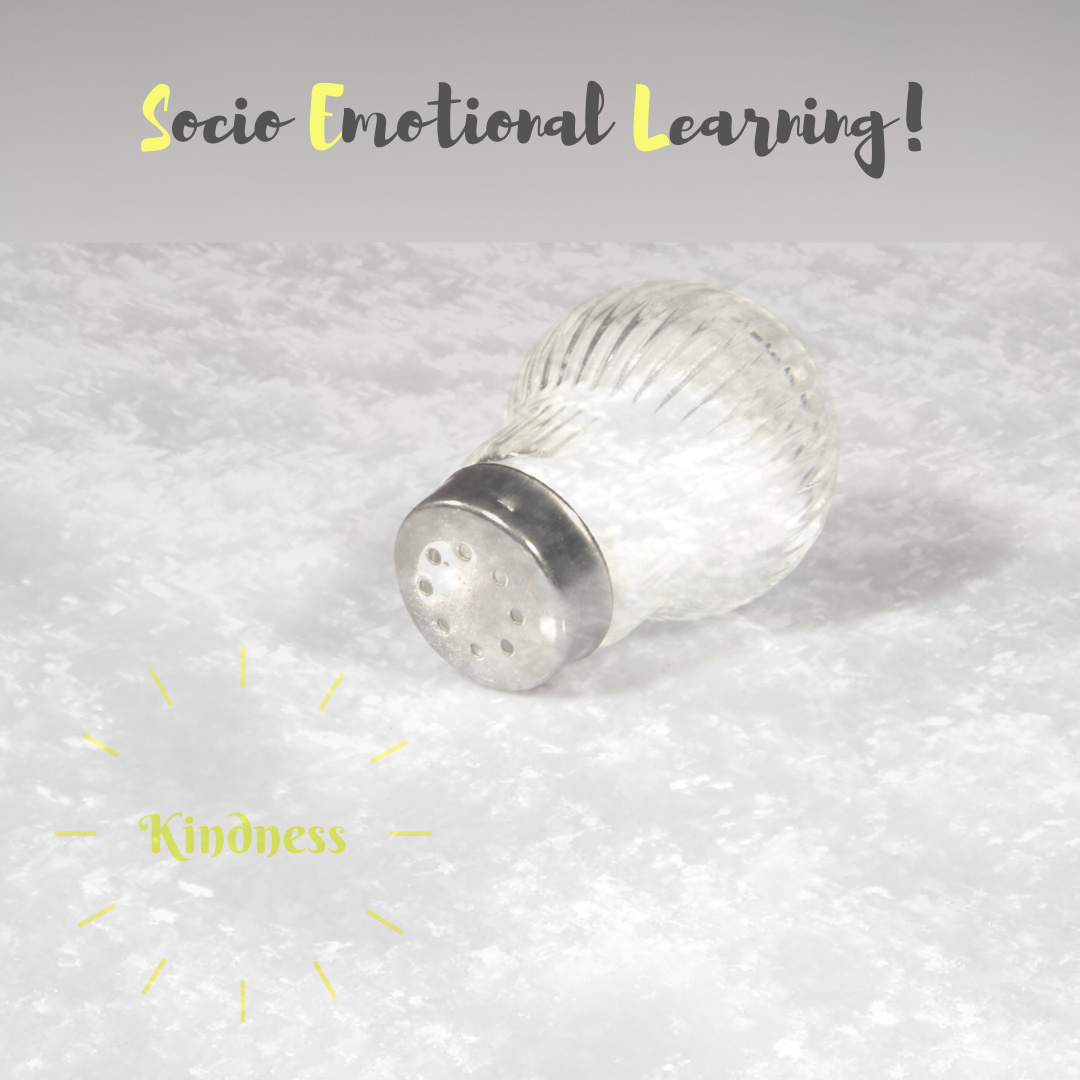
While discussing the recent socio-emotional learning boom with a colleague, Kellie Bhari (@Kbhari5), she called to my attention the fact that SEL is indeed salt. In French. Salt is a preservative. Salt is the basis of most seasoning mixes. Salt is essential, regulatory, nutritive, healing, did I say essential?

I won’t bore you with facts and figures, but the research says that students who have a sense of belonging do better in school than students who don’t. When a school is a place students–and teachers–want to be, everyone is less stressed, more content and better able to achieve. Students learn better from teachers they like. So, as much as I hate bandwagons, the SEL one is a bandwagon we should all be on.

I am warm and fuzzy– in a strict, pragmatic kind of way, an emotional hybrid who has always believed that the world could be a better place if we were to be kinder to one another. As a child I would come in crying, not because I was hurt, but because the kids were being mean to one another. I’ve never been much for “roasting” (“the dozens” for Gen Xers), fail videos, boxing or brutal talk and reality TV shows. I’m the person who rescues puppies, helps sick people in parking lots and goes to fish funerals when invited. I am also the person who navigates the social media waters without stirring the pot for discussion’s sake. I am the teacher who has always built on kindness as the foundation of class management and collaborative learning.

Helping students learn to manage emotions and work collaboratively makes magic in a classroom. When students are taught explicitly to check attitudes, mean-spiritedness and cliquishness at the door, it makes a difference. Quiet students learn to speak out. “Smart kids” build alliances with the “popular kids”. Churlish students find their smile. And everybody can risk failing up.

Maybe you are more of a content nerd ( a good thing, btw) or maybe your school has a schedule that doesn’t leave much time for “extras”. Maybe this is the first you’ve heard about kindness being a part of SEL or maybe you’d just like to know more. Randomactsofkindness.org has a host of resources that are easily integrated into an already full school day. If you’re the bucket filler, challenge your students to do one nice thing for someone else today. And join them. And if you are a go big or go home type, introduce SDGs, the UN’s 17 sustainable global goals, where you and your kids can spread kindness on a global scale. Whatever you do, find a way to add SEL components to your lessons and watch the change.

Yes, salt flavors everything. SEL, likewise, so while the pressure is on and you are gearing up for STAAR, don’t put away your SEL shaker. Send a positive note home, tattle about something good your colleague did, do something nice for yourself, your spouse or your “personal” kids. Sprinkle each day with a little extra kindness. Your students will be better for it, and so will the world.

Salt Of The Earth Read More »

I See You

One evening, some silliness with a couple of teacher friends prompted me to Google an old series, The Beverly Hillbillies. Watching an episode transported me immediately back to my beloved childhood spot on the living room floor in front the TV. Like Jethro and Ellie Mae Clampett from the series, I grew up in an unconventional multi-generational household. The matriarch of our family was my great-grandmother, Mommie (pronounced with the second syllable stressed, in the Creole way), born in 1892. The matriarch of the Beverly Hillbillies was “Granny”. Although the show was an ensemble piece, Mommie seemed to only have eyes for Granny. Granny’s grey hair, her quick movements and her feisty wit rated Mommie’s commentary and wonder. At the time it was curious to me, but now that I am seeing my own Gen-X Hollywood A-listers relinquish their roles to the next generations, I understand why Mommie was so enamored with Granny. She saw in Granny a peer at a time in her life when her own peer group was dwindling. Ageism wasn’t even a word before 1969. There was no Netflix to push quality diverse programming and Norman Lear had not yet shaken up the sitcom scene. There were no Gracie and Frankies, no steamy Richard and Catherine love scenes and certainly no Morgan Freemans who kept getting hired “in spite of” being a minority and a senior. Mommie liked seeing Granny because she saw herself; and in seeing herself reflected on the Curtis Mathis TV screen, she felt un-invisible.

Thinking of how important Granny was to Mommie made me think of how important it is to be seen. EDU has responded to the need for inclusion and, although there are still “bubbles”, many educational settings have made strides in celebrating diversity and ensuring that students see themselves reflected in the staffs, literature and lessons on their campuses. Still, my question is, how are we defining diversity? In Hollywood it’s race, gender and age. In the classroom, we subtract age and add religion and socio-economic status. While these four cover a lot of ground, I’d like to challenge us all to go beyond those labels. How well are we validating and supporting students when the divergence is not apparent? Is there a quiet space at lunch for students who have social anxiety? Are there books to empower and encourage homeless kids or the students who run households? Are there qr codes and easily accessible resources posted for students struggling with depression and self-harm? Are our classes safe spaces for the kids with the “weird” hair or clothes who march to a different beat? Are we ourselves authentic and accepting so that students see themselves reflected in real life role models?

Beyond SEL and differentiation, how are you ensuring equity and access for all? Here is a challenge: have a weekly open door lunch and see who shows up. Get a couple of other teachers to do the same. A ‘lunch and hang’ will clue you in on who feels seen or who needs to be seen. It will give you a chance to learn about campus needs and trends you don’t know exist. You will find out about TikTok, games beyond Fortnite and Pubg, Creepypasta and who writes fan fiction. If your kiddos are younger, you will find out which cartoons are good, if wheelchair and ethnic hair Barbies really make the grade, and probably more about families than you want to know. You’ll find out who has lunch and who has hot Cheetos–or nothing at all. You will find out if your campus is a reflection of the students you serve and how you can serve better.

Mommie’s womance with Granny taught me the essence of what Maslow’s Hierarchy of Needs taught me to name decades later; a sense of love, connection and belonging is essential. The questions I’ve asked here are the questions I ask myself daily. Am I really seeing my students? I can’t include what I don’t see so as an advocate for diversity and inclusion, I will be making sure to use my glasses more. Join me?

I See You Read More »

A Little Help From My Friends

As an only child of an only child of two only children, my biological family can feel a bit smallish at times. That ain’t stopped me none, however! I am blessed to have a warm and supportive framily across two continents, to whom I could not be closer. I inherited some of those relationships from my mom as she taught me the value of a village so it isn’t surprising that I am raising my own only in the same way. What is wonderful and surprising is that I find same Hānai theme in my professional life.

#crazyPLN

Through a series of coincidences–if you believe in such–I have come across some amazing educators. We share many commonalities, and yet, are diverse in a way that would cause riots to break out on Facebook. Not only do we check in and support each other professionally, we have #squadgoals and find ourself spreading our brand of crazy, impactful HeartWork beyond our campuses to educators around the world.

So what’s the point of all this, you’re asking? First, to throw out some gratitude during this season. Having a group of understanding educators to vent to spares our families countless hours of listening to school-day tales while their eyes glaze over (yes, we notice)! Beyond the expression of gratitude and appreciation, I would like to encourage educators to seek out strong professional relationships. Too often we find ourselves alone in our classes, over-salting salted caramel lattes with our tears after some MeanParent email. Education can be brutal without a village, but it doesn’t have to be that way. You may have to put yourself out there and be the change. How about getting to know a teacher you hardly know, or writing someone on your campus a note of praise? You could also try to find groups of educators on other campuses in your district who you can share resources with. Or find educators across the world to Mystery Skype with! And find hashtags on social media that ring true with whatever your thing is, be it #SDGs, #SEL, #6thgrade or something else. I guarantee you’ll find your edumates, people you can double joy and halve pain with. And until you do, pop into our chats on Saturday mornings 9AM CET. You will find a group of extraordinary teachers, leaders, bloggers, authors, and mostly, wonderful human beings who are crazy about impacting the world through education!

A Little Help From My Friends Read More »