Hedreich Nichols

Bias

Shape of You

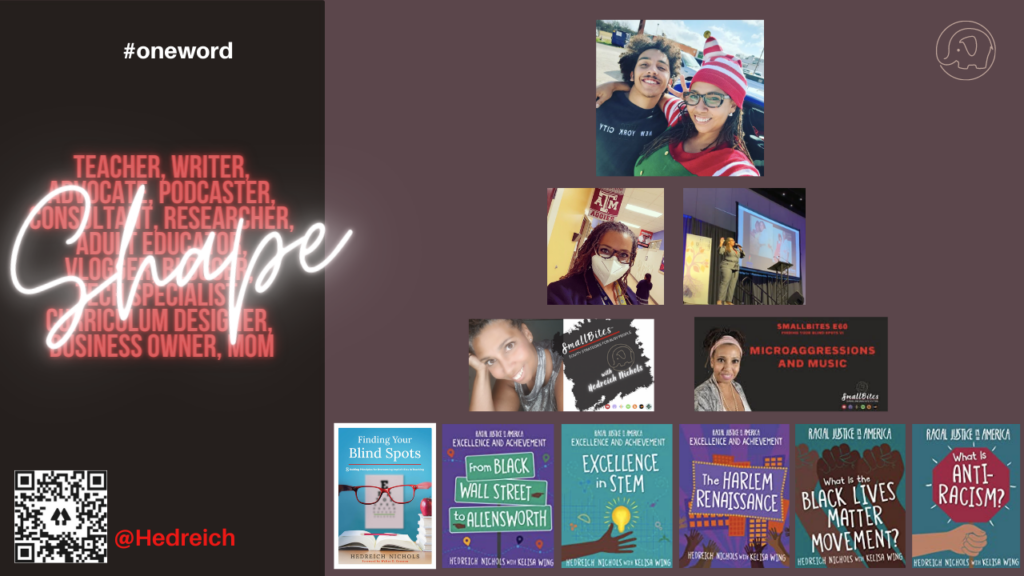
OneWord ’22 graphic. SmallBites returns Monday, January 10th wherever fine podcasts are heard.

Standing at the precipice of the new year has long ceased to feel like some magical new beginning. That’s a good thing. I have not bungled this year. I’m not waiting on the turn of a page so that I can resolutely start anew. What I am doing is taking the wins of the last couple of years and shaping them into a harmonious melding of many hats. If you are a teacher and a parent, you understand being a wearer of many hats.

The thing about wearing many hats is that it can be difficult to identify which hat is The One. Usually that’s because there is no ONE. Could you choose between ‘child’, ‘spouse’, ‘parent’, ‘educator’ or ‘friend’? Each of those hats are vitally important, but they aren’t always on your head all at once. Still, sometimes you stack them, sometimes they sit askew. Sometimes you just want to throw them all down and go hatless.

This evening, as I write the last blog of 2021, I am hatless. It’s one of those rare moments where I can just be. And in this moment, I savor the time to reflect in quiet about my many hats.

Shape Shifter

A template designed by Educator and Youtuber Claudio Zavala led me to define the hats I wear. As I named them, I finalized my one word, ‘shape’. As my role in education and parenting is shifting, I am in the process of reordering my hats. The last two years have been fruitful, yielding 6 books, 65 SmallBites YouTube episodes, 65 hedreich.com blog episodes and 65 SmallBites podcast episodes. Those don’t include courses, guest blogs and articles.

So how do I bring all those hats under one umbrella? Well, that’s my focus this year. A little prioritizing, a little fine tuning the schedule and a little more work-life balance. And this is all worthy of a blog post, why? Because, as usual, I have an ask. In the next few days, I would like each of you multi hat wearers to spend a little time being intentional about which hats need to be worn when, for how long and in what order. By allowing a picture of your priorities to emerge, you’ll be better able to focus on the now and shape your path forward. This is especially true if you are, like many, considering a shift away from the classroom or away from education altogether.

Happy New Year

As you define and re-order your hats, define also what brings you joy, what ameliorates stress and what is good for you. Make choosing yourself a firm priority. All the people around you will be happier if you are balanced and content. How will you do this with the coming year, including COVID and testing season? Only you can say. But I know that if you don’t take a minute to establish your priorities, the year’s stressors will do it for you and you will likely not be pleased with the outcome.

FInally, I’d like to thank you for reading and listening. I hope that by shaping your coming year and beyond, that you’ll continue to have energy to learn, to grow and to make safer, more equitable classrooms and campuses for all students.

Your loyalty is appreciated. See you next year!

Shape of You Read More »

Alles Hat Ein Ende

Watch on YouTube or listen on Anchor, or wherever podcasts are heard.

There’s a song well known in German speaking parts of the world called Alles Hat Ein Ende, Nur Die Wurst Hat Zwei. Translated, that’s “everything has an end, only the sausage has 2”. After over 60 vlog episodes and as many Lagniappe podcast episodes, #SmallBites on YouTube is converting to an all podcast format. I hope you’re as excited about this as I am.

New Day Dawning

After celebrating with friends and family from almost every era of my life on last Friday, it’s time to move on to the next chapter. With Finding Your Blind Spots released to the edu-universe, I find myself busier with consulting and courses, and I want to have time to serve my clients well. Still, my audience is hugely important and you can still expect blogs, resources and answers to your pressing questions on race and identity through social media.

One thing about podcasts is that they usually accompany listeners who are driving. Because of that I will sometimes be extending just a couple of minutes beyond our 5-7m mark to give you even more #SmallBites to chew on. I hope that meets with your approval!

You Are Appreciated!

Beyond that, I would just like to thank you for coming back each week, for listening, for learning and for taking that knowledge back to your classrooms and learning communities. Join me next week for episode 65 when we’ll say our final goodbyes. In the meantime, see below for the 5 most important #SmallBites links and resources.

Small Bites All Time Favorite Friday Five:

When I started #SmallBites, Learning for Justice was still called Teaching Tolerance. This site is the definitive starting place for standards, lessons, articles and resources on race and identity. Whether you are just beginning your journey on classroom diversity and inclusivity, or are well on your way to helping others understand concepts that some find divisive, Learning for Justice is a site that constantly evolves to help you learn more and be better for your students.

The Harvard Implicit Bias tests help you recognize bias and blind spots. And Harvard GSE’s teaching resources provide tools to help you create more inclusive courses, syllabi and to better integrate conversations on race and identity into your daily lessons.

After reading statistics on disparities in school discipline, I can only recommend restorative justice practices as implemented in the San Francisco Unified School District. I have used their model in my own classrooms and watched discipline problems give way deeper relationships and better learning outcomes. Students just need to know we are invested, but it takes a whole team to make the kinds of disciplinary changes that come with consistent campus RJ implementation.

Of course, if you are going to miss #SmallBites Fridays after you’ve revisited the wealth of resources, keep learning with free courses taught by Yale and Harvard professors here. Or, you can read and use the 1619 curriculum (or information from it, if your district allows) in addition to other historical resources, to add multiperspectivity. Finally, with students, use PBS, the Smithsonian and NPS.gov to find a plethora of school resources on history and culture in the US and the world.

See You Soon

Finally, use the 65 episodes of SmallBites to find the above resources and many more that will guide you as you seek to better understand and teach all students.

It has been my honor to serve you with #SmallBites on Youtube. See you on Apple, Spotify and wherever fine podcasts are heard.

Alles Hat Ein Ende Read More »

What I Like About You

Watch on YouTube or listen on Anchor, or wherever podcasts are heard.

Small Bites Friday Five 3-05-21 

20-30m – Read and internalize the outcomes of favoritism (including damage to your reputation) from this UCLA Psych Ed article based on work by Emily Cheng. The article cites studies going back to 1983. The phrase ‘bias in education’ may be new to some, but it is definitely not a new concept.

15-20m – Read this K-12 Dive synopsis and listen to Verna Myers’ Ted talk on mitigating implicit bias.

10-15m – Use this link to watch the #SmallBites Bias collection. If we reduce the big words to our own small actions, we will begin to see change for the better.

5-10m – Dig in to Jennifer Gonzales’ Single Point Rubric strategy. It will not only help you mitigate bias, it will also revolutionize the way you give feedback AND the time it takes to give valuable feedback.  

0-5m – Take this fun quiz to get a feel for the kinds of questions you can ask yourself and the kinds of preferences you should monitor yourself for.

And as promised, a name list randomizer from ClassTools.net,  so you can spin the wheel and randomly call on students.

You know that saying that you wear 20% of your clothing 80% of the time? I remember Oprah doing a whole show around it eons ago that I never hear because that statistic grabbed my attention and locked me in. As I thought about my favorite jeans, my favorite sweater, my favorite PJs with the holes that I just can’t let go of, I thought about why those things mean something.

Are they attached to a memory? Is it the way they feel? The way I feel when I am in them? Pretty much every experience and interaction connects itself to some feeling or preference we already have about something else. The color periwinkle reminds me of my favorite Easter dress ever. It was long and had puff sleeves and a sash. The question, ‘what is your favorite color?’ reminds me of my childhood bestie @Creoleladybug. It’s red and I have no idea why that question always remind me of us and our 5 year old selves. My student, the one talking about why we haven’t changed school since the industrial times so that it reflects the needs of modern society reminds me of who I want to be when I grow up. And the student who often quotes statistics and facts touted by less reliable media organizations without checking their validity reminds me of why I created #SmallBites. My conversations with each of them is valuable; they help me grow.

There is always a connection to something in us in every interaction and the more aware we are of those connections, the more we are empowered to mitigate the effects of unconscious bias in our relationships.

Trust me, you are playing favorites. But you are also, hopefully, actively aware of it and working to course correct. If you are not, consider this your wake-up call. We are all works in progress.

Use a randomizer. Use a single point rubric. All. The. Time. And the next time you eat a popsicle, pull out your favorite coffee mug or step into your favorite worn jeans, remember, there is always a reason you have your favorites. Just make sure those reasons don’t cloud your judgment and adversely impact your relationships.

What I Like About You Read More »

Say My Name

Small Bites Friday Five 12-11-20:

20-30m – Visit the website Peoples of the Historical Slave Trade to get a deeper feel for the faces and places of the slave trade.

15-20m – Read this HuffPost article on the “depressing truth about names and racial bias” then head down the rabbit hole with the hyperlinks.

10-15m – Read the story of enslaved rape victim Celia who was hanged for killing her master and rapist because according to the courts “a slave woman had no virtue that the law would protect against a master’s lust” .

5-10m – Keep challenging your thinking and biases. Here are a few more examples of biases from Practical Psychology to guard against.

0-5m – Use this form to let me know what issues of racism and bias you are struggling with as you work to become a more inclusive educator and let’s start a dialogue. I will be opening up a cohort in January so that we can talk more in depth about HOW to make small changes with big impact.

Sometimes, the smallest, most insignificant thing can be filled with such great humanity. Mr. C., this is for you:

As with many employee groups, my grade level team has a group chat. We trade important information throughout the day, send each other reminders and engage in witticism that only an educator would find funny. Two weeks ago, one text came through, unremarkable, yet significant. A teacher, White, male, needed to communicate about a student. He wrote her first name only, also not remarkable. What was remarkable, for me anyway, was that her name was spelled perfectly. I will call her Sha’ Niqua. As I write this, my computer underlines it in red, denoting an error. But there is no error. The apostrophe, spacing and capitalization all meant something to parents who were excited about the birth of their child. They mean something to the creative, smart 7th grader whose name I see displayed on my screen each class because her camera doesn’t work.

This teacher didn’t write “Shaniqua” or “ShaNiqua”. He didn’t write “S.P.”, convincing himself that it was better for FERPA, but really writing it because he couldn’t be bothered to remember where all the spaces and apostrophes go.

Her name is Sha’Niqua and this teacher, in the midst of all the 2020 craziness, took time to write it correctly. He doesn’t know that it moved me to tears. He just did his job. But I have been in rooms in which teachers roll their eyes or say some not-even-close moniker because they forget that addressing a student correctly by name is basic to connection, which influences learning outcomes.

I have been in rooms in which the refusal to learn a name sprang from glaring biases that associate “Black sounding” names with low socio-economic status and other negative stereotypes. Did you know that students with Black sounding names are more likely to be labeled troublemakers? Did you know that Black jobseekers and Asians who “whiten” their resumes get more interviews? Names play a big part in who we are and who we become. It’s time to examine some of the unconscious biases we carry when encountering names that are unfamiliar, “non-traditional” or “foreign-sounding”. This article on name bias might be a good starting point.

Bias often plays a part in our reluctance to embrace the unfamiliar. But sometimes, we may be unsure of how to be less than the all-knowing authority. If that’s the case, here are some words you can use, especially when encountering a name unfamiliar to you for the first (or second or third) time:

  • “I have never come across that name. Can you help me pronounce it please?”
  • “I am not very good with languages, you may need to help me say your name correctly more than once.
  • “Hey class, if I mispronounce your name, make sure you correct me. Your name is an important part of who you are and I want to get it right.”

A name is an important part of someone’s identity and children deserve to feel seen and valued. Mr. C. will probably read this, and I hope he knows how a little thing he doesn’t know he did made a big difference. And I hope you’ll make that same difference in your classrooms, on your school boards, when hiring babysitters or employees for your side businesses or when running into someone new in your community.

True, a rose by any other name may be just as sweet, but roll over and call your partner by any other name, see how far it’ll get ya.

Say My Name Read More »

Who Are You

Small Bites Friday Five 12-04-20:

20-30m – Watch the election episode of ABC’s Blackish, it’s chock full of context for this year’s election. Did you know that Black people were not officially given the right to vote until 1965?

15-20m – Spend some time reflecting on what has changed since the death of George Floyd and Brionna Taylor, and what still needs to change. Think about who in your community has the power to make that change and join me for #TeacherTurnout Tuesday. Use your Twitter, IG, fb, email or phone to let them know what you, your students and your district need, especially now.

10-15m – Move. Like…stop the video and move. Check out this TikTok video from Dr. Burt (and the one on Small Bites) for inspiration!

5-10m – Look at the graphic in this article on confirmation bias and other types of bias. See if you can find yourself. Reflect on how you form your opinions on the world around you and whether or not you need to make some changes.

0-5m – Use this form to let me know what you are struggling with as you work to become a more inclusive educator and let’s start a dialogue. I will be opening up a cohort in 2021 so that we can talk more in depth about HOW to make small changes with big impact.

Much of what I talk and write about is deeply intertwined with identity. Our thoughts and preferences are often a part of our armor, the thought walls we put up between us and them. Think you’re ‘woke’? Mebbe…but even if you are, your us, them and everything in between is held together by some kind of bias. Bias for things that validate us, bias against things that make us feel insecure or threatened.

When we begin to reflect on how we can create more equitable classrooms and campuses, we often begin with divorcing ourselves from some train of thought and espousing another.

What is your process? How do you know what to leave in and what to leave out? My humble advice is to have you begin by examining your own preferences, and as author Barbara Bray says, define your why. Why do you want to help these students? Do they remind you of your younger self, untarnished by life’s rough spots? Do they remind you of the bits about yourself that you still struggle with? Does helping to level the playing field in education make you feel noble or help you atone for some middle school gym class evils?

Are you doing right because it’s right to do? The answer probably is, partially. Even when we have the purest motives, there is always something self-serving in our ways (Terry Heick has about 180 ways our thinking can go wrong in his article on bias). That’s no indictment, it’s just humanity. But realizing that as fact can help us to make sure that there is nothing odoriferous in our well intended deeds.

Is there a likert scale to help you figure this out? A weighted scale? A chart with four color coded quadrants? Nope. There is only you, a pen, some paper, maybe some sun and fresh air, or perhaps a cuppa in your favorite spot.

As you make changes, look not only outward for new stories to provide context for your students, but look inside yourself as well. The best answers are always there. Find your blind spots, your biases, maybe even turn on a new light or heal a few old wounds with Traci Nicole Smith.

I am excited for you and your willingness to learn how to be a more culturally responsive teacher, but I am even more excited about the opportunity this gives you to be an even better human being.

Who are you? What are your biases? It's one of the things we will explore as we talk about how to implement change in our classrooms and on our campuses. Join us for the #SmallBites cohort next year. Fill out this form  and let's start a conversation!

Who Are You Read More »

This Land is Your Land

Small Bites Friday Five 10-09-20:

20-30m – Do some academic reading with this UCLA-Haas Institute article. Learn vocabulary like racial anxiety and stereotype threat. Reflect on how those phrases can play out in the lives of folks like me.

15-20m – Take this quiz, answer these questions from Bias Busters, then ask yourself how much of this was in the history books you were taught from.

10-15m – Learn about the legacy of Andrew Jackson—the man on our $20 bill—in particular the Indian Removal Act, from the perspective of those he removed. Then look at the life expectancy and economic standards of the descendants of those whose land was taken.  

5-10m – Catch up on older episodes of #SmallBites, go to the sidebar and actually use the links. I see your external clicks, and y’all are not doing the work.

0-5m – Read about how inoculation was introduced to the US by Onesimus, an African who told of the traditional practice in use for centuries. Then use the same article to learn something new about the omitted contributions of melanated Americans.

As I began to reflect on what I would say for this week’s people’s choice topic, I thought about all the things I have learned while researching for my books and for #SmallBites. I thought of how little I learned in 18 years of formal education. This piece was the result of that reflection.

A Spoken Word Piece on Bias in Curriculum

Fourscore and 7 years ago our forefathers brought forth on this continent a new nation…

They told me all about it but they didn’t tell me that…

There were already 600 nations already here. 60 million people here for centuries, people that were forcibly removed: Choctaw, Sioux, Caddo, Powhatan; taken, forced from their lands to make way for this great new nation that would be a whole lot greater, if we would reckon with the blood on our hands because

Four score and seven years ago our fathers brought forth on this continent, a new nation, conceived in liberty even as my people were bound in chains, picking cotton on the land taken from the first Americans who died as they were marched west away from the land they knew; and then further west as Gold was discovered.

They told me of a great president Andrew Jackson, enshrined on our twenties.

But they didn’t tell me that he was responsible the Indian Removal Act that took the land so that White immigrants could profit from cotton and gold and pass that wealth on to generations, while the great nations and descendants of chiefs live on in poverty and die earlier than Americans of non-indigenous descent.

They told me to learn those words, a new nation, conceived in Liberty, and dedicated to the proposition that all men are created equal, but they didn’t tell me that equality did not extend to human beings forced to work for, cook for, nurse for and even bear children for the very people who bought and sold them.

They didn’t tell me about rape culture in the colonial days and they didn’t tell me that the Atlantic Slave Trade was no more than a whitewashed phrase for kidnapping and child rape. They didn’t tell me that that it was a Holocaust that killed an estimate of 40 free Africans out of every 100 that was kidnapped; every man, woman and child. They didn’t tell me that it was a holocaust that has caused intergenerational scars and trauma that Black communities are still recovering from.

They told me of the Emancipation Proclamation but they did not teach me that my Indigenous brothers and sisters were separated from their families and taught in “Christian” boarding schools that stripped them of their culture to rid our country of the “Indian problem”. They told me a thing or two about the Civil Rights Era, but they did not tell me that 10 years after Martin was murdered, Indian children were still humiliated and chastised for their lack of ‘assimilation’.

They told me to learn those words, Four score and seven years ago our forefathers brought forth on this continent, a new nation, conceived in liberty, and dedicated to the proposition that all men are created equal. But they did not teach me that the accomplishments of my out-of-slavery forefathers were important.

Yes, they told me about Martin and Rosa and Harriet and I am glad. They told me about them every year. But they did not teach me about

O. W. Gurley

Garrett Morgan

Susan La Flaesche Picotte

Thomas David Petite

José Mojica

Carlos Graef Fernández

Thomas Jennings

Fannie Lou Hamer

Luis Negrón

Madame C. J. Walker

Sister Rosetta Thorpe

#Saytheirname.

Say them in your STEM classes and in your history classes. Say them in February, but also in March, April and throughout the year. Teach your children Lincoln’s famous words; Four score and seven years ago our fathers brought forth on this continent, a new nation, conceived in Liberty, and dedicated to the proposition that all men are created equal and then show them by what you teach them that they are not invisible, no matter what the textbook says–or doesn’t say. Show them that bias in curriculum does not exist in YOUR classroom. Teach them they have a long heritage; not only of Slavery, reservations and immigration camps.

The lion is always the villain until he has his own historian. –African Proverb

Be the change and help your students “red and yellow, black and white” know the rich tapestry of history in your class. Because if there is still bias in your curriculum, you just aren’t trying hard enough.

This Land is Your Land Read More »