
Hedreich Nichols

Bias Helped Jeffrey Dahmer Kill

Could bias have been responsible for the Jeffrey Dahmer murders? If you think that sounds a bit like a way out there conspiracy theory, let me help you follow the logic.

Glenda Cleveland was a woman in the neighborhood who, along with her daughters, followed up several times with the police because of suspicious activity surrounding Jeffrey Dahmer’s movements. Without going full blown spoiler alert, I’ll simply say that in one instance, had the police believed her and not Jeffrey Dahmer,  the victim would not have met his death.

All-American Kid

Jeffrey Dahmer was a blonde haired, blue eyed person of middle European descent, and he looked like what in my childhood was known as an “all-American” type. The American predisposition to favor that type of good looks was one part of the bias that allowed him to go undetected for so long. Ever notice how the blonde folks are rarely the bad guys? It’s better now, but for a very long time, blonde/blue was THE Hollywood beauty standard.

Combine that with a conflicted policing history and slow police response time in non-White neighborhoods, and you have a perfect storm, especially for crimes committed against gay people of color in a neighborhood of Black and Brown people.

What if Cleveland had been believed? What if the victim’s family, immigrant, English language learners, had been heard and believed? What if the officers called to serve and protect, thought that marginalized populations held the same value as people who looked like them?

Netflix and Chill with your Halloween Candy

This Halloween, if you are watching something scary, consider watching the Jeffrey Dahmer movie on Netflix. It’s hard to watch, and it’ll take longer than one night. BUT, start, and watch for bias that comes into play. Make a note of moments when you feel the unconscious thoughts of one person affected the life—or death—of another. Then join me on Twitter. I’d love to hear your thoughts.

Extend your learning:

Take a Harvard Bias Test

Racial Bias and Disparities in Proactive Policing

National Academies of Sciences, Engineering, and Medicine. 2018. Proactive Policing: Effects on Crime and Communities. Washington, DC: The National Academies Press. https://doi.org/10.17226/24928.

Bias Helped Jeffrey Dahmer Kill Read More »
Data Driven Equity

Often, when we think of moving the equity needle on our campuses, we talk in terms of implicit bias, diverse representation and personal responsibility. We don’t often connect it to data. Data tells you which teachers are having discipline referral problems within certain populations. Data tells you which teachers are closing gaps for Black and Brown students more quickly. Data tells you which apps are positively impacting intervention and extension for special populations. For example, because ST math is a game based program that requires no language based skills, it works well for ELs and students who are reading below grade level. 

How are we using data to create equitable learning environments? Male students typically have more office referrals. Is it that boys are “bad” or is it that schools have designed a system for sedentary, compliant learning while socializing boys to be anything but sedentary and compliant? 

Using a Strength Based Lens

How do we use the information we have to drive action? First, find out what’s working, and which teachers are succeeding. Use peer observations to build cultural competencies across your campuses and districts. Add accountability discussions and mentoring to learning walks so that you can impact student learning and behavioral outcomes by replicating behaviors and strategies of successful teachers. 

I’ll be talking more to administrators the rest of this year about campus and district equity initiatives, and how to move them from reflection to data driven action. Make sure to recommend SmallBites to your favorite admin team or school board so we can all be better together, one small bite at a time. 

Watch the interview with Dana Cole in its entirety here.

Learn more here:

MacPherson, Kelly-Robin St. John, “Reducing Disproportional Discipline Referrals for African American Male Students at The Elementary Level” (2016). Dissertations, Theses, and Masters Projects. Paper 1499449719. http://doi.org/10.21220/W44H2H

Data Driven Equity Read More »

Cultural Appropriation and Halloween

Because it’s time to don costumes and have some fun, I thought it would be a good time to send this friendly public service reminder: culture ≠ costume.

Borrowing the sari, the skull or the sombrero is not the same as wearing a secret service agent suit, a superhero cape or a celebrity gown. Those are examples of cultural appropriation. 

Having a cultural day at school in which students wear culturally inspired clothing in addition to presenting an oral essay and expressing understanding and appreciation for diverse cultures can also be a good thing. That’s cultural appreciation. 

Using Halloween as a day to don the clothing of Hollywood stereotypes is something that we have always done. However, we are only beginning to understand that some of the items we’ve worn have deep historical meaning and context. Headdresses, “Hula girl” outfits and turbans, for example, all have meanings that most of us know nothing about. Wearing those items in a frivolous way shows a lack of respect, even when we don’t mean it.

Think of it like this: wearing a Priest’s cassock or going Trick or Treat with a cross tied to your back would turn heads, and not in a good way. That’s how it should be when we see meaningful cultural symbols being used for costumes.

Learn more.

Cultural Appropriation and Halloween Read More »

SmallBites at Sunset Live on location: The Confederacy, Civil Rights and Student Safety

Happy fall break!! Head over to @Hedreich on Instagram for this week’s live episode. And for context: https://www.theguardian.com/environment/2018/jul/13/hiking-african-american-racism-nature  https://www.sierraclub.org/sierra/why-people-color-often-feel-unsafe-outdoors by @amandaemachado0 www.voxmagazine.com/tncms/asset/editorial/11e7709e-74cd-11eb-83b2-8f13b43d6648 And by Emma veidt https://outdoorafro.com/

SmallBites at Sunset Live on location: The Confederacy, Civil Rights and Student Safety Read More »

At The Intersection of Columbus Day and Hispanic Heritage Month

Listening to a wonderful teacher read the legend of La Llorona to her class on Mexican Independence Day eve, I began to ponder the intersection of Columbus Day and Latinx Heritage Month. There is irony in the fact that we celebrate an explorer who opened the floodgates of Spanish colonization, which essentially meant the downfall of the original inhabitants of the Americas and the Caribbean, the descendents of whom we celebrate this month. 

Armed with that truth, it is fitting that we highlight the societies that were growing and thriving before European contact, especially on holidays when we may not have grown up with the diverse stories that paint a well-rounded picture of historical happenings. Here’s your homework:

Who had dinner with the Pilgrims and what are 5 facts about their way of life? 

Who discovered Columbus shipwrecked on their island?

Martin Luther King Jr. was a civil rights hero, but what were life and death for him like once he started speaking out?

As we near what I now prefer to call Indigenous Peoples Day, let’s get more of the story out there. Telling all the stories is a great way to center narratives that have not traditionally been centered. You’ve got a week to prepare and here are resources. 

https://www.nationalgeographic.com/history/article/meet-survivors-taino-tribe-paper-genocide

And for good measure, the legend of La Llorona

Let me know how it goes!

At The Intersection of Columbus Day and Hispanic Heritage Month Read More »

Five Ways To Elevate Your Practice This School Year

We apologize for any player issues encountered. If the player is not working, please click here.

Sometimes, it’s the little things. And as you know, SmallBites is always about the high impact little things. Below are 5 ways you can elevate your practice this year.

  1. Know your state and district laws. “ban crt” and “don’t say gay” type legislations are in over 500 jurisdictions in the country. UCLA’s interactive map and corresponding resources will help you keep abreast of the latest laws that may directly influence what you can and cannot include in the teaching and learning loop on your campus. Knowing the laws, as well as your district’s stance can help you navigate the complexities of teaching truth in America in the 2020s. If you are at the district level, consider what your legal and administrative response will be and let teachers know in advance what kind of support they can expect.
  2. Integrate diverse narratives. After finding out what laws are, do your best to push your students’ critical thinking by challenging them to research lesser known stories and narratives. Here is a month of SmallBites Episodes and resources to help you plan and research diverse narratives; and shape conversations around diversity and equity.
  3. Teaching on a homogenous campus? Not possible! Sameness has more to do with culture, zip codes and melanin. Here is an article that is worth the read. In short, diversity matters–and it’s all around us.
  4. Inclusivity is the opposite of judgment. Just let that sit. 
  5. Reduce your consumption of incendiary media. Fight the algorithms by broadening your searches and reading articles from a variety of sources. If you’re in the classroom, teach your students to do the same. If you are at the district level, consider making media literacy a campus initiative and start an awareness campaign of the types of words and articles that make us mad and divide us. Awareness is the start, consuming less is the goal.

Teaching is harder than it’s ever been and the plates of educators are overflowing. Still, we all want to be better. Let me know how this podcast episode helps you and feel free to DM me on Twitter or IG to ask any lingering questions you might have.

Five Ways To Elevate Your Practice This School Year Read More »

SmallBites: Hispanic Heritage(s) Month(s)

As you know, if you’ve listened often, I am not a big fan of relegating cultural literacy to certain months of the year. However, since most campuses are highlighting Latinx communities this month, I do hope you’ll represent the diversity of the cultures on your campuses. This week, please refer to my most recent Edutopia article for great information on how to respectfully give voice to diverse Hispanic communities throughout the month, throughout the year. 

SmallBites: Hispanic Heritage(s) Month(s) Read More »

BTS Edition: Losses, Gatekeeping and Selfcare

Queen Elizabeth, 9/11 and Mourning

As I thought about the pomp and circumstance surrounding the death of the Queen, the national remembrance of 9/11 and how we, as a country, grieve, it occurred to me that our losses are ranked. And those rankings reinforce our caste system, our gatekeeping. Why, for example, are flags lowered for government officials and foreign dignitaries? Are those losses more profound than the losses suffered by “regular” citizens?

If we accept grief rankings, where else might we be reinforcing structures that do not honor and value people equitably? How do those systems and structures subtly influence the way we approach building classroom and campus culture?

What Is Normal Anyway?

What kinds of inherent structures of honor are in place on your campus? Who do “norms” honor and center? Are there “norms” that can be rethought? Let these questions guide your reflections this week. And to support you in being a reflective practitioner, listen to Angela Watson of the 40 Hour Teacher Workweek Club in her powerful interview with Jennifer Gonzales. Being rested, balanced and regulated is THE best thing you can do to propagate a positive, supportive campus culture. Setting strong work-life boundaries is key.

Finally, if you feel grief over the loss of the Queen, at the thought of 9/11 or at any other world impacting event; be true to your feelings. We feel what we feel, and that’s ok. If others feel those losses less acutely, that’s ok too.  Reflection and acceptance are perfectly balanced, leaving no room for judgment. 

Happy Back to School, see you next week with more SmallBites.

BTS Edition: Losses, Gatekeeping and Selfcare Read More »

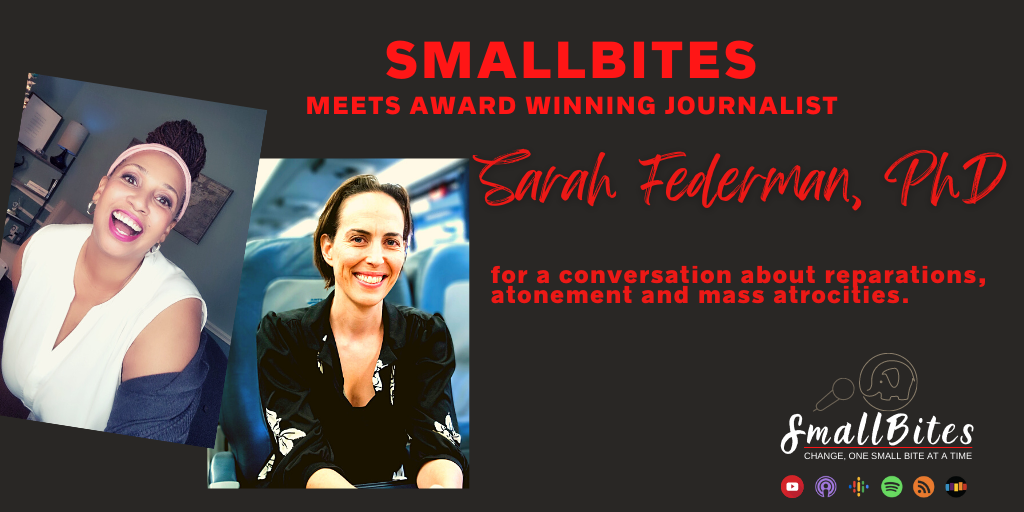
Freedom: Reparations, Atonement and Mass Atrocities, with Sarah Federman (Pt. 3)

Listen to the final installment of the interview with Sarah Federman here.

In this final installation of the conversation on responding to mass atrocity harm with Sarah Federman, we talk about practical ways we can acknowledge and help diverse stakeholders, both those who suffer fallout in the form of ongoing structural inequities, and those who are perhaps unwittingly complicit. We also talk about how those who research and work with difficult topics like mass atrocities, social justice issues, genocide, etc., can circumvent burnout.

Listen to part 1 here. Listen to part 2 here. Buy Sarah’s award winning title, Last Train to Auschwitz: Grounded in history and case law here.

Last Train to Auschwitz traces the SNCF’s journey toward accountability in France and the United States, culminating in a multimillion-dollar settlement paid by the French government on behalf of the railways.The poignant and informative testimonies of survivors illuminate the long-term effects of the railroad’s impact on individuals, leading the company to make overdue amends. In a time when corporations are increasingly granted the same rights as people, Federman’s detailed account demonstrates the obligations businesses have to atone for aiding and abetting governments in committing atrocities. This volume highlights the necessity of corporate integrity and will be essential reading for those called to engage in the difficult work of responding to past harms.

About the guest:

Sarah Federman is an Associate Professor of Conflict Resolution at the University of San Diego’s Kroc School of Peace Studies. She is the author of the award winning Last Train to Auschwitz: The French National Railways and the Journey to Accountability (2021). She has also written for the Harvard Business Review and the Journal of Business Ethics concerning the corporate obligation to atone for participation in mass atrocity such as genocide, slavery, and violence associated with colonialism. In 2022, she testified before Congress concerning the responsibility of U.S. banks to respond to their slavery ties. This summer her co-authored anthology “Narratives of Mass Atrocity: Victims and Perpetrators in the Aftermath” will be published by Cambridge University Press. Federman comes to this work after a decade as an international advertising executive working with companies such as Google and NFL.

Freedom: Reparations, Atonement and Mass Atrocities, with Sarah Federman (Pt. 3) Read More »

Freedom: Reparations, Atonement and Mass Atrocities, with Sarah Federman (Pt. 2)

Listen to the episode here.

Yes, it’s summer. But I’m back anyway!

This is part 2 of a conversation with Sarah Federman on enslavement within the context of mass atrocity ‘reckoning’. (Listen to part 1 here.) Highlights in this conversations include suggestions and recommendations for impactful apologies and ways to acknowledge ties to harms that still impact communities in the present. The Baltimore Sun provides an exemplary template for what needs to be said–in government, in corporations, in organizations–in order for us to heal and move forward as a nation. This episode begins to explore ways to talk about present day ties to mass atrocities of the past without indicting people who themselves may be struggling with poverty or disenfranchisement. It also acknowledges the difficulty of the “it wasn’t me, I wasn’t there” argument. Come back for part 3 next week. 

About the guest:

Sarah Federman is an Associate Professor of Conflict Resolution at the University of San Diego’s Kroc School of Peace Studies. She is the author of the award winning Last Train to Auschwitz: The French National Railways and the Journey to Accountability (2021). She has also written for the Harvard Business Review and the Journal of Business Ethics concerning the corporate obligation to atone for participation in mass atrocity such as genocide, slavery, and violence associated with colonialism. In 2022, she testified before Congress concerning the responsibility of U.S. banks to respond to their slavery ties. This summer her co-authored anthology “Narratives of Mass Atrocity: Victims and Perpetrators in the Aftermath” will be published by Cambridge University Press. Federman comes to this work after a decade as an international advertising executive working with companies such as Google and NFL.

Freedom: Reparations, Atonement and Mass Atrocities, with Sarah Federman (Pt. 2) Read More »