Hedreich Nichols

smallbites

Tell Me No Lies

Watch on YouTube or listen on Anchor, or wherever podcasts are heard.

Small Bites Friday Five 5-14-2021

20-30m – Watch this video that explains the Truth Commission of South Africa and the process they used to confront racial violence and inequities. Compare and contrast the similarities of the Apartheid system and issues with our own system

15-20m – Read this Andrew Johnson article and watch the accompanying video on critical race theory. Reflect on his definition and compare it to what you’ve heard or read.

10-15m – Read this Phi Delta Kappan article from Antony Farag on why we do students in schools with predominantly White populations a disservice when we do not teach them to explore varied perspectives and experiences.

5-10m – Read this American Bar article from Janel George that explains some of the basics of critical race theory and its implications.

0-5m – Read this article on confirmation bias from VeryWellMind. Remember, you will be tempted to find information on critical race theory that supports what you already believe. If you have some extra time, read articles on CRT written by those who do not espouse your opinion and take note of valid points. Every argument has them.

Doris Day. Farrah Fawcett. Cindy Crawford. Madonna. Then finally Janet, Whitney, Naomi. Finally.

Watching TV with my grandmother and great-grandmother in our multigenerational household meant that I grew up on a LOT of old Hollywood movies. At that time, movie directors were still selling Elizabeth Taylor as a North African and White extras speaking broken English as ‘Indians’. On the screens I grew up watching, people who looked like me were mostly invisible. Even though the doctors I saw were Black, all the pretty young women I knew in my community were black, the lawyers and stage actors I knew were Black, the amazingly talented musicians I knew were Black and the hard-working everyday heroes I knew were Black; the message mainstream media presented to me was that if you were not White, your story, your accomplishments, were not valuable and not worthy of being visible.

When you see don’t see yourself in history, stories and achievements represented in textbooks, magazines and on screen; when you are taught through classical education that the great philosophers and composers were White and mostly from Western European civilizations; you internalize a message of being less than because society constantly tells you who is greater than. That is what “White supremacy” is at its core. It’s not people being mean or even discriminating against others. It’s an acceptance of messaging that values whiteness and white cultures over others. That value—and lack of value for diverse cultures— plays out in a million ways in education, economics, healthcare and other sectors. If you are White, you may not notice. If you aren’t White, it’s your norm. Now, if I were White and reading this, I might read this and feel angry, accused or even feel I was being guilted up about something I have no control over.  

It is not my intention to make anyone feel guilty about the systems that value western White cultures above others. I just hope you can imagine what it’s like for those of us who are from the many great societies that do not get the airplay that White ones do: I want you to think about what it would be like to live, for example, in China where you see Chinese stars and Chinese scientists and Chinese inventors, and where you are taught about the great ancient Chinese societies and philosophers and great Chinese achievement. You, however, are not Chinese. Can you imagine feeling small and insignificant? Can you imagine the energy it takes to develop and maintain your own sense of self-worth, when you rarely see people like you being touted for their contributions? That is what happens when society values one culture over others, when one culture is rated as ‘supreme’. Conversations about White supremacy are not some politically motivated reverse racism. They are simply a struggle for acknowledgement and needed change: non-White stories and cultural achievements have not been valued in the way that White ones have, and that puts us at a disadvantage.

If you are an educator, especially one skeptical of critical race theory or curricula like 1619, I get it. It seems to upend everything you’ve learned. But, as my great-grandma said, what we don’t know can fill a big book. The world was once believed to be flat, but we’ve evolved. Is it possible that knowing the truth about Andrew Jackson and the Trail of TearsJapanese war heroes or the enslaved man responsible for the path that led to vaccine success can help us evolve and make us stronger, better, greater?

I have one ask: Consider how your students feel when they only hear about their historical greatness through the stories told in their homes and at family gatherings. If there is even one student feeling small and insignificant, can you make a difference? Can you be responsible for telling stories that change how students see themselves, which will change learning outcomes and contribute to transforming economic and health outcomes for whole communities? Can you divorce yourself from the rhetoric of critical race theory and just concentrate on the humanity of inclusivity?

Consider the power that you wield as an educator open to evolving as we learn more. The important questions have nothing to do with critical race theory or identity politics. The only important question is, are you willing to do the very best for each student whose life you touch. If you are, start by asking yourself, “who else was there” whenever you teach. By starting on a truth finding mission, you will be able to understand more and begin to reduce the size of that big book my great-grandma talked about. I wish you a wonderful journey of discovery, a journey that will be exceptional in its simplicity and transformational in its impact.
Tell Me No Lies Read More »

This is Me

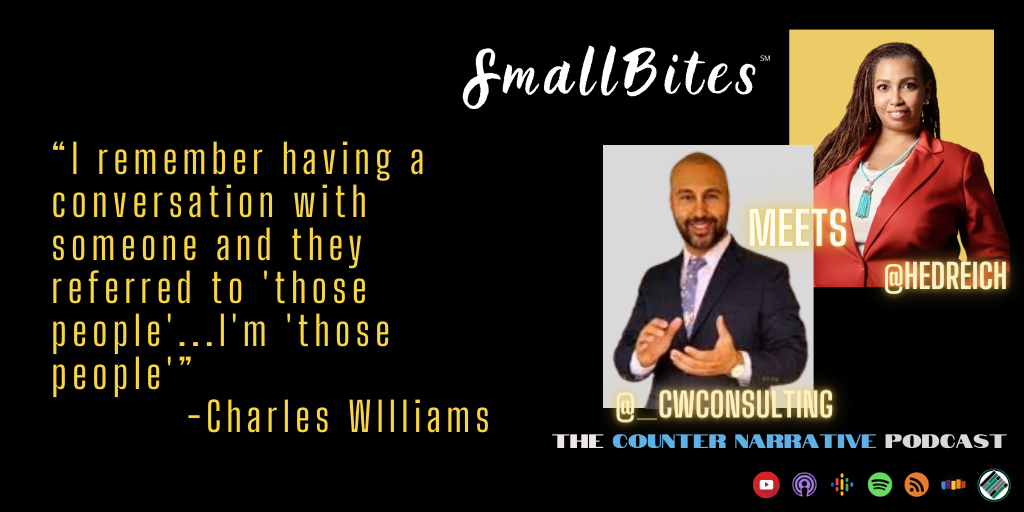
This week, I am excited to announce the launch of the #SmallBites One Question series. This season asks educators about the privilege–and the dark side–of ‘assimilation’. Follow the link to listen to an open, honest conversation on the experiences of a Black Educator teaching in White spaces in my #SmallBites Lagniappe podcast with The Counter Narrative Podcast‘s Charles Williams.

Additionally, am taking off this weekend for the observance of Good Friday and Easter. Please listen to SmallBites Lagniappe: Lead With Love, a message to my Christian friends.

This is Me Read More »

I Like What You Like, You Like What I Like

Watch on YouTube or listen on Anchor, or wherever podcasts are heard.

Small Bites Friday Five 2-26-2

20-30m – Explore this article by David Palank to see how likely it is that halo bias influences your teaching (spoiler alert, a lot). Then choose two strategies to mitigate your own biases, like grading anonymously or ALWAYS using a written rubric. Finally, reflect on a time when the halo effect likely played a part in a decision you made.

15-20m – Start with your youngest learners using this rich well of art and literary projects. Mandisa’s website is designed for toddlers but the projects can be easily scaled up for PK-4.

10-15m – Use this Precious Children article from PBS to help you understand why teaching acceptance is important early on, then prepare at least one of the activities for your class or personal kids and grands. My favorite line, “If your group is not diverse, display images of diversity in your community or in U.S. society.”

5-10m – Review this Nielson Group article that explains halo bias and think about how it affects your teaching.

0-5m –  Write down 5 people you know who you attribute certain traits to. For example, Kevin is tall, he must play basketball; or My co-teacher is really pretty, she must have been popular in high school. Now, write down all the reasons your assumptions might be false.

Did you know that mirroring is a real thing in which people subconsciously mimic the affectations of those they like? And even among invertebrates, there is sexual mimicry in which one sex imitates the other sex to signal interest. If you are a scientist or social scientist, you are probably cringing right now. But for us lay persons, I think the gist is clear. Imitation is more than the sincerest form of flattery, it’s how we align ourselves with those we admire.

If we like someone, we also imitate, or at least buy into, their beliefs and values. And usually, if we believe one thing that they believe, we tend to believe it all. We also tend to minimize or write off any negatives or character flaws. Conversely, if we don’t like someone, we are likely to magnify their faults, disavowing them and whatever they stand for.

We see this play out in politics, but how does this play out in education? Well, in the hundred and one discretionary decisions you make daily, it can affect students in a million and one small and large ways. For example, if you like a student, you might be tempted to round up in grading, if you dislike a student, you may round down, or just not round up. If a student impresses you, you are likely to recommend them for awards, AP courses, write reference letters, etc. If you don’t particularly fancy them, you might write them a college letter, but will it be glowing? The adjectives you choose are more likely to be based on your feelings about the student than on performance or achievement.

We say, know better, do better. But that is more than a notion unless you are committed to being a reflective practitioner in a very real, honest-with-yourself-until-it-hurts way. If you really want to be a change agent and make education better, be willing to start by taking stock of your feelings about each student. Start by reading this article, reflecting on how this bias played out in your classroom today; then make plans to course correct.

That’s how real change begins, with you doing your best for each child in front of you. Make it concrete: Read, reflect, make your own plan to be more intentional in dealing with the students you support now.

I Like What You Like, You Like What I Like Read More »

Dirty Laundry

Watch on YouTube or listen on Anchor, or wherever podcasts are heard.

Small Bites Friday Five 2-19-21

20-30m – Watch Jay Smooth’s Media Literacy crash course that delves into media strategies, our reactions to those tricks and our biases. Watch them all if you have time. If not, watch #2, #4 and #5. These are great for you, but can also be watched with a class. 

15-20m – Read this Parent’s Guide to Media Literacy from the National Association for Media Literacy and Education (NAMLE). It features sample questions for analyzing media like who made it, why was it made and how might different people interpret it. It’s also in Spanish and even Greek, if you need it.

10-15m – Reflect on the information in the above document and jot down any personal tweaks you need to make in your own media consumption. Then consider send your favorite section or even a class sketchnote of your favorite section home to parents.

5-10m – Review this Time For Kids resource for use with younger students, or this Media Smarts Break the Fake resource that includes 4 easy ways to fact check and share with friends and family.

0-5m –  Learn the words dorsolateral prefrontal cortex and watch this Above the Noise video on the brain and fake news to learn how to circumvent the way our brains react to news. Probably best with 6-12th graders he says BS (the letters, not the words) in the video. Ooohhhh…

Something dark in human nature makes us like to watch others suffer. The lions and the Christians in the Coliseum; shoot ’em ups; shocking and bad news; social media rants. America’s Funniest Home Videos and even the rash of prank Tiktoks indulge our darker side, give us the opportunity to assure ourselves that we are not as bad off as those we ridicule.

Media takes advantage of that. A message is always crafted by one person with an agenda. From the early days of yellow journalism to today’s polarized news outlets, someone crafts messages to manipulate the masses. We don’t think of our democracy as being ruled by the messages of propaganda, but considering how polarized we are and how news is as much opinion, analysis and editorial content as anything else, we should think again. So much content is needed to fill up the current 24 hour thirst for dirty laundry that we have gotten used to opinion pieces being front page news and incendiary headlines being fact.

The only thing I would like you to do this week is to watch 5 minutes of news daily from an outlet you don’t usually watch. Refrain from making negative comments or judgments. Research what you hear, if you like. But work on tweaking your own media consumption habits so that when you teach civics and citizenship–which should happen daily– you will be able to teach your students to think critically, not to think like you.

Dirty Laundry Read More »