Hedreich Nichols

Racism

Patriot Games

Watch on YouTube or listen on Anchor, or wherever podcasts are heard.

While going through some memorabilia, I ran into my US constitution poster. I usually keep the pocket version handy. But this one is the inexpensive replica one with the big calligraphed We the people. That first sentence is the one that I’d like to highlight:

We the People of the United States, in Order to form a more perfect Union…

E Pluribus Unum

Union. Unity. Unite. United. All of these words come from the Latin ‘unus’-one. You know it in another form from our Great Seal and our money. E Pluribus Unum-out of the many, one. That was the motto selected in 1776 by John Adams, Ben Franklin and Thomas Jefferson. Our founding fathers declared that unity was to be woven into the fabric of our nation. But somehow, along the way, we’ve fought to keep national reverence of our founding fathers in tact while wholly disregarding their original intent-unity.

How can a house divided stand? On both sides, people are fighting to ‘establish justice’. But what does justice look like? Depending on who you ask, the answer will, of course, be different. So how do we reach common ground? How do we build bridges instead of walls? Here are three thoughts to guide the process of establishing more unity in our communities.

1. We all can’t have our way.

If we realize that our way is just that, our way, we can work on letting others have their way. Everyone around us does not have to believe what we believe, think what we think or even behave the way we do. We keep ourselves and others safest when we stay in our own lane, both on the road and in life. There are enough like-minded souls to commune with without attacking those who are looking to build their own communities.

2. The other guy may be at least partially right.

While we may be convinced that our way is absolutely right, it may not be right for everyone. We can compromise on immigration, abortion, climate action and even what we do about issues of identity and equity. The truth is, there is no absolute solution to any of those problems. For example, murder is a punishable offence, most everyone would agree. However, soldiers kill common enemies, homeowners kill robbers, executioners kill those convicted of crimes and these are all considered justifiable. Absolutes rarely exist without exceptions and we can find common ground when we find and accept those exceptions. Some exceptions may line up with our beliefs, some we may not like so much. Still, compromise is necessary. That works best when we, in humility, acknowledge that we may not be 100% right even 50% of the time.

3. Patriotism involves commitment to democracy.

Democracy and patriotism go hand in hand. Consider that in 2016, many were unwilling to accept the presidential election results because Hillary Clinton won the popular vote. Since our country’s presidential elections are decided by our electoral college, the popular vote has no bearing. Donald Trump became everyone’s president in 2016, without dispute. Then, in 2020 more than 50 lawsuits trying to prove voter fraud in the last presidential election were dismissed by the courts and Joe Biden became everyone’s president. In a democracy we vote. That means that someone always has to take the loss. That’s how democracy works. Either we accept the rules of democracy or we become something completely incongruent with the ideals set forth in our founding documents.

Ask Yourself…

What can you let go of? What hotly debated topic are you willing to see from someone else’s vantage point? If you personally concede your opinion to someone else, might there be a gain for the greater good? What if we refuse to feel threatened or become irate when our neighbor thinks or opines differently unless it directly affects us?

My guess is, if you reflect over those questions and let go of even one issue that you irately post about online, we could begin to lay a foundation for bridges instead of walls. My ask this week is that you think about what unity and patriotism really mean. If John, Ben and Tom could envision it in a document we still hold dear, let’s consider working toward that more perfect union by using the three thoughts above as a measuring stick for our conversations, posts and actions. Do it as if your children are watching, because they are.
Patriot Games Read More »

Say My Name

Small Bites Friday Five 12-11-20:

20-30m – Visit the website Peoples of the Historical Slave Trade to get a deeper feel for the faces and places of the slave trade.

15-20m – Read this HuffPost article on the “depressing truth about names and racial bias” then head down the rabbit hole with the hyperlinks.

10-15m – Read the story of enslaved rape victim Celia who was hanged for killing her master and rapist because according to the courts “a slave woman had no virtue that the law would protect against a master’s lust” .

5-10m – Keep challenging your thinking and biases. Here are a few more examples of biases from Practical Psychology to guard against.

0-5m – Use this form to let me know what issues of racism and bias you are struggling with as you work to become a more inclusive educator and let’s start a dialogue. I will be opening up a cohort in January so that we can talk more in depth about HOW to make small changes with big impact.

Sometimes, the smallest, most insignificant thing can be filled with such great humanity. Mr. C., this is for you:

As with many employee groups, my grade level team has a group chat. We trade important information throughout the day, send each other reminders and engage in witticism that only an educator would find funny. Two weeks ago, one text came through, unremarkable, yet significant. A teacher, White, male, needed to communicate about a student. He wrote her first name only, also not remarkable. What was remarkable, for me anyway, was that her name was spelled perfectly. I will call her Sha’ Niqua. As I write this, my computer underlines it in red, denoting an error. But there is no error. The apostrophe, spacing and capitalization all meant something to parents who were excited about the birth of their child. They mean something to the creative, smart 7th grader whose name I see displayed on my screen each class because her camera doesn’t work.

This teacher didn’t write “Shaniqua” or “ShaNiqua”. He didn’t write “S.P.”, convincing himself that it was better for FERPA, but really writing it because he couldn’t be bothered to remember where all the spaces and apostrophes go.

Her name is Sha’Niqua and this teacher, in the midst of all the 2020 craziness, took time to write it correctly. He doesn’t know that it moved me to tears. He just did his job. But I have been in rooms in which teachers roll their eyes or say some not-even-close moniker because they forget that addressing a student correctly by name is basic to connection, which influences learning outcomes.

I have been in rooms in which the refusal to learn a name sprang from glaring biases that associate “Black sounding” names with low socio-economic status and other negative stereotypes. Did you know that students with Black sounding names are more likely to be labeled troublemakers? Did you know that Black jobseekers and Asians who “whiten” their resumes get more interviews? Names play a big part in who we are and who we become. It’s time to examine some of the unconscious biases we carry when encountering names that are unfamiliar, “non-traditional” or “foreign-sounding”. This article on name bias might be a good starting point.

Bias often plays a part in our reluctance to embrace the unfamiliar. But sometimes, we may be unsure of how to be less than the all-knowing authority. If that’s the case, here are some words you can use, especially when encountering a name unfamiliar to you for the first (or second or third) time:

  • “I have never come across that name. Can you help me pronounce it please?”
  • “I am not very good with languages, you may need to help me say your name correctly more than once.
  • “Hey class, if I mispronounce your name, make sure you correct me. Your name is an important part of who you are and I want to get it right.”

A name is an important part of someone’s identity and children deserve to feel seen and valued. Mr. C. will probably read this, and I hope he knows how a little thing he doesn’t know he did made a big difference. And I hope you’ll make that same difference in your classrooms, on your school boards, when hiring babysitters or employees for your side businesses or when running into someone new in your community.

True, a rose by any other name may be just as sweet, but roll over and call your partner by any other name, see how far it’ll get ya.

Say My Name Read More »

Keep On Keeping On

Small Bites Friday Five 06-19-20:

20-30m – Google anti-racism or something simple like “how to be a more culturally responsive teacher”. Nothing beats finding your own rabbit hole to fall into.

15-20m – Google “HBCU”, pick one and then read about its rich history and even consider giving your support. Here’s one option.

10-15m – Read or watch a social justice story from your favorite news outlet then read or watch a story covering the same topic from your least trusted news source. Reflect on perspective vs. fact.

5-10m – Have a conversation with at least one child or teen about race in America. Don’t proselytize, just listen. Consider it a fact-finding mission.

0-5m – Read “Teaching as Activism, Teaching as Care” from tolerance.org.

Every January I start a new health and fitness routine. Like clockwork. And every March I start the slow slide into the next January when I have to start all over again. The excitement of a new chance to do something big is always a huge draw at the year’s beginning. So is the likelihood that it won’t stick. According to a University of Scranton study, only 19% of those resolutions are kept long term.

The current social awakening to systemic disenfranchisement of marginalized populations bears every hallmark of a January 1st new beginning. Outrage and the opportunity for sweeping change is fueling a movement around the world. But I wonder, what will change look like 2 months or even 2 years from now?

The truth is, as much as we want to say we’ll keep pushing for change, life happens. You will have to learn new tech to teach in a blended environment, figure out how to work out without your 5AM spin class, give your personal kids more learning support or find new childcare for a totally new routine.

It will get cold and you won’t want to stand outside at a rally. Christmas will come and you may face balancing taking the kids to see grandma with Covid 2nd wave health and safety concerns.

Life will happen and, unless racism is causing you personal pain or at least personal difficulty, you will re-prioritize. You won’t want to, you may not even mean to but you will—unless you have a plan.

Decide now what your priorities are. Are you a letter writer? Grant writer? Check writer? Are you a relationship builder, library collection builder, a content connection builder? Do you see yourself making a difference with one? With a few? With many? In your family? In your classroom? In politics and policy?

Where and how can you keep pushing change forward when life hits? Whatever you can see yourself doing, make a plan now to do it when it’s cold, uncomfortable, busy and 100th on a list of 150 things you need to have done yesterday. Put your supports in place and make a plan to do it even when your best laid plan has gone wrong or made you the object of constant “oh-here-she-comes” eye-rolls.

Make a plan because when the protests stop, the real work will just be starting. Small Bites can be your go to. But even if it’s not, find one thing you can do even in the busiest of times because we can’t afford to lose one voice. We can’t afford to lose your voice.

You can get tired, you can get it wrong but you can’t give up.

Keep On Keeping On Read More »

What Cha’ Gonna Do…

Last night, as I scrolled and double-tapped my way through post after post of black squares for #BlackoutTuesday, after my friends across the globe assured me that they stand with the us in English, German, French, Spanish, Italian and halting mixes of the above, I felt hope. I felt the hope of 2008. I felt the hope of MLK and Johnson. I felt the hope of our collective ancestors crossing the Mason-Dixon line. Even as I read of fires, and of the reprehensible hate-stoking by our nations fearmongers, I felt hope.

The overwhelming support of my less melanated sisters and brothers enveloped me in a warmth and kindled the hope that this time, we just might take a step forward in our fight against prejudice, racism and the inequities that have been plaguing our country since European settlers arrived here and created an Indian problem.

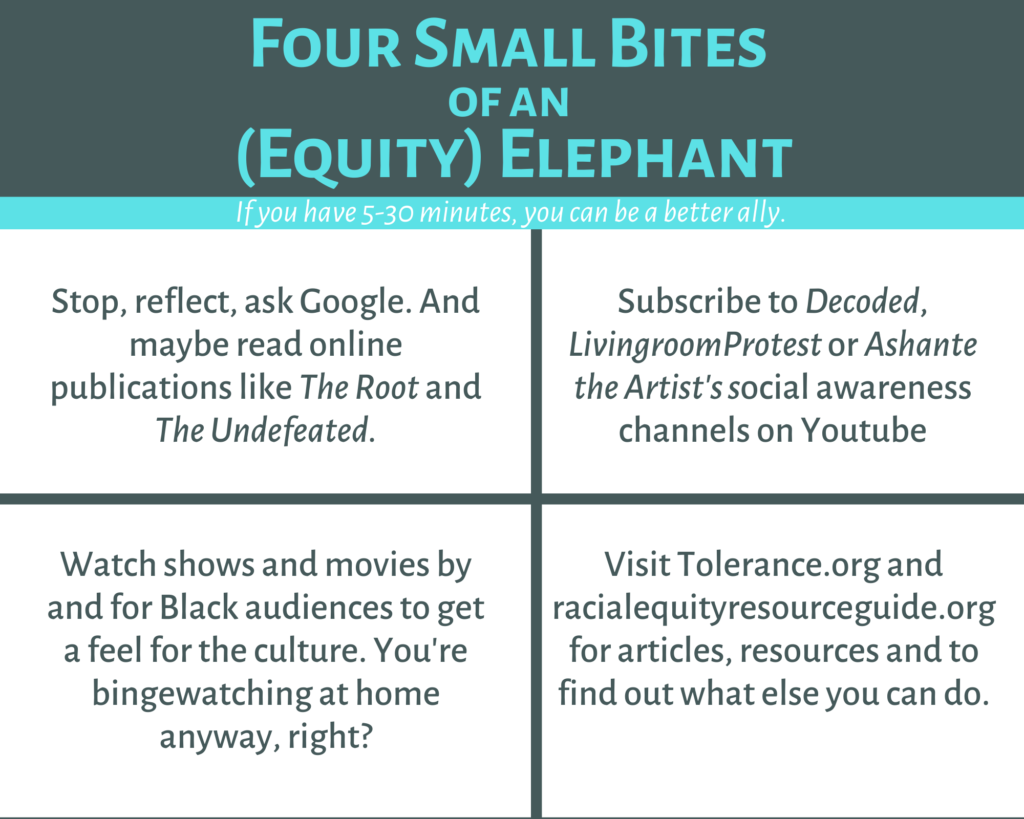
I’ve talked to friends and I’m not the only one who felt that hope. It felt significant. Hope can kindle change bigger than any riot fire IF the outrage of every individual is translated into action. Yes, fighting for social justice is a big ticket challenge. But like eating an elephant, if you do it one small bite at a time, it’ll get done, just start. Here are 5 things you can do today to advance the cause of equity and social justice.

If You Have at least 5 minutes:

If You Have at least 15 minutes:

If You Have At Least 30 minutes:

  • Watch an episode of Blackish. It’s light fare, but the lessons and issues tackled are not.

Conquering, enslaving and oppressing other humans is not a new concept, it is, unfortunately, the concept that has fueled competing powers since the beginning of time. Keeping that in mind, fighting for social justice is not a sprint, it’s a marathon. If you are just joining this fight, don’t get so overwhelmed now that you lose steam. Take small bites. That doesn’t mean don’t act with urgency, we need revolutionary change now. I’m just reminding you to take action at a sustainable pace. Set a measurable, attainable goal for today, for this week, for this year.

You have no idea how moved I have been at the great outpouring of solidarity. Now the question is, how will you translate that into action. What cha’ gonna do?

What Cha’ Gonna Do… Read More »