Hedreich Nichols

education

The View From Outside the Building

For most of my career, my understanding of education came from inside the building.

The classroom. The hallway. The staff meeting that should have been an email. The sixth grader crying in the corner. The teacher quietly buying snacks because somebody came to school hungry again. If you know, you know.

Then, unexpectedly, I stepped outside the building.

In the years since leaving the classroom, I’ve had the privilege of working in educational communications, school culture, AI policy conversations, and most recently with the Center for Outcomes Based Contracting, where districts and providers partner around one deceptively simple idea: if we are spending money to help students, we should know whether students are actually benefiting.

And whew. The view from outside the building is different.

What I have seen has made me both more hopeful and more compassionate.

Schools are carrying a lot right now.

Teachers are navigating classrooms full of students whose lives, identities, worries, and needs often look very different from our own. Leaders are balancing shrinking patience, stretched budgets, and communities that sometimes feel divided by politics, conflict, fear, and uncertainty. Somewhere in the middle of all of this, schools are also trying to make sense of artificial intelligence, student data privacy, third-party sharing agreements, screen monitoring tools, and what good teaching even looks like in a world where information is no longer scarce.

Honestly? It is a lot.

But here is the thing stepping outside the building taught me: most educators are trying really hard to do right by kids.

In district conversations around AI, I watched leaders wrestle with important questions. How do we protect students without over-policing them? How do we guard against misuse without turning schools into surveillance spaces? How do we move beyond “gotcha” tools and instead help students think critically, ask better questions, and demonstrate learning in richer ways?

Interestingly enough, none of this feels entirely new.

People once worried that airplanes were impossible, calculators would ruin math, Google would destroy thinking, and Wikipedia would singlehandedly collapse civilization as we know it. Yet here we are.

Maybe the question is not whether change is coming. It always does.

Maybe the better question is: How do we stay human while we navigate it together?

For me, that question is part of why I shifted from music into educational technology years ago. I saw both the struggle and the possibility.

And after stepping outside the building for a while, I find myself more convinced than ever that the heart of this work has never really changed.

Kids still need good humans.

Educators still matter.

And schools are still one of the most hopeful places we have.

The View From Outside the Building Read More »

I’m A Teacher, You’re A Teacher…

Over the past few weeks, I have awakened daily to the news of new humans in the classroom. Now, if you’ve taught a while, you’ll remember when “new humans in the classroom” meant meeting a fresh-faced new group in August or September of each year. Now, it means new humans teaching in the classrooms. Well, teaching is relative. As long as the children are attended, we’re good. Hey Rick Grimes, got a few minutes??

Education: In The Beginning

You see, when free public education was conceived centuries ago, it was designed to cement a unified version of American pride and way of life after the Revolutionary War. Later, after the industrial revolution and, more importantly, after women entered the workforce in large numbers, it evolved as a cost effective way to provide social services and keep our GDP growing. 

Under the flag of education we have designed a system that cares for, feeds, assesses and entertains students for most of the waking day while parents work. Working parents means more money flows into and through the economy. Or at least, that’s how it was before COVID. After shut downs crippled and even killed off businesses, the right people must have cried foul: Schools MUST be kept open at any cost. Of course, “virtual learning doesn’t work” was the tagline. ‘Learning loss’, especially ‘in our most vulnerable populations’ was a big problem. Quality learning face to face with teachers, that’s what we needed to do for our kids.

GDP Maintenance vs. Learning Loss Mitigation

Fast forward, more COVID, so much so that schools are suddenly closing on an emergency rolling basis. And in order to prohibit that? Creative thinkers everywhere are getting warm bodies into classrooms to keep schools open. The learning loss needs of fall have given way to the economic needs of winter and the other Big Lie is now lain bare. Learning loss is not and never was the real concern. 

The US does not have the number 1 GDP in the world for no reason. We have been ruthless in prioritizing profit, this is no different. Schools are necessary to the economy. Now you, as a teacher, are most likely in this job for the kids. And if you really want the best for them, here are three things you need to do THIS WEEK to prioritize academic needs:

  1. PRIORITIZE VALUING THEIR TEACHER. Decide that if anyone can stand in your class to teach and get bonuses and special permissions, you deserve bonuses and special permissions too. Get together with other teachers and decide what kinds of monetary and non-monetary bonuses would best support the valuable work you do. 
  2. Stop giving your employer money. If you’re working 10+ hours more than your contract calls for, you’re investing in a system that does not value prioritizing you or education. Make needed changes, start here with the 40h teacher work week. The information on Jennifer Gonzales’ podcast is a good beginning.
  3. Write your school board members and show up to meetings. Use your voice, do your research and vote in local elections. Better yet, run for office. If that’s not something you want to do, campaign for a teacher who will.

Mostly, we have work to do. Our students need more resources than we can give and it’s time that education gets a bigger slice of the economic pie. Valuing the job you do is a big part of that.  Not only are you an educator, you are an essential part of the largest GDP in the world. Start valuing yourself, and ensure that others do too.

Note: This OpEd is designed as a thought provoking, rather than research based, informative article

I’m A Teacher, You’re A Teacher… Read More »

Free at Last (The MLK Edition)

It was not so very long ago that Senator Jesse Helms of North Carolina led the charge against this Martin Luther King Jr. holiday that we now celebrate. Today, that congressional fight has largely faded from memory as we celebrate the powerful words Dr. King spoke. In Selma. In Detroit. In Washington. From the many great speeches: I have a dream…; Now is time to make real the promise of democracy… so many great words flood our social media threads on this day. We remember the greatness but forget what he fought for. Dr. King’s marches began because of segregation and voting rights. This past year, the rights he fought for have been under attack like no time since he began the fight.

From Brennancenter.org:

In 2021, the state legislative push to restrict access to voting was not only aggressive — it was also successful.  Between January 1 and December 7, at least 19 states passed 34 laws restricting access to voting. More than 440 bills with provisions that restrict voting access have been introduced in 49 states in the 2021 legislative sessions. These numbers are extraordinary: state legislatures enacted far more restrictive voting laws in 2021 than in any year since the Brennan Center began tracking voting legislation in 2011. More than a third of all restrictive voting laws enacted since then were passed this year. And in a new trend this year, legislators introduced bills to allow partisan actors to interfere with election processes or even reject election results entirely.

Unfortunately, the momentum around this legislation continues. So far, at least 13 bills restricting access to voting have been pre-filed for the 2022 legislative session in four states. In addition, at least 152 restrictive voting bills in 18 states will carry over from 2021.

Liberty and Justice for All?

Who are we? Are we really who our founding documents say we are, or are we only patriots when it serves us? Gerrymandering, redrawing districts and attempted coups make me afraid of what that answer might be.

How will you honor the memory of a man who believed in the America we could be? My ask this week is that you spend some time reading the article on voter suppression from the Brennan Center, and that you contact your congressional representatives. After that, ask at least 3 friends to do the same. If you’d like additional information on voting rights and redistricting (wtheck do we do that for anyway??), head to Ballotpedia and use the dropdown menu on the left.

You Can Make a Difference

Although we teach all to often only about the great speeches in schools, Dr. King’s legacy is far greater than the words he spoke. MLK was not just a Nobel prize winner, not just a man of great words. He was a man of action, arrested 29 times and finally assassinated, shot in the face at the age of 39 for leading the nation into the constitutional promiseland of liberty and justice for all. He was a true patriot who gave his life for his country. If you want to honor his legacy, skip the quote post and instead, post a copy of your protest letter. That would be a celebration worthy of a King.

Free at Last (The MLK Edition) Read More »

Invisible for Christmas

This episode is dedicated to Sidney Poitier, the first actor I remember seeing who looked like me, may he rest in peace.

I don’t remember when it happened, but somewhere along my journey, I lost my taste for ‘classic’ movies. As much as I loved curling up together with my grandmom to watch old Hollywood movies, and as much as those memories warm me, the movies themselves no longer hold the same enchantment. Without using Google, the only big stars I remember who looked like me in mainstream movies were Butterfly McQueen, Lena Horne and Sidney Poitier. As a matter of fact, the cartoons and sitcoms were similarly populated, until Norman Lear came along, with mostly Americans of European descent. Since that was my norm, I never really knew what I was missing.

She missed–without knowing what she missed…

The old adage “you can’t miss what you never had” could not be further from the truth. Just as childhood trauma leaves scars to be reckoned with in later life, the lack of representation in my childhood smacks me in the face quite often. Scooby-Doo? Where were the diverse actors. After school cartoons? Same question. And hollywood ‘classics’? Well, geez, we couldn’t even get a Black Cleopatra.

Amazon Prime for the Win!

This year, that smack in the face came as I settled in to watch some of my childhood favorites for Christmas. My invisibility weighed heavily on me, cast a pall over my downtime–until Amazon Prime Video breathed new life into the phrase “Christmas Classics”. I found myself in romcom heaven with Black protagonists doing all the kitchy stuff people do in romantic comedies. And they were doing it in falling snow and red and green Christmas lighted backdrops. My little girl’s heart found what it had missed!!

Representation Matters

Everytime a child sees themselves reflected in the classroom around them, they stand up a little taller, knowing that their place in the world is secure. And everytime children see the world as a place rich in diversity, they develop a little more empathy, understanding and respect for differences. That’s a win for us all.

The next time someone tells you that culturally responsive teaching is a bad or dangerous thing, share this blog with them. Responding positively and with inclusivity to the diverse populations that make up our nation isn’t indoctrination, it’s just good teaching.

Invisible for Christmas Read More »

Shape of You

OneWord ’22 graphic. SmallBites returns Monday, January 10th wherever fine podcasts are heard.

Standing at the precipice of the new year has long ceased to feel like some magical new beginning. That’s a good thing. I have not bungled this year. I’m not waiting on the turn of a page so that I can resolutely start anew. What I am doing is taking the wins of the last couple of years and shaping them into a harmonious melding of many hats. If you are a teacher and a parent, you understand being a wearer of many hats.

The thing about wearing many hats is that it can be difficult to identify which hat is The One. Usually that’s because there is no ONE. Could you choose between ‘child’, ‘spouse’, ‘parent’, ‘educator’ or ‘friend’? Each of those hats are vitally important, but they aren’t always on your head all at once. Still, sometimes you stack them, sometimes they sit askew. Sometimes you just want to throw them all down and go hatless.

This evening, as I write the last blog of 2021, I am hatless. It’s one of those rare moments where I can just be. And in this moment, I savor the time to reflect in quiet about my many hats.

Shape Shifter

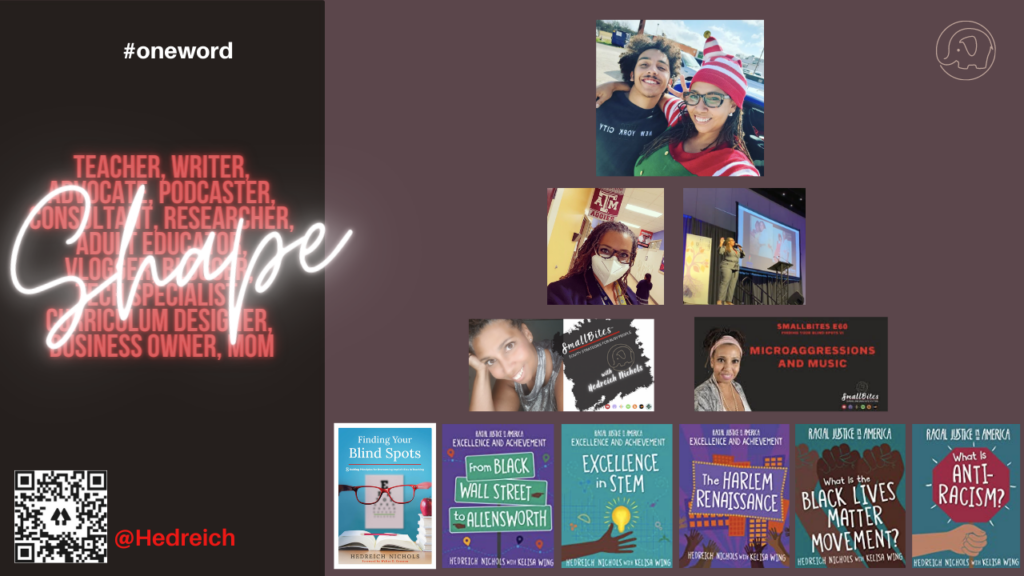
A template designed by Educator and Youtuber Claudio Zavala led me to define the hats I wear. As I named them, I finalized my one word, ‘shape’. As my role in education and parenting is shifting, I am in the process of reordering my hats. The last two years have been fruitful, yielding 6 books, 65 SmallBites YouTube episodes, 65 hedreich.com blog episodes and 65 SmallBites podcast episodes. Those don’t include courses, guest blogs and articles.

So how do I bring all those hats under one umbrella? Well, that’s my focus this year. A little prioritizing, a little fine tuning the schedule and a little more work-life balance. And this is all worthy of a blog post, why? Because, as usual, I have an ask. In the next few days, I would like each of you multi hat wearers to spend a little time being intentional about which hats need to be worn when, for how long and in what order. By allowing a picture of your priorities to emerge, you’ll be better able to focus on the now and shape your path forward. This is especially true if you are, like many, considering a shift away from the classroom or away from education altogether.

Happy New Year

As you define and re-order your hats, define also what brings you joy, what ameliorates stress and what is good for you. Make choosing yourself a firm priority. All the people around you will be happier if you are balanced and content. How will you do this with the coming year, including COVID and testing season? Only you can say. But I know that if you don’t take a minute to establish your priorities, the year’s stressors will do it for you and you will likely not be pleased with the outcome.

FInally, I’d like to thank you for reading and listening. I hope that by shaping your coming year and beyond, that you’ll continue to have energy to learn, to grow and to make safer, more equitable classrooms and campuses for all students.

Your loyalty is appreciated. See you next year!

Shape of You Read More »

…Do I Fit In?

Watch on YouTube or listen on Anchor, or wherever podcasts are heard.

Small Bites Friday Five 10-8-21:

20-30m – Visit the University of California San Francisco’s Youtube page for a phenomenal selection of videos on belonging, diversity and inclusivity. Start with the “Faces of…” series, featuring diverse student stories in their own words.

15-20m – Listen to this Journey to Belonging podcast with Ilene Winokur entitled “Belonging Before Blooms”. As a matter of fact, bookmark the podcast. She explores the theme of belonging and it’s importance with a variety of inspiring educators from across the globe.

10-15m – Visit the University of California San Francisco’s LGBTQ+ YouTube resource center. The 7 minute introduction video is especially helpful for explaining diverse terms and definitions.

5-10m – Read this “Toolkit for ‘You Belong Here’ article from Learning for Justice” (formerly Teaching Tolerance) on the impact of the student-teacher diversity gap in our nation. Helping diverse students feel a sense of belonging means ensuring that diverse teachers feel a sense of belonging too.

0-5m – The stigma around mental health issues impact how we “other”, so once again, visit the UCSF’s Youtube page to listen to Kristin’s story, a story about anxiety and depression. Reflect on how to better include students struggling with mental health issues, both the readily visible and the invisible ones.

“My Kids”

If you listen to teachers talk about their students, they often refer to “my kids”. I too have often said “my personal kid” to ensure that people know which “my kids” I was talking about. I don’t have any research, but I am willing to bet that not caring if kids fit in or don’t fit in is not common in this profession. Still, when kids are asked whether or not they fit in or not, the answers are all too often less than positive. How can we turn that around?

In Finding Your Blind Spots, the first chapter talks all about how we “other”. “Othering” is what we do when we categorize people as different, as the “them” to our “us”. Othering is not Black or White. It’s not male, female or non-binary. It’s what we do when we come across someone who looks, behaves, thinks or even ‘feels’ different. We other the mom that dresses “too sexy”. We other the guy who doesn’t like sports. We other the person who doesn’t get our jokes. And even though we don’t mean to, we other students in our class who are unlike us (or maybe too much like us) every day.

Be Intentional

I can use all the Big Bad Diversity Words and talk about DEI, the ‘isms”, CRT, race politics, or even a “gay agenda”. Those words usually send people off to rantville in all sorts of political directions. But this space is for educators. And teachers, well, we believe that our kids should feel like they belong, full stop. So when some inflammatory headline threatens to pull you in one direction or another, I am asking you to remember that they are all “your kids”.

Creating classroom and campus spaces that welcome every student every day should be the goal. But like with any goal, reaching it takes intentionality. Besides using the resources above, do the following:

  • Consider taking a few of the Harvard Implicit Bias gamified tests to find your own blind spots.
  • Use the above information to make an action plan based on your personal hidden biases (i.e., refer fewer BIPOC students to the office; learn more about the LGBTQ+ community; make more opportunities for non-male students in STEM courses and clubs, etc.)
  • Look at your roster and pick 2 students with whom your relationship could be better. Have a transparent conversation with them, letting them know that you feel you could get to know each other better. Then, make time to get to know them better. Let them get to know you better as well.
Lead the Way

I am well aware that sometimes, it’s not teachers but students who often make other students feel “othered”. Explicit teaching on kindness and humanity are as necessary as lessons in reading and math. Our kids are watching us. They hear what we say and feel what we don’t say. Your disdain for “the bad kid” becomes theirs. Your barely perceptible annoyance comes across loud and clear to a kid already struggling to fit in. Make it a point to check in with yourself. Admit to yourself how you feel about your kids. Then be intentional about changing anything that might cause a child to feel othered.

When you are intentional about creating a sense of belonging for all your kids, when you teach your kids to do the same for each other, you’ll have a foundational culture shift that changes trajectories for your students. Let’s be intentional about creating a sense of belonging for all our kids.

As Ilene says, belonging before blooms.

…Do I Fit In? Read More »

This is Me

This week, I am excited to announce the launch of the #SmallBites One Question series. This season asks educators about the privilege–and the dark side–of ‘assimilation’. Follow the link to listen to an open, honest conversation on the experiences of a Black Educator teaching in White spaces in my #SmallBites Lagniappe podcast with The Counter Narrative Podcast‘s Charles Williams.

Additionally, am taking off this weekend for the observance of Good Friday and Easter. Please listen to SmallBites Lagniappe: Lead With Love, a message to my Christian friends.

This is Me Read More »

Who Are You

Small Bites Friday Five 12-04-20:

20-30m – Watch the election episode of ABC’s Blackish, it’s chock full of context for this year’s election. Did you know that Black people were not officially given the right to vote until 1965?

15-20m – Spend some time reflecting on what has changed since the death of George Floyd and Brionna Taylor, and what still needs to change. Think about who in your community has the power to make that change and join me for #TeacherTurnout Tuesday. Use your Twitter, IG, fb, email or phone to let them know what you, your students and your district need, especially now.

10-15m – Move. Like…stop the video and move. Check out this TikTok video from Dr. Burt (and the one on Small Bites) for inspiration!

5-10m – Look at the graphic in this article on confirmation bias and other types of bias. See if you can find yourself. Reflect on how you form your opinions on the world around you and whether or not you need to make some changes.

0-5m – Use this form to let me know what you are struggling with as you work to become a more inclusive educator and let’s start a dialogue. I will be opening up a cohort in 2021 so that we can talk more in depth about HOW to make small changes with big impact.

Much of what I talk and write about is deeply intertwined with identity. Our thoughts and preferences are often a part of our armor, the thought walls we put up between us and them. Think you’re ‘woke’? Mebbe…but even if you are, your us, them and everything in between is held together by some kind of bias. Bias for things that validate us, bias against things that make us feel insecure or threatened.

When we begin to reflect on how we can create more equitable classrooms and campuses, we often begin with divorcing ourselves from some train of thought and espousing another.

What is your process? How do you know what to leave in and what to leave out? My humble advice is to have you begin by examining your own preferences, and as author Barbara Bray says, define your why. Why do you want to help these students? Do they remind you of your younger self, untarnished by life’s rough spots? Do they remind you of the bits about yourself that you still struggle with? Does helping to level the playing field in education make you feel noble or help you atone for some middle school gym class evils?

Are you doing right because it’s right to do? The answer probably is, partially. Even when we have the purest motives, there is always something self-serving in our ways (Terry Heick has about 180 ways our thinking can go wrong in his article on bias). That’s no indictment, it’s just humanity. But realizing that as fact can help us to make sure that there is nothing odoriferous in our well intended deeds.

Is there a likert scale to help you figure this out? A weighted scale? A chart with four color coded quadrants? Nope. There is only you, a pen, some paper, maybe some sun and fresh air, or perhaps a cuppa in your favorite spot.

As you make changes, look not only outward for new stories to provide context for your students, but look inside yourself as well. The best answers are always there. Find your blind spots, your biases, maybe even turn on a new light or heal a few old wounds with Traci Nicole Smith.

I am excited for you and your willingness to learn how to be a more culturally responsive teacher, but I am even more excited about the opportunity this gives you to be an even better human being.

Who are you? What are your biases? It's one of the things we will explore as we talk about how to implement change in our classrooms and on our campuses. Join us for the #SmallBites cohort next year. Fill out this form  and let's start a conversation!

Who Are You Read More »

Turkey in the Straw

Small Bites Friday Five 11-20-20:

20-30m –Spend some time exploring the NPS indigenous stories and reflecting over the old cowboy and “Indian” movies. Do it with your families, with your students.

15-20m – Put yourself in timeout, the world will not stop turning. Use that time to do whatever recharges you.

10-15m – Look at your lesson plans and reflect on how your students can show mastery in fewer steps. Don’t teach less, don’t question less, but reduce testing stress. In populations that are struggling educationally and because of COVID more than others, a little ‘air’ is helpful.

5-10m Look up the most recent CDC and WHO guidelines and share them with your students and families. Do everything you can to mitigate COVID spread over the holidays.

0-5m – Breathe. Just breathe. Here’s a meditation from Flocabulary that I do with my students.

This year I had really all but decided that I was NOT buying a turkey. I barely like turkey. And for my small family, that’s a WHOOOOOOLE lotta leftovers that I don’t like. But the pull was so strong that I not only bought one, I created a whole Small Bites about it.

Thing is, I grew up in a house where none of us really liked turkey. I remember this same conversation with my grandmom who made THE best fried chicken. It would have been a much better choice, but, we always went with turkey. Here I am, generations later, a whole grown up, and I have a turkey alarm set on my phone so I don’t forget to defrost starting Sunday.

That’s the pull of traditions. I can say that the confederate flag is a symbol of hate because it is flown by Americans who who fought for human trafficking, kept citizens from voting and education and is today carried by people who lynch (domestic terrorists). However, in my life as a Texan, I have met some mostly benevolent people who did not see that flag as egregious, it was simply a symbol of Southern pride. It was the flag that had been in grandpa’s truck, the same grandpa that taught them to fish and hunt. It was the flag touted in history books as a symbol of heroism, a flag revered without consideration of the definition of treason.

If I am honest, I was 16 before I realized that my Southern pride and patriotic education left little room for honest discourse about what we were really proud of.

This Thanksgiving, let’s look honestly at what we have been taught to internalize as fact and ask ourselves, ‘who else was there’, ‘what might have been their experiences?’

Do we consider that the Sioux and Cheyenne were protecting their land and that it was the settlers who were the interlopers since the land was already settled?

Do we consider that although Thomas Jefferson had a longstanding dalliance of some kind, that Sally Hemings was his property, a girl of 14 who he impregnated, whether or not it was her choice?

Do we consider that there are traditions that may or may not be steeped in false narratives or shaded versions of truths that, like a mountain range, may have many views and vantage points?

Do we consider that many songs like Turkey in the Straw or the Eyes of Texas may be traditional songs better left to their racist pasts?

I know that traditions connect us to our past and our world at large, like me buying that turkey I don’t really want to eat. But I also know that setting aside traditions that have out-served their usefulness makes room for growth. As we prepare for our holiday traditions this year, let’s reflect on them and broaden our viewpoint to include the stories of others who share our journey, but not our path.

Turkey in the Straw Read More »

We Are One (The Pre-election Edition)

Small Bites Friday Five 10-30-20:

K-3 – Here are fully fleshed out election day lesson plans from Colorful Pages.

K-12 – No time to devote to a full-blown plan? Use this sample ballot, also from Colorful Pages, to host your own election. Vote for candidates or something fun like vanilla or chocolate ice cream. Talk about why there are only two choices. (No time to copy? Put it on the screen and let kids make their own.)

3-8 – Ask your students if they know that women could not always vote. Watch this 3-minute video that helps explain why. 

K-12 – When you think about your classes, which of your students isn’t connected to the group? Make a point to connect with them one on one. Exchange some personal fun fact and really listen when you ask how they are.

Educators – Make it a point to have a bedtime, preferably no later than 10:30, no exceptions.

Earlier this week, I did a session for Rethinking Learning with Barbara Bray. We talked about strategies on how to have empathy with ‘others’. Others are people who think or look different than us and our friends. Once we stopped recording, talk turned more specifically to the upcoming election and how every ‘we’ in the country is sure that every ‘they’ in the country is destroying the American way of life.

The problem with that way of thinking is, we and they are us. This isn’t our team against the other team. This is one team, one nation indivisible.

What happens Wednesday? How do we heal the bitter divide and seek to understand that, in this case, there really are very fine people on both sides?

Tuesday night, one side will cheer, one side will hang their heads. But on Wednesday, after the best man wins, even if we don’t all agree that he is the best man, we have to shake hands and move forward. I personally will have a difficult time losing. I will be like the woman I mentioned in this week’s episode of #SmallBites. I may cry, and even if I don’t I will wonder what will become of our country. Because, while there are, at least in this case, some fine people on both sides, some is a long way off from all or even many.

If my side loses, I will wonder what will become of my country because those who are not fine people terrify me with their vision for our country that excludes so many and divides us all. And yet…

…I will log into my Zoom on Wednesday and tell my students that we will be OK. I will pull up a list of controversial elections all over the world and show them how many of those countries survived and even thrived in the wake of change, sometimes even bad change.

I will remind my kiddos that an election does not make or break a country, its citizens do. I will remind them that we are the only fine people who really decide the fate of a nation.

I will remind myself too.

We Are One (The Pre-election Edition) Read More »