Hedreich Nichols

CovidResponse

Imagine

Twitter Chat Bitmoji Intro (3)

For those who know me from Twitter, you may know that I am a member of a group of educators that host the popular Saturday morning #CrazyPLN chat. One of this week’s questions was, “What’s your greatest fear about reopening in fall?” That one gave me pause. I have been reading about various district fall plans and contingencies much like Kermit sipping tea, as very much the outsider. Today’s question tapped me on the shoulder and reminded me that this coming fall, fraught with all of it’s challenges, is my world and the world of people I care about. My students will rely on me to provide calm, consistency, courage, communication and care–my 5 Cs of education in the Covid era. It’s hard to do that if I am freaking out–which after this morning’s discourse, I kinda was.

The inequities are being unearthed (for those for whom they were still earthed) and those who control the purse strings are having to consider making decisions based on human need and the fact that, if we are to remain a first world country, we have to decide how to be capitalists and care for the most vulnerable among us. With minority communities being hit hardest by Corona mortality, digital inequities, job loss and food insecurity, 30-40% of the country will suffer lasting, life trajectory altering consequences related to Covid-19. Again, that’s only minority communities. White households experienced a 10% jump in unemployment and our country’s overall employment rate is 14.7%.

While the families represented in our school buildings are suffering, the education sector layoffs have already started with some larger districts predicting 15-25% revenue loss, according to the Washington Post.

Then there is the social distancing piece of the puzzle, with the average square footage per classroom woefully inadequate to allow 6 feet of distance between students, if they even want to be distant. Because, you know, kindergartners never touch each other or their teachers and no one in secondary ever has a boyfriend or girlfriend in school. Add to all that the scarcity of sanitation supplies and toilet paper and…and…honestly, thinking of it all gave me the sweats and a headache.

But then I remembered that this situation, with all it’s uncertainty, is also rife with opportunities and rewards. Spoiler alert, fall will not look like any school opening we’ve ever known and that’s really not a bad thing. Yes, I miss the certainty of knowing just what it will look like, but I am ecstatic that we have to re-imagine the institution of education and its role in our society. I am calmed by the front line workers I know who invest deeply in their students, all while battling their own fears. If we concentrate on those 5 Cs–calm, consistency, courage, communication and care, I can imagine us fighting like heck to get our students to an even better place than they would have been if we’d maintained the status quo. I’m not so much of a naïf that I believe we will magically emerge stronger and better like a Tiktok #dontrush challenge. There will be painful loss, change and more than a few missteps on the way to getting it right. But I do know that if we could transform our whole existing system to an online one within days, we can emerge from any dust with a new vision for educating children that reflects the people and society we are now.

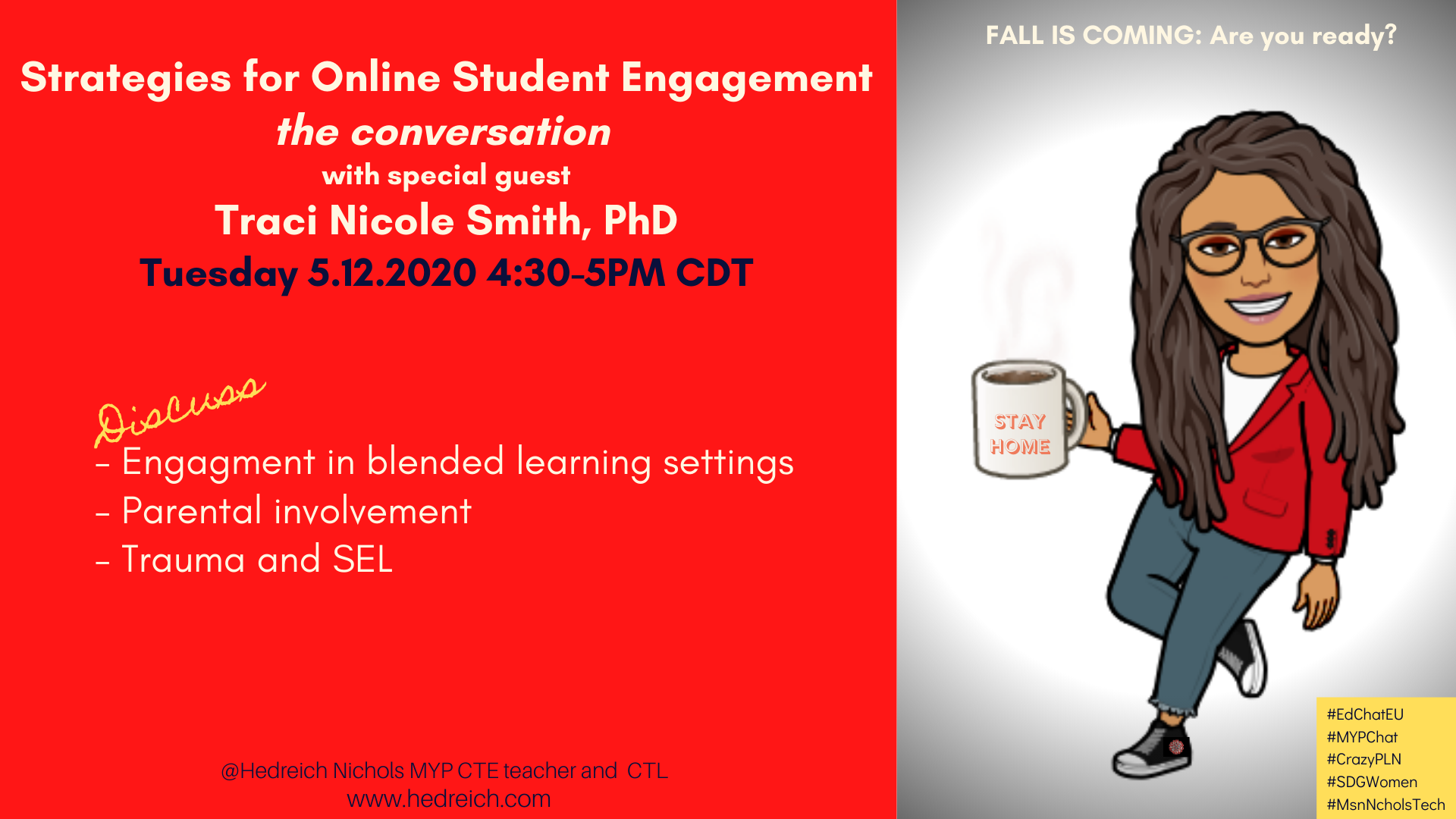
What we’ve been doing hasn’t been working for a long time and now, we have the opportunity do better. Now we’ll have to do better, lean in, try new things. If you’re not sure what new things, read the post below, “From A Distance” for some ideas. Or, I’ll be hosting a virtual learning session Tuesday at 4:30 with the incredible Traci Nicole Smith, PhD to talk about how we can better connect. Join us!
Imagine Read More »

My Students Are Not All Okay

I am fortunate to work with a diverse group of really great educators. Some of them have backgrounds similar to my own. Others come from very diverse backgrounds which heightens our ability to tackle problems from all angles. Sometimes, those same differences are food for thought, providing impetus to greater action. When talking to one of my favorite colleagues recently about the equity issues involved in moving learning online, I felt the difference in our backgrounds like a punch in the gut and it brought me here.

I was raised in a single-parent-ish, multi-generational home, one generation out of Houston’s Third Ward public housing. My mom used every extra penny to give me upper middle class exposure. I traded on those experiences to travel the world, even living and teaching in Switzerland for a decade and a half. My circle is a colorful community of friends who sometimes live in very different socio-economic worlds. Although I am in the Venn diagram middle of those worlds, folks on the high earning end don’t always know what life on the other side looks like. I find myself regularly in a room in which people do not know that living paycheck to paycheck is a real thing, without label and latte habits. I have friends who are shocked when I say that 1 in 4 Americans makes less than 40K. Even my friends who work in the trenches to get their students everything they need sometimes don’t know what it’s like to not make rent or eat 2 corndogs a day until your paycheck comes in. My early career as an artist taught me some real lessons about hunger and the gig economy and I have not forgotten them. I ache for people who are about to sacrifice everything so that we can flatten the curve and I fear that we don’t see the urgency of those needs.

I am glad to be a voice that helps uncover equity and access issues that we may not be aware of, especially now, as we push to get our lessons online. I am glad that my background has taught me how to ask questions and get help, for myself, for others. I am glad that I can raise awareness about the precipice that some of our families live on the edge of. I am also afraid that being a voice is not enough.

Now that we are in an economy that is doing a nose dive for many who were already barely making ends meet, what does equity look like? As we work on connecting kids to learning, have we built strong enough relationships so that we can connect kids to resources that will meet their basic needs? Are we making sure that mental health resources, food pantries, rental assistance and community outreach resources are on our Reminds, campus email blasts and even Google Classroom feeds, where appropriate? Do our kids know how to access a suicide or abuse hotline? Can their parents read well enough to fill out complicated forms necessary to access resources that we do send? Do we have basic needs crisis teams on every campus to provide help and additional services?

My kids are not all ok. I’m pretty sure that most of them are, but I am not content with most. Still, I am lucky. I work with an incredible team of caring educators who go the extra mile. I know that, while I don’t know every name and every need, I can call 3 people right now and they can let me know where help is still needed. For that I am thankful.

My challenge this week is for you to slow down on your Zooms and Flipgrids. Talk about Maslow and mental health in your PDs. Make it a priority to check in with your students. Find out who’s alone all day, who is taking care of younger siblings, who is hiding in his room because he’s stressed or afraid. Find out who can’t do meal pick up because their mama’s car broke down. Find out who is not ok and then do something about it. And if your students are all ok, maybe your students or family can donate to a local food pantry or even #stayhome and volunteer online to help those who aren’t.

Here is a list of resources for families in crisis:

  1. COVID-19 Response for Youth Who Are Homeless or in Foster Care
  2. Find Your Local Food Bank
  3.  Disaster Distress Helpline
  4. National Suicide Prevention Lifeline 1-800-273-8255
  5. National Domestic Violence Hotline 1-800-799-7233
  6. Evictions and Foreclosure Moratoriums
  7. Salvation Army
  8. Pausing bills like mortgage, utilities and student loans
  9. E-filing back taxes quickly to get a stimulus check (more straightforward than the IRS site, but from the company Turbotax)

We won’t save every child in our classroom. We couldn’t when we were face to face and that hasn’t changed. But we can make sure that connecting with kids and helping the most vulnerable among us is a priority. For additional resources, see these earlier blog posts and to read up on equity strategies in general, consult my guest blog article on Jennifer Gonzalez’ Cult of Pedagogy.

My Students Are Not All Okay Read More »