Hedreich Nichols

covidcampus

From a Distance

If you are a hedreich.com regular AND a music fan, you may have noticed that the blog article titles are song titles. Music is my thing. I can regularly be seen embarrassing my bio and school kids by breaking into song at unexpected times. Music weaves it’s way into articles, posts, lessons, on guest vlogs and even in PDs. My upcoming webinar is no different. From A Distance was a part of my original webinar title but I thought it was a bit unclear. It remains, however, the theme. From a distance ≠ at a distance. During this time of Covid19 social distancing, we have to lean in.

Leaning in means realizing that not only is from a distance ≠ at a distance, but similarly, distance learning is not the same as distance teaching:

  1. The person who is talking is the person who is learning.
  2. If you are lecturing for your 80 percent of your online sessions you are not building the communication skills of your students, you’re building your own.
  3. If teacher-student connection is the primary socialization in your class, your students are missing critical skill-building opportunities.

The good news is, you can correct that easily. Here are a couple of ideas that you can easily integrate. Assign students to:

  • “host” the class and be responsible for letting students in and greeting them in the chat while you host 5 minutes of Zoom unmuted chaos.
  • use the whiteboard or screen sharing functions to teach a part of the lesson.
  • pull up “guess the gibberish” on Instagram and play with the class (older students, of course).
  • host a Kahoot for the class.
  • have group discussions in breakout rooms.
  • have student led discussions after group work.
  • Have show and tell.
  • invite mom, dad, grandparents, siblings, animals, stuffed animals etc to be a part of the final 5 minutes of class. Take a group pic and send it to parents thanking them for all their help.

The point is that drilling information into your kids because you have fewer instructional minutes is not probably going to make them any smarter. The research tells us that making sure they feel connected will, however. So lean in. teaching them from a distance does not mean that you all remain separated by distance. Give them opportunities to interact. Let them do most of the talking. Set up your instructional nuggets as questions as much as possible so they are thinking and making connections– with the content, with you, with each other.

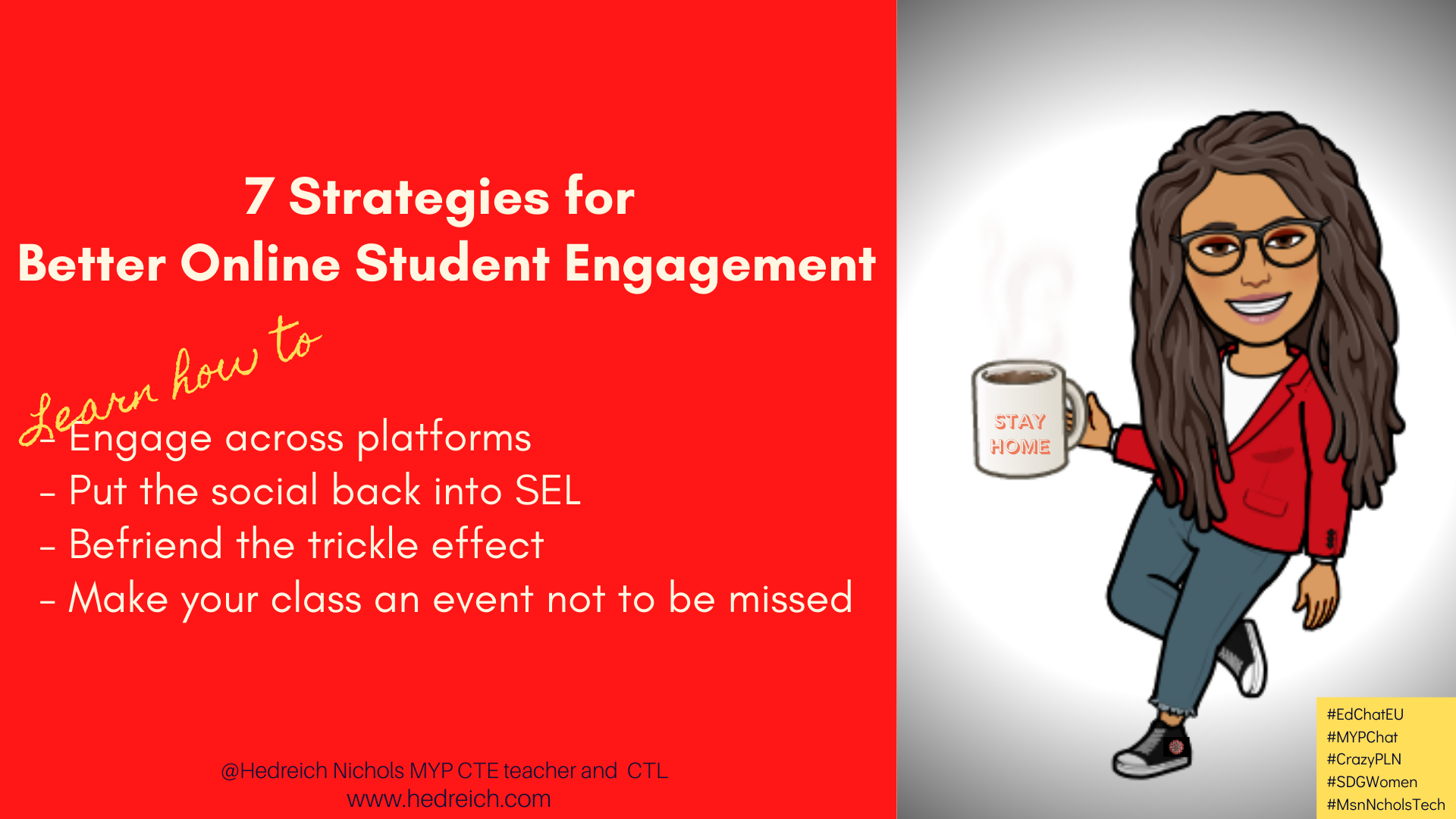
If you want to learn more about it, join me on Wednesday at 11AM (Texas time) for 7 Strategies for Better Online Student Engagement where we’ll talk about learning, engagement and connecting from a distance.

From a Distance Read More »

My Students Are Not All Okay

I am fortunate to work with a diverse group of really great educators. Some of them have backgrounds similar to my own. Others come from very diverse backgrounds which heightens our ability to tackle problems from all angles. Sometimes, those same differences are food for thought, providing impetus to greater action. When talking to one of my favorite colleagues recently about the equity issues involved in moving learning online, I felt the difference in our backgrounds like a punch in the gut and it brought me here.

I was raised in a single-parent-ish, multi-generational home, one generation out of Houston’s Third Ward public housing. My mom used every extra penny to give me upper middle class exposure. I traded on those experiences to travel the world, even living and teaching in Switzerland for a decade and a half. My circle is a colorful community of friends who sometimes live in very different socio-economic worlds. Although I am in the Venn diagram middle of those worlds, folks on the high earning end don’t always know what life on the other side looks like. I find myself regularly in a room in which people do not know that living paycheck to paycheck is a real thing, without label and latte habits. I have friends who are shocked when I say that 1 in 4 Americans makes less than 40K. Even my friends who work in the trenches to get their students everything they need sometimes don’t know what it’s like to not make rent or eat 2 corndogs a day until your paycheck comes in. My early career as an artist taught me some real lessons about hunger and the gig economy and I have not forgotten them. I ache for people who are about to sacrifice everything so that we can flatten the curve and I fear that we don’t see the urgency of those needs.

I am glad to be a voice that helps uncover equity and access issues that we may not be aware of, especially now, as we push to get our lessons online. I am glad that my background has taught me how to ask questions and get help, for myself, for others. I am glad that I can raise awareness about the precipice that some of our families live on the edge of. I am also afraid that being a voice is not enough.

Now that we are in an economy that is doing a nose dive for many who were already barely making ends meet, what does equity look like? As we work on connecting kids to learning, have we built strong enough relationships so that we can connect kids to resources that will meet their basic needs? Are we making sure that mental health resources, food pantries, rental assistance and community outreach resources are on our Reminds, campus email blasts and even Google Classroom feeds, where appropriate? Do our kids know how to access a suicide or abuse hotline? Can their parents read well enough to fill out complicated forms necessary to access resources that we do send? Do we have basic needs crisis teams on every campus to provide help and additional services?

My kids are not all ok. I’m pretty sure that most of them are, but I am not content with most. Still, I am lucky. I work with an incredible team of caring educators who go the extra mile. I know that, while I don’t know every name and every need, I can call 3 people right now and they can let me know where help is still needed. For that I am thankful.

My challenge this week is for you to slow down on your Zooms and Flipgrids. Talk about Maslow and mental health in your PDs. Make it a priority to check in with your students. Find out who’s alone all day, who is taking care of younger siblings, who is hiding in his room because he’s stressed or afraid. Find out who can’t do meal pick up because their mama’s car broke down. Find out who is not ok and then do something about it. And if your students are all ok, maybe your students or family can donate to a local food pantry or even #stayhome and volunteer online to help those who aren’t.

Here is a list of resources for families in crisis:

  1. COVID-19 Response for Youth Who Are Homeless or in Foster Care
  2. Find Your Local Food Bank
  3.  Disaster Distress Helpline
  4. National Suicide Prevention Lifeline 1-800-273-8255
  5. National Domestic Violence Hotline 1-800-799-7233
  6. Evictions and Foreclosure Moratoriums
  7. Salvation Army
  8. Pausing bills like mortgage, utilities and student loans
  9. E-filing back taxes quickly to get a stimulus check (more straightforward than the IRS site, but from the company Turbotax)

We won’t save every child in our classroom. We couldn’t when we were face to face and that hasn’t changed. But we can make sure that connecting with kids and helping the most vulnerable among us is a priority. For additional resources, see these earlier blog posts and to read up on equity strategies in general, consult my guest blog article on Jennifer Gonzalez’ Cult of Pedagogy.

My Students Are Not All Okay Read More »

Every Little Thing’s Gonna Be Alright

Yesterday as I got to the 5th store on the third shopping day only to find shelves devoid of toilet paper, I decided to buy some emergency toilet Kleenex, get some pasta and call it a day. Once in line, I spontaneously started singing to a crying baby as the mom of 3 in front of me frantically searched for his binky. Baby Shark turned tears to smiles. People around looked up and relaxed their furrowed brows just briefly. A conversation started between the cashier and I; how the silliest songs work magic, how she hadn’t had a break all day, how I’d come in for toilet paper and found none. Again. Then more magic, she produced three packages confiscated from people trying to flout the “limit 2” rule. I took 2, Charmin, my favorite! I had come in, seven rolls between me and dry leaves and I had been spiraling. What if I really couldn’t find any? Would my neighbors share? What if we got the runs?! What if I never found toilet paper, even the cheap kind?! Fear was rising and then, *POOF*, I somehow had exactly what I needed. That taught me something.

Things are rarely as perilous as they seem, “no soup is eaten as hot as it’s served”. We paint worst case scenarios to protect ourselves from worst case scenarios, and that preparation is not bad, let’s just not live there. Let’s take control of the things we can. For teachers, one thing we can control is how we stay connected with our students. If you are converting to distance learning, here are my top five resources, with tutorials and app alternates for non US users:

  1. Screencastify, K-12. Here is the tutorial for recording your voice and integrating Google Slides. Screencastify will record your screen with a voiceover so it’s a great gateway app if you want to make your own tutorials for parents or students. Before you do, check YouTube. There are many great tutorials already out there and many lessons that you may be just about to re-create. While littles won’t need Screencastify lessons, depending on what you’re having them do, it could be helpful for the parents helping them.
  2. Flipgrid, K-12+. Here’s a tutorial in which Ann will get you started and put you in a good mood. She is super upbeat! Once you get set up, you can use it for read-alouds, discussions, video journals and for various peer to peer exchanges during this time of relative isolation. It’s also a great alternative to TikTok for younger kids, if you want to do dance challenges together.
  3. Pixton, grades 3-12+. Here’s a tutorial that gets you started. Pixton is great for ELA, tech, humanities and even math, if you want to really get into word problems. It’s a comic strip creator that allows for a lot of creativity. It would be great to have kids write about how they feel about Covid19 and about how they feel the adults in their lives are handling it. I bet we could learn a few things from their stories.
  4. CS First, grades 5-8, which has interactive, interdisciplinary lessons on various topics, from basic coding and digital storytelling to music and fashion. There are lessons in both English and Spanish. Here are tutorials to get you started. If you are outside of the US, let me recommend Hour of Code, which has lessons in over 45 languages for students in pre-k through high school!
  5. Interland, grades 4-7. No tutorial here, just click and play to learn digital citizenship principles. This is Google based, so if you are out of the country, try Common Sense Education for K-12 digital literacy curriculum and games for grades 3-5. These lessons are especially useful as reminders, since many students will have more screen time than usual.

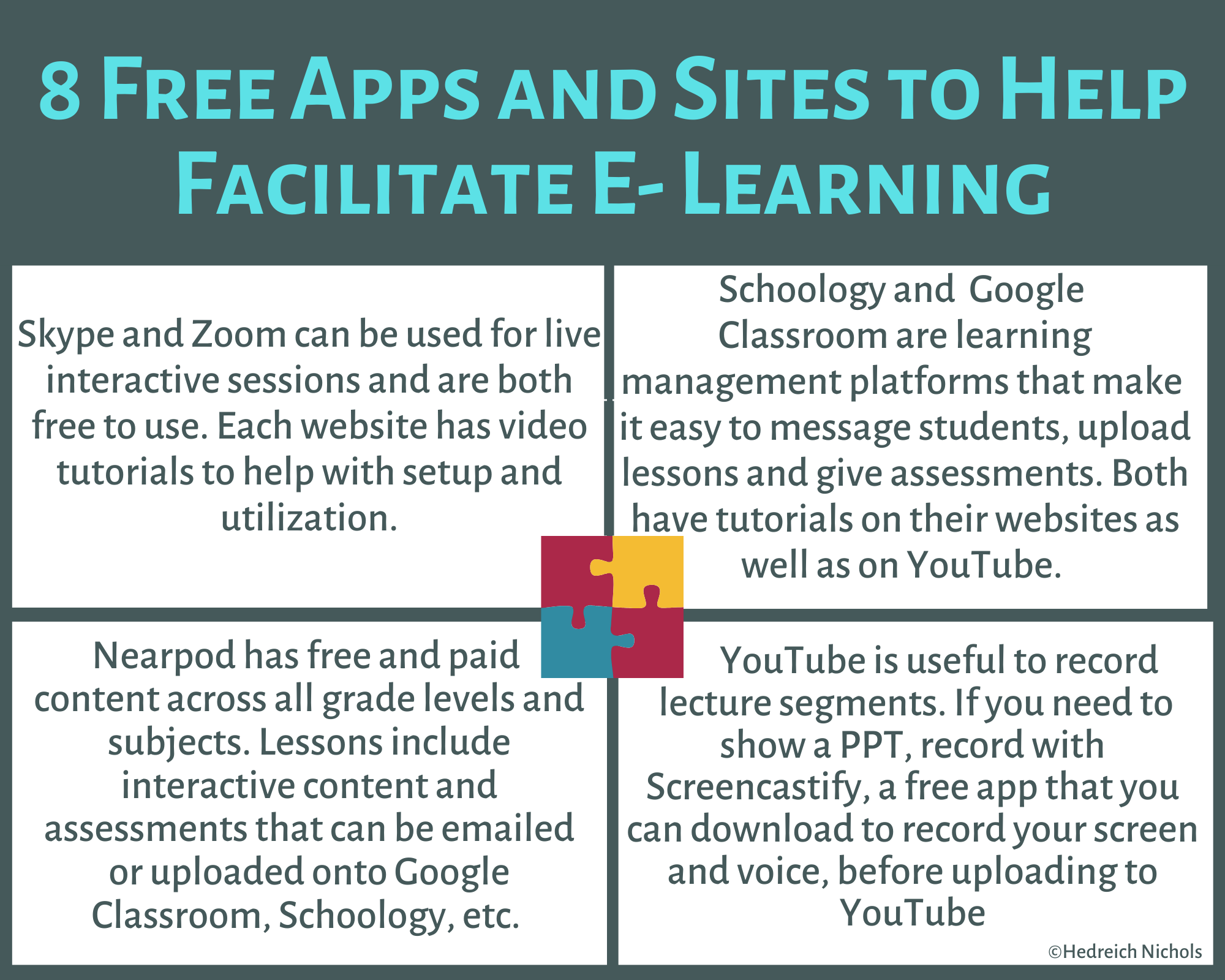
All of these are good options, and there are many more. My advice? Keep it simple. Send something out using your email or remind system if you don’t have an online classroom set up. Or, set one up. Google Classroom and Schoology are user friendly, free options. With them, share links to any resources in one place and even have students turn in their work by a certain time like in a real classroom. Also, really consider Flipgrid, YouTube, TikTok or a social media platform, as policies allow. Human contact is necessary and being a live, talking, steadying influence for your students will be the most important thing you can do for them.

Finally for some, no matter how great your virtual teaching is, this time will be a nightmare. Consider using your resources to help those who may need more than just an internet connection. Here are some national links that connect you to resources in local communities, I’m sure there are many others.

You may be the first person to sense that something is wrong and that’s a big responsibility. But I think most of us signed up because we genuinely care so let’s move from empathy to action when we see students in need.

Will things get worse before they get better? Maybe. Will people we know get the Coronavirus? Maybe. Will they recover? Maybe. There are a lot of maybes and a lot of factors that are beyond our control. But here’s a spin: as chaotic as things are, we are also alive and living through something unique and unprecedented. That ain’t all bad, is it? You can teach in your jammies and send YouTube videos to your students of you and your dog explaining math. How cool is that? You can try your best to do a TikTok dance, give your kids a Cheerio tower challenge on Flipgrid, or send snail mail notes to ss who are not connected filled with love and message in a bottle challenges. Help your students to see adventure and the chance to problem solve in everything that’s happening. It won’t always be possible, but your calming voice can be the one to remind them that everything will indeed be alright.

Every Little Thing’s Gonna Be Alright Read More »