Hedreich Nichols

equity

I’m Not Your Super(wo)man

Visit my YouTube channel for previous Small Bites episodes.

Small Bites Friday Five 07-17-20:

20-30m – Delve into Jorge Valenzuela’s SEL strategy article from Teacher2Teacher.

15-20m – Visit the National Child Traumatic Stress Network website and choose resources you can use to support students in the coming months.

10-15m – Have conversations with colleagues and admin to figure out about how you can best support each other.

5-10m – Read Why Are Blacks Dying at Higher Rates From Covid to get an idea of how lack of equity means more than just gaps in education and income.

0-5m – Wear a mask, wash your hands and refrain from gathering in crowds, especially if you are in an area where COVID cases are spiking.

Most teachers I know are not in education for the paycheck. They are not in it for the summers folks think they have off and they certainly don’t do it for the prestige. The teachers that I know are dedicated, capable and will leave it all on the field for their kids.

Sadly, these same dedicated professionals are being cast as not only unwilling to work, but they are also seen as unworthy of consideration as plans are being made to reopen schools.

In Texas and many other states, not only teachers, but also districts have been emasculated and left out of the decision making process.

The response from teachers across the country has been colossal. Teachers used to “doing it for the kids” recognize that this is not about the kids and no amount of guilt is making us believe that it is. We are not willing to watch even one of our students or colleagues die, and we are certainly not willing to sacrifice the health of our families to do it, not if we have any say in the matter.

What does this mean for us? It means that each of us has to decide if we risk lives or livelihood. Or it means we risk the health and welfare of our communities because losing our income or our educational funding is simply not an option. Maybe it means asking for a leave, taking a paycut and dealing with the personal economic consequences. Maybe, for some, it means not understanding what the fuss is all about and being at odds with teachers who are expressing fear for their safety and the safety of others around them. Whatever your stance right now, it is bound together with anxiety, stress and possibly fear.

Our students will also return full of anxiety and fear. Between COVID exposed inequities, loss, economic distress and the protests, we are experiencing trauma as a nation and that trauma will show up in our f2f or virtual classes in a few short weeks. Unlike loss, our trauma is ongoing and our most vulnerable students will need us even more. Students will need us to be aware of signals for help and even codes like posts about pasta on social media. SEL will have to be a priority and if your school isn’t yet equipped, Casel has excellent SEL resources for helping students during the COVID crisis.

What are you doing to prepare personally? Are you bingeing on news and COVID statistics or are you being mindful? Are you staying awake late mulling over possible scenarios or are you practicing wellness in in a way that brings you peace? Summer will be over soon and we will have to be prepared to meet our students where they are.

You can’t pour from an empty cup so I implore you, as you go through the resources to help your students learn while they manage grief, anxiety and traumatic experiences, make sure that you are practicing self-care. As much as we say teaching is our superpower, we can’t take it all on. The best way for you to take care of your students is for you to take care of yourself.

I’m Not Your Super(wo)man Read More »
A Little Less Talk and a Lot More Action

#SmallBites E3

Small Bites Friday Five 06-26-20:

20-30m – Set up a doc with contact info of https://www.usa.gov/elected-officials. Then create a basic “Dear Official” template. Use it often to quickly and efficiently let your voice be heard.

15-20m – Use Ballotpedia to find out when school board elections are and what’s at stake, then vote. Better yet, run for office or help support someone who will!

10-15m – Watch Uncomfortable Conversations with a Black Man from Emmanuel Acho.

5-10m – Remember last week’s conversation you had with a young person on race? This week talk with someone older than you. Again, don’t guide the conversation, just listen.

0-5m – Find an organization to support or donate to.

The recent protests and Covid19 have combined to spotlight inequities that have long plagued our country. People who don’t look like me are waking up to the reality that people who do look like me face daily. They are finding out that we are more likely to die early; in childbirth, of curable diseases, from violence. We make less money, hit glass ceilings before our less pigmented peers and are, as a community, experiencing the traumatic effects of the vestiges of enslavement, Jim Crow and systemic inequitable practices of the last 400 years.

People are beginning to have conversations about issues of racial inequities that are long overdue. I’m glad.

I’m also tired.

I am tired of big words and bigger concepts. How do I fight systemic racial discrimination and marginalization anyway? Do I use a sword? A pen? Expo Markers? A protest sign? How can I fight hate? With more trainings? With firings? With well-crafted laws? We’ve seen how well those work.

Yes, we need to talk, listen, have uncomfortable conversations. But if we are not taking some form of action while we are talking, listening and learning, we are getting smarter but not making an impact on students and communities. While you are reading the third chapter of White Fragility, a child is going hungry, a man is dying of preventable causes before he’s reached retirement and another top student is leaving an ivy league campus because the constant onslaught of microaggressions has started to affect her mental health (“Oh, you’re only here because of affirmative action, right?”).

Let me be clear, the talking, listening and learning are necessary. It’s just that they are not a precursor to action, not a phase that we complete before we go on to the action phase. The action phase has to happen now. If you’re not sure how to start, watch episode 3 of #Smallbites (and 1 and 2) to find out what you can do this week.

The world needs your voice, but it needs your hand to the plow too.

A Little Less Talk and a Lot More Action Read More »

Times They Are A-Changin’

Replay of tonight’s live edition of #SmallBites!

Small Bites Friday Five 06-12-20:

20-30m – Watch ABC’s Blackish or Mixed-ish for light fare through a social justice lens.

15-20m – Find the local city council and school board websites and inform yourself.

10-15m – Visit Tolerance.org’s magazine section and read one article.

5-10m– Check your voting status at whenweallvote.org and encourage one friend to do the same.

A Whole Zero Minutes– Don’t judge anyone else’s helping unless it’s doing harm.

– #SmallBites

With the launch of #SmallBites, I have set out to help those who want to create more equitable classrooms and communities. Many, in shock and outrage, are eagerly consuming resources and investing time and energy to learn about and stand against systemic inequities that have long plagued our society. I feel in that energy a world-wide awakening, even as some alte-Garde political and cultural regimes dig their heels in.

We decide if this will be a trend or a moment, if that “one day when the Glory comes” will be sooner rather than later. You can begin with strategies mentioned in #SmallBites. The weekly Friday Five will allow you to keep up the anti-racism marathon by allowing you to pace yourself and not get so overwhelmed that you give up. As you hit your stride, you can create some space to go deeper.

Unfortunately, every problem can’t be tackled only with strategies that take less than 30 minutes. Going to a protest takes a day, reading a book, a few days. Making lasting change for marginalized populations across the globe, a lifetime and more.

To that end, I have had inspiring conversations with white colleagues this week, in particular with Barbara Bray, author of Define Your Why. Those conversations have produced this work in progress that uses Helm’s framework of racial identity to help people identify where they are on the journey to becoming more culturally responsive.

If you find yourself wanting a heaping round of seconds after consuming #SmallBites, open the document, set a spell and sift through the links, book titles and social action sites. Cut on some Brad Paisley with LL (hey, I liked the song!) or Freedom Sounds while you do. Take what you need, leave the rest. This ain’t a clean your plate kind of party. Social responsibility is both necessary and personal.

For now, go fast–because it’s been too long in coming to go slow–but keep a sustainable pace, because we can’t afford to lose even one voice.

How do you eat an elephant? One bite at a time, so pop in to YouTube next week for a serving of #SmallBites and follow me on Twitter, Instagram or Facebook.

Times They Are A-Changin’ Read More »

More Than Words

How I came to create #SmallBites

If there ever was a modern martyr, George Floyd is one. His daughter’s declaration of “Daddy changed the world” was manifested in protests from Amsterdam to Zimbabwe. His death has begun policing policy reform change in Washington and in cities throughout the country and the world is saying his name as they search for ways to bring about change.

People all over the world are not only waking up to the sometimes brutal realities that BIPOCs face, but they are understanding that, like being born pretty, sometimes life comes with unearned privilege that is wielded, unwittingly causing harm.

If you are someone who wants to teach better, include better, be better, join me for Friday night’s 8PM central live launch of #SmallBites. Each week you’ll get a Friday 5 with 5 actionable steps you can use to help create a more level playing field for those of us who all too often never even get inside the ballpark. Want to ask a question? You can do that too.

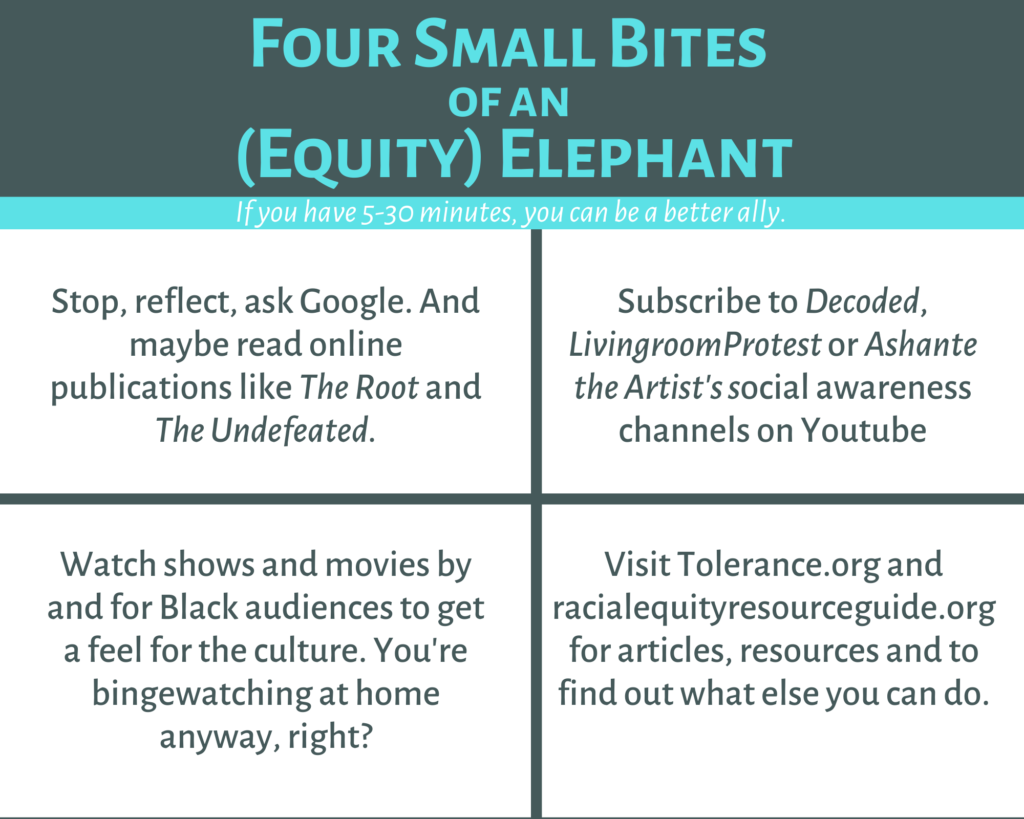
Fighting racism is a full time job, and most of us already have full time jobs. You can’t do everything, but you can do just one thing. How do you eat an elephant? One bite at a time.

More Than Words Read More »

Eat the Elephant

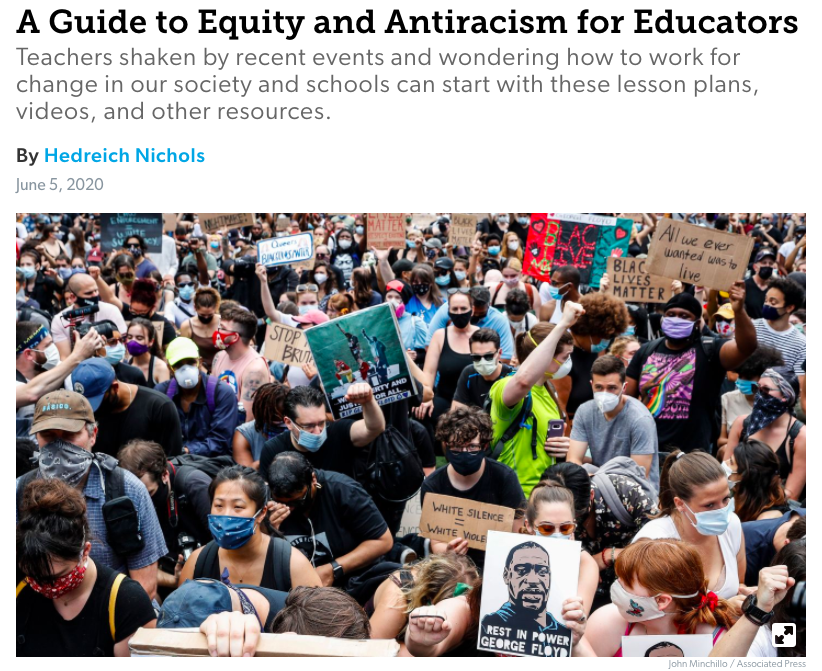
For this week’s post, I’d like to invite you to read my latest article, “A Guide to Equity and Antiracism for Educators”, published by Edutopia. It’s all about actionable steps that you can take now.

I would also like to invite you to Small Bites, my YouTube channel soft re-launch, next Friday. If you’re familiar with the UN’s Lazy Person’s Guide to Saving the World, the concept is similar. Look for news on Twitter and Instagram.

We can’t eat an elephant all at once, but we can move forward if we commit to actionable steps that move us forward one bite at a time.

Eat the Elephant Read More »

What Cha’ Gonna Do…

Last night, as I scrolled and double-tapped my way through post after post of black squares for #BlackoutTuesday, after my friends across the globe assured me that they stand with the us in English, German, French, Spanish, Italian and halting mixes of the above, I felt hope. I felt the hope of 2008. I felt the hope of MLK and Johnson. I felt the hope of our collective ancestors crossing the Mason-Dixon line. Even as I read of fires, and of the reprehensible hate-stoking by our nations fearmongers, I felt hope.

The overwhelming support of my less melanated sisters and brothers enveloped me in a warmth and kindled the hope that this time, we just might take a step forward in our fight against prejudice, racism and the inequities that have been plaguing our country since European settlers arrived here and created an Indian problem.

I’ve talked to friends and I’m not the only one who felt that hope. It felt significant. Hope can kindle change bigger than any riot fire IF the outrage of every individual is translated into action. Yes, fighting for social justice is a big ticket challenge. But like eating an elephant, if you do it one small bite at a time, it’ll get done, just start. Here are 5 things you can do today to advance the cause of equity and social justice.

If You Have at least 5 minutes:

If You Have at least 15 minutes:

If You Have At Least 30 minutes:

  • Watch an episode of Blackish. It’s light fare, but the lessons and issues tackled are not.

Conquering, enslaving and oppressing other humans is not a new concept, it is, unfortunately, the concept that has fueled competing powers since the beginning of time. Keeping that in mind, fighting for social justice is not a sprint, it’s a marathon. If you are just joining this fight, don’t get so overwhelmed now that you lose steam. Take small bites. That doesn’t mean don’t act with urgency, we need revolutionary change now. I’m just reminding you to take action at a sustainable pace. Set a measurable, attainable goal for today, for this week, for this year.

You have no idea how moved I have been at the great outpouring of solidarity. Now the question is, how will you translate that into action. What cha’ gonna do?

What Cha’ Gonna Do… Read More »

What’s Going On

While being interviewed this week for Ted Nesloney’s #tellyourstory series, we talked a little about equity. He mentioned, rightly so, that the word equity is kind of “buzzy”, meaning that it’s one of the words popularly thrown around in education these days. He asked me what equity means to me. My encapsulated reply is that equity means doing the very best you can do for the student standing right in front of you.

When we think of the Big Concepts surrounding equity, it’s easy to be overwhelmed. Be a culturally responsive educator. Decolonize your classroom. Teach anti-racist curriculum. Where do you start? How do you start? How do you eat an elephant? One bite at a time. How do you begin to make your corner of the world a more equitable place as an educator? By doing the best for the one student standing in front of you.

Let me be clear: systemic racism is a big problem in the US and across the world and this week we have seen it play out in ugly ways in our country, once again. However, seeing the problem, acknowledging the problem, being aware of the symptoms and solutions of the problem and maybe even seeing your own part in the problem is not going to change anything unless you do one thing: Do your very best for the student standing in front of you. A child standing in front of you needs to know 3 things:

  • You value all students;
  • Every student deserves to be valued;
  • If someone is not valued, you will use your voice to help make sure that they are.

If every teacher would model and teach those three things, we could stop defining terms that essentially all mean the same thing: value others just as you value yourself (if you’re so inclined, you may recognize this as one of the 10 commandments). If every teacher had been teaching those three things, Amy Cooper might have grown up to be a person who leashed her dog instead of pulling the Fear Of The Black Man card. If teachers had been teaching students to value others all along, George Floyd would likely still be alive.

If every teacher would do the best for each child in front of them by valuing all students and speaking out against those who don’t, I wouldn’t have to worry about my teenager driving/running/living while black. That’s a hashtag, you know, #livingwhileblack. My pride and joy, a well-liked 16 year-old kid, who is now taller than I am, is perceived by the world as a black man, and we see what happens to black men, even when they are Harvard educated birders or lying faced down, pleading for breath as a peace officer’s knee crushes the life out of them.

Educators, if you are reading this and thinking that my recipe for eradicating racism is overly simple, I’ll concede that. I just don’t understand why it can’t be.

As a teacher, how can I not use my voice to speak out against wrong and teach my students to do the same? How can I not understand that melanin can mean convictions and rogue justice death sentences, often without vindication? How can I not understand that #blacklivesmatter means that students in your class, who look like me, don’t feel like their lives matter as much as the lives of whites because of what we experience and what we see happening in our communities.

As an educator, how can you not want to hug them and protect them and make sure that everyone who does NOT look like them knows that it’s not ok that they feel that way. It’s not ok that they die early and often for reasons rooted in systemic disenfranchisement, reasons that should make every educator into an activist, even if it’s only for one child at a time.

You want a more equitable classroom? Do your very best for the student standing in front of you. Make your campus a place where fairness and justice are not regulated by race, class, ideology or popularity. Esteem and celebrate those whose stories and histories you may have to look beyond the textbook for. When you read the painful stories of those who are not being valued, don’t look away. Teach your students the truth about what happens to people of color and the ugly historical truths surrounding the ugly present realities. Then teach them that they can make a difference. Send cards and letters to mothers of the slain, work with organizations who fight for social justice and teach your students that the grief we feel today will lessen if they value those who look like them– and those who don’t.

Don’t worry about the Big Concepts surrounding equity. Just do your best for the student that’s standing in front of you.

What’s Going On Read More »

I See You

One evening, some silliness with a couple of teacher friends prompted me to Google an old series, The Beverly Hillbillies. Watching an episode transported me immediately back to my beloved childhood spot on the living room floor in front the TV. Like Jethro and Ellie Mae Clampett from the series, I grew up in an unconventional multi-generational household. The matriarch of our family was my great-grandmother, Mommie (pronounced with the second syllable stressed, in the Creole way), born in 1892. The matriarch of the Beverly Hillbillies was “Granny”. Although the show was an ensemble piece, Mommie seemed to only have eyes for Granny. Granny’s grey hair, her quick movements and her feisty wit rated Mommie’s commentary and wonder. At the time it was curious to me, but now that I am seeing my own Gen-X Hollywood A-listers relinquish their roles to the next generations, I understand why Mommie was so enamored with Granny. She saw in Granny a peer at a time in her life when her own peer group was dwindling. Ageism wasn’t even a word before 1969. There was no Netflix to push quality diverse programming and Norman Lear had not yet shaken up the sitcom scene. There were no Gracie and Frankies, no steamy Richard and Catherine love scenes and certainly no Morgan Freemans who kept getting hired “in spite of” being a minority and a senior. Mommie liked seeing Granny because she saw herself; and in seeing herself reflected on the Curtis Mathis TV screen, she felt un-invisible.

Thinking of how important Granny was to Mommie made me think of how important it is to be seen. EDU has responded to the need for inclusion and, although there are still “bubbles”, many educational settings have made strides in celebrating diversity and ensuring that students see themselves reflected in the staffs, literature and lessons on their campuses. Still, my question is, how are we defining diversity? In Hollywood it’s race, gender and age. In the classroom, we subtract age and add religion and socio-economic status. While these four cover a lot of ground, I’d like to challenge us all to go beyond those labels. How well are we validating and supporting students when the divergence is not apparent? Is there a quiet space at lunch for students who have social anxiety? Are there books to empower and encourage homeless kids or the students who run households? Are there qr codes and easily accessible resources posted for students struggling with depression and self-harm? Are our classes safe spaces for the kids with the “weird” hair or clothes who march to a different beat? Are we ourselves authentic and accepting so that students see themselves reflected in real life role models?

Beyond SEL and differentiation, how are you ensuring equity and access for all? Here is a challenge: have a weekly open door lunch and see who shows up. Get a couple of other teachers to do the same. A ‘lunch and hang’ will clue you in on who feels seen or who needs to be seen. It will give you a chance to learn about campus needs and trends you don’t know exist. You will find out about TikTok, games beyond Fortnite and Pubg, Creepypasta and who writes fan fiction. If your kiddos are younger, you will find out which cartoons are good, if wheelchair and ethnic hair Barbies really make the grade, and probably more about families than you want to know. You’ll find out who has lunch and who has hot Cheetos–or nothing at all. You will find out if your campus is a reflection of the students you serve and how you can serve better.

Mommie’s womance with Granny taught me the essence of what Maslow’s Hierarchy of Needs taught me to name decades later; a sense of love, connection and belonging is essential. The questions I’ve asked here are the questions I ask myself daily. Am I really seeing my students? I can’t include what I don’t see so as an advocate for diversity and inclusion, I will be making sure to use my glasses more. Join me?

I See You Read More »