Hedreich Nichols

equity

Shape of You

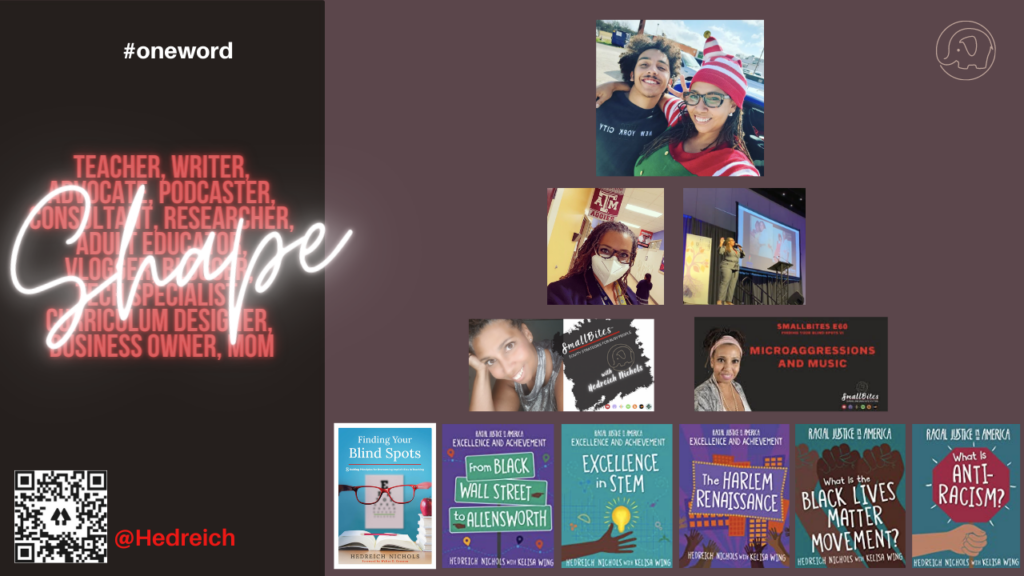
OneWord ’22 graphic. SmallBites returns Monday, January 10th wherever fine podcasts are heard.

Standing at the precipice of the new year has long ceased to feel like some magical new beginning. That’s a good thing. I have not bungled this year. I’m not waiting on the turn of a page so that I can resolutely start anew. What I am doing is taking the wins of the last couple of years and shaping them into a harmonious melding of many hats. If you are a teacher and a parent, you understand being a wearer of many hats.

The thing about wearing many hats is that it can be difficult to identify which hat is The One. Usually that’s because there is no ONE. Could you choose between ‘child’, ‘spouse’, ‘parent’, ‘educator’ or ‘friend’? Each of those hats are vitally important, but they aren’t always on your head all at once. Still, sometimes you stack them, sometimes they sit askew. Sometimes you just want to throw them all down and go hatless.

This evening, as I write the last blog of 2021, I am hatless. It’s one of those rare moments where I can just be. And in this moment, I savor the time to reflect in quiet about my many hats.

Shape Shifter

A template designed by Educator and Youtuber Claudio Zavala led me to define the hats I wear. As I named them, I finalized my one word, ‘shape’. As my role in education and parenting is shifting, I am in the process of reordering my hats. The last two years have been fruitful, yielding 6 books, 65 SmallBites YouTube episodes, 65 hedreich.com blog episodes and 65 SmallBites podcast episodes. Those don’t include courses, guest blogs and articles.

So how do I bring all those hats under one umbrella? Well, that’s my focus this year. A little prioritizing, a little fine tuning the schedule and a little more work-life balance. And this is all worthy of a blog post, why? Because, as usual, I have an ask. In the next few days, I would like each of you multi hat wearers to spend a little time being intentional about which hats need to be worn when, for how long and in what order. By allowing a picture of your priorities to emerge, you’ll be better able to focus on the now and shape your path forward. This is especially true if you are, like many, considering a shift away from the classroom or away from education altogether.

Happy New Year

As you define and re-order your hats, define also what brings you joy, what ameliorates stress and what is good for you. Make choosing yourself a firm priority. All the people around you will be happier if you are balanced and content. How will you do this with the coming year, including COVID and testing season? Only you can say. But I know that if you don’t take a minute to establish your priorities, the year’s stressors will do it for you and you will likely not be pleased with the outcome.

FInally, I’d like to thank you for reading and listening. I hope that by shaping your coming year and beyond, that you’ll continue to have energy to learn, to grow and to make safer, more equitable classrooms and campuses for all students.

Your loyalty is appreciated. See you next year!
Shape of You Read More »

Alles Hat Ein Ende

Watch on YouTube or listen on Anchor, or wherever podcasts are heard.

There’s a song well known in German speaking parts of the world called Alles Hat Ein Ende, Nur Die Wurst Hat Zwei. Translated, that’s “everything has an end, only the sausage has 2”. After over 60 vlog episodes and as many Lagniappe podcast episodes, #SmallBites on YouTube is converting to an all podcast format. I hope you’re as excited about this as I am.

New Day Dawning

After celebrating with friends and family from almost every era of my life on last Friday, it’s time to move on to the next chapter. With Finding Your Blind Spots released to the edu-universe, I find myself busier with consulting and courses, and I want to have time to serve my clients well. Still, my audience is hugely important and you can still expect blogs, resources and answers to your pressing questions on race and identity through social media.

One thing about podcasts is that they usually accompany listeners who are driving. Because of that I will sometimes be extending just a couple of minutes beyond our 5-7m mark to give you even more #SmallBites to chew on. I hope that meets with your approval!

You Are Appreciated!

Beyond that, I would just like to thank you for coming back each week, for listening, for learning and for taking that knowledge back to your classrooms and learning communities. Join me next week for episode 65 when we’ll say our final goodbyes. In the meantime, see below for the 5 most important #SmallBites links and resources.

Small Bites All Time Favorite Friday Five:

When I started #SmallBites, Learning for Justice was still called Teaching Tolerance. This site is the definitive starting place for standards, lessons, articles and resources on race and identity. Whether you are just beginning your journey on classroom diversity and inclusivity, or are well on your way to helping others understand concepts that some find divisive, Learning for Justice is a site that constantly evolves to help you learn more and be better for your students.

The Harvard Implicit Bias tests help you recognize bias and blind spots. And Harvard GSE’s teaching resources provide tools to help you create more inclusive courses, syllabi and to better integrate conversations on race and identity into your daily lessons.

After reading statistics on disparities in school discipline, I can only recommend restorative justice practices as implemented in the San Francisco Unified School District. I have used their model in my own classrooms and watched discipline problems give way deeper relationships and better learning outcomes. Students just need to know we are invested, but it takes a whole team to make the kinds of disciplinary changes that come with consistent campus RJ implementation.

Of course, if you are going to miss #SmallBites Fridays after you’ve revisited the wealth of resources, keep learning with free courses taught by Yale and Harvard professors here. Or, you can read and use the 1619 curriculum (or information from it, if your district allows) in addition to other historical resources, to add multiperspectivity. Finally, with students, use PBS, the Smithsonian and NPS.gov to find a plethora of school resources on history and culture in the US and the world.

See You Soon

Finally, use the 65 episodes of SmallBites to find the above resources and many more that will guide you as you seek to better understand and teach all students.

It has been my honor to serve you with #SmallBites on Youtube. See you on Apple, Spotify and wherever fine podcasts are heard.

Alles Hat Ein Ende Read More »

Cry Freedom

Watch on YouTube or listen on Anchor, or wherever podcasts are heard.

20-30m – Read this article Business Insider article from Shayanne Gal , Andy Kiersz , Michelle Mark , Ruobing Su , and Marguerite Ward curating 26 charts that explain some of the current issues and consequences that stem from racism. Visit the hyperlinked articles and their hyperlinks to gain understanding for the very real present day problems caused by anti-Black sentiment.

15-20m – Read the above Business Insider article and visit at least 2 of the hyperlinks. Or, continue the journey above.

10-15m – Learn about the catch 22-ish balancing act between Plenary Power and Self Determination in the ongoing fight for Native American rights in the US in this Minority Rights Group International article on Native Americans.

5-10m – If you only have 5-10 minutes, read about Anti-Mexican racism in this History.com article. Be sure to read to the end. You don’t want to miss learning about Sylvia Mendez. Like Ruby Bridges, she too is still alive and can be found on social media platforms.

0-5m – If time is tight, think about one person you know who does not look or identify like you do. Reflect on whether or not their life experiences are more like yours or unlike yours.

Southlake School District and Banned Books

Hearing about the Southlake school district’s plan to ban any diversity issues saddened me. Finding myself on a Texas politician’s banned book list gave me a myriad of other feelings. Both incidents made me realize that, as a country, we are not in line with our forefathers’ vision. If we pledge that our country should be one nation with “liberty and justice for all”, how can we also refuse to shine a light on the things that move us toward that “more perfect union” goal?

If I can’t talk about being born in a Negro hospital or being the first generation of post Jim Crow children in America, does that mean that those things never happened? And if I ignore that part of my history–of OUR history–does that negate the ravaging effects of those inequitable systems?

Silence and Inaction Are Not an Option

Racism is not something we have the luxury of ignoring. Talking about it does not divide us, but refusing to talk about it will continue to be the wall that keeps us from ever reaching our potential as a nation. Just like a husband and wife experience childbirth from very different vantage points, so do diverse peoples in this country have different stories to tell.

In the chapter of Finding Your Blind Spots on Bias and Cultural Expression, I talk about practicing acceptance. How can we practice acceptance if we are unwilling to hear the truths of another?

Stories matter. Acceptance matters. Liberty and justice for each of us matters. Keep doing what you can to respectfully civilly and empathetically shine a light on the truths that impact us all. Because truth–or the lack thereof–impacts us all.

Cry Freedom Read More »

…Do I Fit In?

Watch on YouTube or listen on Anchor, or wherever podcasts are heard.

Small Bites Friday Five 10-8-21:

20-30m – Visit the University of California San Francisco’s Youtube page for a phenomenal selection of videos on belonging, diversity and inclusivity. Start with the “Faces of…” series, featuring diverse student stories in their own words.

15-20m – Listen to this Journey to Belonging podcast with Ilene Winokur entitled “Belonging Before Blooms”. As a matter of fact, bookmark the podcast. She explores the theme of belonging and it’s importance with a variety of inspiring educators from across the globe.

10-15m – Visit the University of California San Francisco’s LGBTQ+ YouTube resource center. The 7 minute introduction video is especially helpful for explaining diverse terms and definitions.

5-10m – Read this “Toolkit for ‘You Belong Here’ article from Learning for Justice” (formerly Teaching Tolerance) on the impact of the student-teacher diversity gap in our nation. Helping diverse students feel a sense of belonging means ensuring that diverse teachers feel a sense of belonging too.

0-5m – The stigma around mental health issues impact how we “other”, so once again, visit the UCSF’s Youtube page to listen to Kristin’s story, a story about anxiety and depression. Reflect on how to better include students struggling with mental health issues, both the readily visible and the invisible ones.

“My Kids”

If you listen to teachers talk about their students, they often refer to “my kids”. I too have often said “my personal kid” to ensure that people know which “my kids” I was talking about. I don’t have any research, but I am willing to bet that not caring if kids fit in or don’t fit in is not common in this profession. Still, when kids are asked whether or not they fit in or not, the answers are all too often less than positive. How can we turn that around?

In Finding Your Blind Spots, the first chapter talks all about how we “other”. “Othering” is what we do when we categorize people as different, as the “them” to our “us”. Othering is not Black or White. It’s not male, female or non-binary. It’s what we do when we come across someone who looks, behaves, thinks or even ‘feels’ different. We other the mom that dresses “too sexy”. We other the guy who doesn’t like sports. We other the person who doesn’t get our jokes. And even though we don’t mean to, we other students in our class who are unlike us (or maybe too much like us) every day.

Be Intentional

I can use all the Big Bad Diversity Words and talk about DEI, the ‘isms”, CRT, race politics, or even a “gay agenda”. Those words usually send people off to rantville in all sorts of political directions. But this space is for educators. And teachers, well, we believe that our kids should feel like they belong, full stop. So when some inflammatory headline threatens to pull you in one direction or another, I am asking you to remember that they are all “your kids”.

Creating classroom and campus spaces that welcome every student every day should be the goal. But like with any goal, reaching it takes intentionality. Besides using the resources above, do the following:

  • Consider taking a few of the Harvard Implicit Bias gamified tests to find your own blind spots.
  • Use the above information to make an action plan based on your personal hidden biases (i.e., refer fewer BIPOC students to the office; learn more about the LGBTQ+ community; make more opportunities for non-male students in STEM courses and clubs, etc.)
  • Look at your roster and pick 2 students with whom your relationship could be better. Have a transparent conversation with them, letting them know that you feel you could get to know each other better. Then, make time to get to know them better. Let them get to know you better as well.
Lead the Way

I am well aware that sometimes, it’s not teachers but students who often make other students feel “othered”. Explicit teaching on kindness and humanity are as necessary as lessons in reading and math. Our kids are watching us. They hear what we say and feel what we don’t say. Your disdain for “the bad kid” becomes theirs. Your barely perceptible annoyance comes across loud and clear to a kid already struggling to fit in. Make it a point to check in with yourself. Admit to yourself how you feel about your kids. Then be intentional about changing anything that might cause a child to feel othered.

When you are intentional about creating a sense of belonging for all your kids, when you teach your kids to do the same for each other, you’ll have a foundational culture shift that changes trajectories for your students. Let’s be intentional about creating a sense of belonging for all our kids.

As Ilene says, belonging before blooms.

…Do I Fit In? Read More »

For the Mamas

Watch on YouTube or listen on Anchor, or wherever podcasts are heard.

SmallBites focuses on issues of belonging and identity, and intersectionality is one of those topics. This week, I will focus on intersectionality in a unique way:

So many of us who are in the classroom are dedicated to our kids–our personal kids and our school kids. I know my personal kid has displayed sibling rivalry a few times throughout the years, and he’s an only child. Of course he knows that he is my kid, but he knows that they are too. That is how us mamas, us parents are.

I am a teacher, I am a parent, and a big part of who I am is at that intersection.

While the resources here are mostly geared toward educators, shaping the world starts in our own personal corners. So if you are a mama, a grandmama, a surrogate mama, a play mama, or simply a person of any gender who mothers all the time or from time to time, this blog is for you.

Small Bites Friday Five 5-7-2

Before – Before you become a mama, think carefully about your own ideologies and beliefs. Does your stance leave room for the beliefs and ideologies of others? How do you meet ‘others’ in the real–and virtual–world? Are you respectful and ready to model being a good person by your own highest definition? Armed with intentionality, prepare yourself to model being the person you hope your child will one day grow up to be.

Littles – If you have ever watched littles bonk each over over the head with a toy they just took, you will know that humanity in it’s best form, has to be taught. Begin with these tips from Jen Cort’s conversation with Sarah Hershey and this wealth of resources from NPR. If you have experienced discrimination or if your kids are mixed race (code for Black, ask Barack Obama), Kamau Bell has some tips and resources to help you navigate the spaces we find ourselves in.

Middles – My book “What is Anti Racism?” from Cherry Lake Publishing is an excellent place to start. Although it talks primarily about anti-Black racism, it opens talking about how we other and treat people because of their identity. Throughout the book there are reflection questions and activities so that you can your kids can talk or go beyond just talking.

Young Adults  With summer reading lists on the horizon, how about a family book study? Here is an allyship lesson plan from Bryanna Wallace and Autumn Gupta called Justice in June. Even if you are planning on binge watching more than reading, you can pull from this comprehensive resource to do more than ‘have conversations around race’. Further, this Rich in Color list links to several other sites and lists to expand your horizons.

Solo Flyers  By now, you have done your job as a parent and hopefully you have raised thoughtful, empathetic children who care about others. Maybe you and your children share values, maybe you have divergent beliefs. If so, this is where you practice acceptance and embrace them for who they are. Still, if discussions tend to get heated at family gatherings, here are a few tips to help you keep Mother’s day celebratory. And if relationships are strained, you are not alone, but just know, there is no reason they have to stay that way.

And finally, this Lagniappe from Common Sense Media with great questions to guide conversations with children of all ages.

For the Mamas Read More »

This is Me

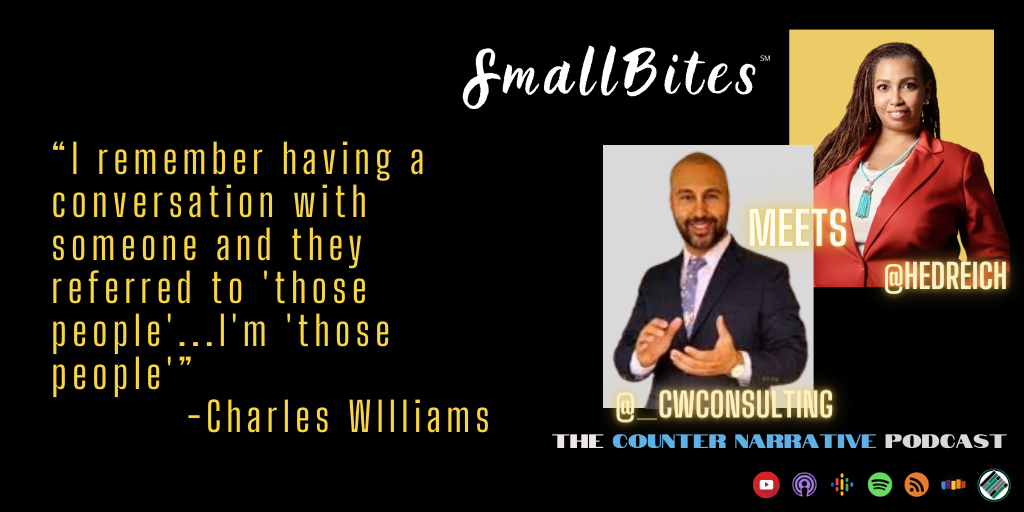
This week, I am excited to announce the launch of the #SmallBites One Question series. This season asks educators about the privilege–and the dark side–of ‘assimilation’. Follow the link to listen to an open, honest conversation on the experiences of a Black Educator teaching in White spaces in my #SmallBites Lagniappe podcast with The Counter Narrative Podcast‘s Charles Williams.

Additionally, am taking off this weekend for the observance of Good Friday and Easter. Please listen to SmallBites Lagniappe: Lead With Love, a message to my Christian friends.

This is Me Read More »

I Like What You Like, You Like What I Like

Watch on YouTube or listen on Anchor, or wherever podcasts are heard.

Small Bites Friday Five 2-26-2

20-30m – Explore this article by David Palank to see how likely it is that halo bias influences your teaching (spoiler alert, a lot). Then choose two strategies to mitigate your own biases, like grading anonymously or ALWAYS using a written rubric. Finally, reflect on a time when the halo effect likely played a part in a decision you made.

15-20m – Start with your youngest learners using this rich well of art and literary projects. Mandisa’s website is designed for toddlers but the projects can be easily scaled up for PK-4.

10-15m – Use this Precious Children article from PBS to help you understand why teaching acceptance is important early on, then prepare at least one of the activities for your class or personal kids and grands. My favorite line, “If your group is not diverse, display images of diversity in your community or in U.S. society.”

5-10m – Review this Nielson Group article that explains halo bias and think about how it affects your teaching.

0-5m –  Write down 5 people you know who you attribute certain traits to. For example, Kevin is tall, he must play basketball; or My co-teacher is really pretty, she must have been popular in high school. Now, write down all the reasons your assumptions might be false.

Did you know that mirroring is a real thing in which people subconsciously mimic the affectations of those they like? And even among invertebrates, there is sexual mimicry in which one sex imitates the other sex to signal interest. If you are a scientist or social scientist, you are probably cringing right now. But for us lay persons, I think the gist is clear. Imitation is more than the sincerest form of flattery, it’s how we align ourselves with those we admire.

If we like someone, we also imitate, or at least buy into, their beliefs and values. And usually, if we believe one thing that they believe, we tend to believe it all. We also tend to minimize or write off any negatives or character flaws. Conversely, if we don’t like someone, we are likely to magnify their faults, disavowing them and whatever they stand for.

We see this play out in politics, but how does this play out in education? Well, in the hundred and one discretionary decisions you make daily, it can affect students in a million and one small and large ways. For example, if you like a student, you might be tempted to round up in grading, if you dislike a student, you may round down, or just not round up. If a student impresses you, you are likely to recommend them for awards, AP courses, write reference letters, etc. If you don’t particularly fancy them, you might write them a college letter, but will it be glowing? The adjectives you choose are more likely to be based on your feelings about the student than on performance or achievement.

We say, know better, do better. But that is more than a notion unless you are committed to being a reflective practitioner in a very real, honest-with-yourself-until-it-hurts way. If you really want to be a change agent and make education better, be willing to start by taking stock of your feelings about each student. Start by reading this article, reflecting on how this bias played out in your classroom today; then make plans to course correct.

That’s how real change begins, with you doing your best for each child in front of you. Make it concrete: Read, reflect, make your own plan to be more intentional in dealing with the students you support now.

I Like What You Like, You Like What I Like Read More »

Dirty Laundry

Watch on YouTube or listen on Anchor, or wherever podcasts are heard.

Small Bites Friday Five 2-19-21

20-30m – Watch Jay Smooth’s Media Literacy crash course that delves into media strategies, our reactions to those tricks and our biases. Watch them all if you have time. If not, watch #2, #4 and #5. These are great for you, but can also be watched with a class. 

15-20m – Read this Parent’s Guide to Media Literacy from the National Association for Media Literacy and Education (NAMLE). It features sample questions for analyzing media like who made it, why was it made and how might different people interpret it. It’s also in Spanish and even Greek, if you need it.

10-15m – Reflect on the information in the above document and jot down any personal tweaks you need to make in your own media consumption. Then consider send your favorite section or even a class sketchnote of your favorite section home to parents.

5-10m – Review this Time For Kids resource for use with younger students, or this Media Smarts Break the Fake resource that includes 4 easy ways to fact check and share with friends and family.

0-5m –  Learn the words dorsolateral prefrontal cortex and watch this Above the Noise video on the brain and fake news to learn how to circumvent the way our brains react to news. Probably best with 6-12th graders he says BS (the letters, not the words) in the video. Ooohhhh…

Something dark in human nature makes us like to watch others suffer. The lions and the Christians in the Coliseum; shoot ’em ups; shocking and bad news; social media rants. America’s Funniest Home Videos and even the rash of prank Tiktoks indulge our darker side, give us the opportunity to assure ourselves that we are not as bad off as those we ridicule.

Media takes advantage of that. A message is always crafted by one person with an agenda. From the early days of yellow journalism to today’s polarized news outlets, someone crafts messages to manipulate the masses. We don’t think of our democracy as being ruled by the messages of propaganda, but considering how polarized we are and how news is as much opinion, analysis and editorial content as anything else, we should think again. So much content is needed to fill up the current 24 hour thirst for dirty laundry that we have gotten used to opinion pieces being front page news and incendiary headlines being fact.

The only thing I would like you to do this week is to watch 5 minutes of news daily from an outlet you don’t usually watch. Refrain from making negative comments or judgments. Research what you hear, if you like. But work on tweaking your own media consumption habits so that when you teach civics and citizenship–which should happen daily– you will be able to teach your students to think critically, not to think like you.

Dirty Laundry Read More »

Turkey in the Straw

Small Bites Friday Five 11-20-20:

20-30m –Spend some time exploring the NPS indigenous stories and reflecting over the old cowboy and “Indian” movies. Do it with your families, with your students.

15-20m – Put yourself in timeout, the world will not stop turning. Use that time to do whatever recharges you.

10-15m – Look at your lesson plans and reflect on how your students can show mastery in fewer steps. Don’t teach less, don’t question less, but reduce testing stress. In populations that are struggling educationally and because of COVID more than others, a little ‘air’ is helpful.

5-10m Look up the most recent CDC and WHO guidelines and share them with your students and families. Do everything you can to mitigate COVID spread over the holidays.

0-5m – Breathe. Just breathe. Here’s a meditation from Flocabulary that I do with my students.

This year I had really all but decided that I was NOT buying a turkey. I barely like turkey. And for my small family, that’s a WHOOOOOOLE lotta leftovers that I don’t like. But the pull was so strong that I not only bought one, I created a whole Small Bites about it.

Thing is, I grew up in a house where none of us really liked turkey. I remember this same conversation with my grandmom who made THE best fried chicken. It would have been a much better choice, but, we always went with turkey. Here I am, generations later, a whole grown up, and I have a turkey alarm set on my phone so I don’t forget to defrost starting Sunday.

That’s the pull of traditions. I can say that the confederate flag is a symbol of hate because it is flown by Americans who who fought for human trafficking, kept citizens from voting and education and is today carried by people who lynch (domestic terrorists). However, in my life as a Texan, I have met some mostly benevolent people who did not see that flag as egregious, it was simply a symbol of Southern pride. It was the flag that had been in grandpa’s truck, the same grandpa that taught them to fish and hunt. It was the flag touted in history books as a symbol of heroism, a flag revered without consideration of the definition of treason.

If I am honest, I was 16 before I realized that my Southern pride and patriotic education left little room for honest discourse about what we were really proud of.

This Thanksgiving, let’s look honestly at what we have been taught to internalize as fact and ask ourselves, ‘who else was there’, ‘what might have been their experiences?’

Do we consider that the Sioux and Cheyenne were protecting their land and that it was the settlers who were the interlopers since the land was already settled?

Do we consider that although Thomas Jefferson had a longstanding dalliance of some kind, that Sally Hemings was his property, a girl of 14 who he impregnated, whether or not it was her choice?

Do we consider that there are traditions that may or may not be steeped in false narratives or shaded versions of truths that, like a mountain range, may have many views and vantage points?

Do we consider that many songs like Turkey in the Straw or the Eyes of Texas may be traditional songs better left to their racist pasts?

I know that traditions connect us to our past and our world at large, like me buying that turkey I don’t really want to eat. But I also know that setting aside traditions that have out-served their usefulness makes room for growth. As we prepare for our holiday traditions this year, let’s reflect on them and broaden our viewpoint to include the stories of others who share our journey, but not our path.

Turkey in the Straw Read More »

Different

Diversity is NOT Equity. Watch Episodes 1-8 at Youtube/Hedreich

Small Bites Friday Five 08-7-20:

20-30m – Watch the rest of Black America Since MLK: And Still I Rise on PBS.

15-20m – Check out Burbank High School’s curated Justice in June resources.

10-15m –Reflect on Kellie Bahri’s ITEA (Inquiry-Truth-Empathy-Action) learning framework and article.

5-10m – Watch Kenyona “Sunny” Matthews talk about how she hates diversity. Funny and poignant.

0-5m – Pick a Small Bites episode or blog you missed and catch up.

While talking to Chuck Poole on a recent episode of his Teacher Summit live series, we started talking about the HUGE difference between two words that are often used interchangeably, ‘diversity’ and ‘equity’.

When talking about education in the classroom or workplace, the Big Three, diversity, equity and inclusion or, ‘DEI’, are always a part of the conversation. So often do we use the three terms together, in fact, that they have come to mean the same thing in the hearts and minds of many.

Let’s be clear, those terms are not coequal. Diversity means we all have a seat at the table. But equity means that each person at the table is being served dinner. Further, the dinner meets the unique needs of each individual. Is it equitable to serve a Philly cheesesteak to someone who is gluten and lactose intolerant? Umm, no. Is it equitable to serve turkey and dressing to a vegan? Again, no. Well meaning offerings to diverse students without understanding and considering their unique needs will never lead to equity.

Some ways to better understand the needs of diverse students:

Until we start focusing on the needs of diverse students in all the ways they are diverse, we will be able to celebrate diversity but not reap the benefits of equity.

Small Bites Episode 10!

Next week, join me for a frank conversation on equity and social justice for the new school year. Bring your questions and I’ll see you on YouTube at 8PM Central–LIVE!

Different Read More »