Hedreich Nichols

Hedreich Nichols

Get Here

SmallBites Friday Five 4-23-21

Once again, I have 5 important prompts for reflection. This week, think of them in terms of your students and staff:

Why do you think police violence in the US is so much higher than in other democratic countries?

Why do disciplinary practices in schools tend toward punitive measures over restorative ones?

What is one way you can bring restorative practices into your daily routine?

Name 3 ways that you can make room on your campus for respectful discourse on divisive topics?

How can you change from leading discussions to mediating discussions?

The weekend before the trial verdict, the video footage of the police shooting of 13 year old Adam Toledo was released. And before the verdict could be read, Ma’Khia Bryant was killed in Ohio. Some people see police doing their jobs. Some see criminals being killed unjustly, instead of stopped in some less lethal way. Hopefully, everyone sees tragedy.

Unfortunately, these are the times in which we pull out our own violent instruments. If, indeed, the tongue is mightier than the sword, than we kill each other a million times over by attacking each other instead of the problem. Racist. Woke lord. Misogynist. Homophobe. We judge and rail against behaviors and even people themselves; those making, in our estimation, questionable choices. It’s not that there are not behaviors deserving of these labels. The question is, will calling a spade a spade help someone gain a different perspective?

There are many more and less logical viewpoints to every argument. Who gets to decide what is more logical? Unfortunately, most of us always think we are in the right. And mostly, we all equally hate to be told we’re wrong. So then what? Now what?

We have seen humanity prevail. Sadly, through a trial that retraumatized many. What if Derek Chauvin had instead apologized, pled guilty and offered himself up as someone who made a horrible mistake that he wanted to make amends for? What if the officers who beat Rodney King had set that precedent in the 90s? What if someone had reminded them that they hurt someone and had to find a way to make amends. What if we all believed in an eye for an eye, not as revenge, but for restoration?

As educators, it’s imperative that we teach our students to listen with empathy, apologize when wrong and make amends when we can. Pointing out how a behavior impacts another should be a regular part of what we do. Explaining how a wrong can be righted and how that benefits us all should be a daily occurance in our classrooms.

Yes, there are racists, homophobes, misogynists, woke lords and generally mean-spirited people. But calling them those things will rarely bring about a change of heart or a desire to right wrongs. When we stand in our classrooms and on our campuses ready to hear opposing viewpoints with respect–even for those viewpoints we find unworthy of respect–we are teaching respect, civility and empathy. And when we resist the urge to call out our students and colleagues in favor of pointing out wrongs that can be righted, we miss an opportunity to inch a little closer to a more equitable society.

This week, start making plans, in your corner of the educational world, to promote unity. Not the Kum By Ya pretend we all get along kind, but the kind that allows for respectful discourse even in a room full of vehemently divergent viewpoints. Explicitly teach your students and staff to opt for respect over righteous indignation. Teach them to consider how others feel and build a foundation based on civility and humanity, if not commonality. As long as empathy is the centerpiece, we’ll get there.
Get Here Read More »

Crying Over You

SmallBites Friday Five 4-16-21

This week instead of resources, here are 5 prompts to reflect on. Be brutally honest, this is for you alone. Make sure you are not answering as your perfect personae, but as the self you keep hidden, perhaps even from yourself:

Think of someone you love who has struggled to “get it all together”. Think about whether this person should be jailed, beaten or killed for a mistake that does not include murder.

Think about your experiences and opportunities. Do you believe that others have exactly the same opportunities? Do you believe that all people get exactly the same chance at success?

How many generations have your forefathers had the opportunity to vote and go to college?

What is the stupidest thing you have ever done that adversely affected others?

When reflecting over the above questions, what is your big takeaway?

This week, I am thinking of George Floyd, Army Lieutenant Caron Nazario, Daunte Wright and my son, 17 year old Christopher von Reichert. Four Black men, 2 killed and one injured at the hands of police. One, my son, is still riding with mom, thank Covid.

I remember the first time he and his cousins were riding in their Nana’s old Ford SUV. I was excited, I was afraid. Three young Black “men” in a car together. In a random traffic stop, no one would look into the back of the vehicle and see the violin, cello and bass the boys played in orchestra. If they were ordered from the car and shoved faced down to the ground, no one would know the youngest was still in middle school or that the oldest still prized his Lego collection. No one would know they still liked to remember the bedtime stories aunt Hedreich made up with them all as superheroes. In a traffic stop they might be stripped of all humanity. There could be threats or violence, my precious boys deemed guilty before charged. Possibly not? Yes, it could be that the boys will never have such an encounter. But I don’t know a Black man who has not had some similar experience; and I have had one or two of my own.

When these things happen, please, don’t assume we make it about race. I don’t know many white moms who have had “the talk” with their sons. Assume, just for a moment, that it really is about the bias and fear people feel when they see a Black person, particularly a Big Black Man. Think about those words and ask yourself if they make you uncomfortable.

That fear is why George Floyd is dead.

The absence of that fear is why almost no one was killed by the police in the January Capitol breach.

If you don’t know that fear, reflect on the questions above and watch the PBS special, The Talk. Watch it with your students, your family, share it with those who may not understand why Lt. Navario drove to a well lit area or why Daunte Wright ran. Did you know, Black people are pulled over 20% more than Whites according to this 2019 study on traffic stops? And if you think it’s not about race, here’s some context. Before you condemn their actions, especially if you have students who look like them, try to imagine what it must be like to live with that kind of fear.

And instead of being so sure that things would have ended differently if only they would have/have not________, consider that maybe, like in so many other cases, things might not have turned out differently at all.

Crying Over You Read More »

Willow Weep for Me

Small Bites Friday Five 4-9-21 

20-30m – Read this Learning for Justice article with content supports for student conversations. I especially am fond of the ‘silent dialogue’, which can be especially helpful if your class espouses diverse perspectives. Evaluate your own feelings and decide how you can support students who may be experiencing emotional fallout from the trial.

15-20m – Using the above article, plan lessons or choose and practice appropriate responses to questions that might come up in class. “We’re not discussing that” is NOT an appropriate response, so decide now how you will set any personal feelings aside in order to meet student needs, guiding them in respectful, if sometimes emotionally laden, discourse.

10-15m – Examine the statistics on Mapping Police Violence. Sometimes, it’s hard to see that something needs fixing unless we compare it to something that’s working. For example, according to a 2019 Statista report, US police officers kill citizens 3-4 times more often than in comparable democratic countries like Canada and Australia. Here are the numbers from other countries.

5-10m – Consider ordering a copy of my Cherry Lake trade book for middles,What is the Black Lives Matter Movement, to read contextual information on how there came to be a need for such a movement and how the Black community grieves at times like these.  

0-5m – Listen to SmallBites Lagniappe: Talking to Students about the Derek Chauvin Trial on Apple, Spotify or wherever you listen to podcasts.

At times like these; when yet another trial of yet another police officer is happening because of yet another violent death of yet another Black person: there is sadness.

Maybe you have a loved one on the force and you know the fear of getting that midnight call every loved one fears. I can see that, get my head wrapped around it. I share a similar fear; the fear of my 16 year-old son being pulled over because he looks like a Black man, 5′ 8, a ‘suspect’. I have a fear of him not coming home. Ever. I fear that same midnight call.

Can you also see my side, understand my fear? Can you fathom my part in this communal grief, this loss that reminds me that George Floyd could have been my son? If you can’t, your students are in danger. They are in danger of experiencing your silence or even worse, your silent scorn. If you teach anywhere, especially if you teach anywhere where the communities you serve experience violence rooted in bias and discrimination, you can’t be silent.

Whatever you believe at home, you have to believe that in acknowledging the collective grief that your students and coworkers may be feeling, you serve your campus better. If all lives really matter then that means the Black ones too. That’s what Black Lives Matter means, it means Black lives matter, too. It means don’t forget us, we are much too often harmed and killed while people look the other way.

Showing up with a ‘Teachers for Black Lives Matter” t-shirt is not the Goal Line. There is no race to be the most vocal activist on your campus. Your support can be loud and visible or quiet but unmistakable. Just don’t look the other way.

Say, “I’ve been watching the trial. I am so sad this happened to George Floyd and that his family has to go on without him.”

Say, “there are too many of these trials, I hope we can be better as a country.”

Say, “you matter to me, I hope you know that.”

Willow Weep for Me Read More »

This is Me

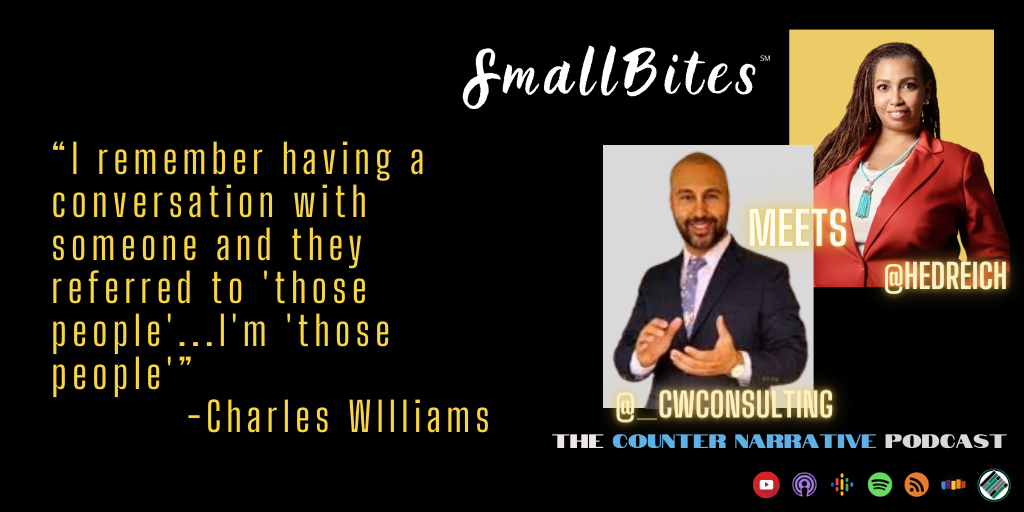
This week, I am excited to announce the launch of the #SmallBites One Question series. This season asks educators about the privilege–and the dark side–of ‘assimilation’. Follow the link to listen to an open, honest conversation on the experiences of a Black Educator teaching in White spaces in my #SmallBites Lagniappe podcast with The Counter Narrative Podcast‘s Charles Williams.

Additionally, am taking off this weekend for the observance of Good Friday and Easter. Please listen to SmallBites Lagniappe: Lead With Love, a message to my Christian friends.

This is Me Read More »

Grandma’s Hands

https://youtu.be/c0c1NzQ5Y-w

Small Bites Friday Five 3-26-21 

20-30m – Spend 30 minutes disconnecting from school and doing something you love. Cliché but true, you cannot pour from an empty cup. (Scrolling in Pinterest or Teachers Pay Teachers for class deco or activities does not count.)

15-20m – Browse these parent SEL guides from Today and the Chan Zuckerberg Initiative to find something to watch or share with your parents. Summer is coming and they need PD too!

10-15m – It’s testing season and everyone will need to support one another. Choose some cool new SEL games and activities for your campus and classroom. Common Sense Media has curated a few, like Mix it Up Lunch day from Learning for Justice (Formerly Tolerance.org).

5-10m – Review some of the SEL stats collected by Casel. In particular I noticed, that if we are giving out number grades, we—teachers, schools—are currently failing.

0-5m – From what you learned by looking at the SEL data, choose one small great SEL thing to focus on. How about class routines?

When I was a little girl, I lived in a multi-generational household. Mommie, born in 1892 (or 1893, the census records in ‘Negro’ households weren’t too exact back then) and Gammy, born in 1920 or even my mom, born in 1944 had first hand experiences with Sundown towns and lynchings.

Of course when Gammy, the neighborhood grandma, talked about race, well, through the eyes of the 2021 cultural police, it was anything BUT politically correct. But in a world where she had seen Black men pulled from their homes and beaten or lynched for “mouthing off” or being “uppity” or even just trying to vote, her experiences with White people framed her view and gave her reason to have a deep and abiding mistrust of White people.

I now understand why my family was always turned out like it was church at PTA meetings. We were fighting to be the anti-stereotypes. Most people at that school had never seen Black people up close. They believed media stereotypes and Jim Crow propaganda that told them Black people were lazy, unkempt, uneducated and that we even shuffled when we walked and only talked in high-fives, soul-handshakes and slang.

Before there was ‘socio-emotional learning’, there was my grandma. She modeled humanity and kindness, baked cookies for class that no white children ever touched, volunteered and showed up to Every. Single. PTA meeting, paying her dues before she paid the light bill. I also heard my grandmother tell me to “get the White man’s hands out of my pocket” which meant to cut the lights out (‘turn the lights off’ if you are from north of the Mason Dixon). There were other colorful phrases heard now and then, because mostly, her world was segregated, until she took me to school. She also admonished me to watch my step because ‘that white boy’s parents did not want him liking me and I might wind up in an alley dead”. She had seen it happen with her college roommate. Still, at those PTA meetings, I saw her talk politely with him and his parents because my playground pal and I were, for a time, inseparable. She bought Valentine’s day cards and gift exchange presents and always had something special to do with me when she heard that it was so-and-so’s birthday party, so much so that I was way grown before I realized that I never went to their birthday parties and they’d never come to mine.

My grandma was the person who most modeled humanity for me. She knew the neighbors, sent care packages to me and my friends at college and remembered birthdays. She was the kind of person who would call people on the anniversaries of the deaths of those they loved, the kind of person who always sent enough 5AM-freshly-fried chicken for me to share on field trips.

What does all this have to do with SEL? Well, it hopefully reminds you that we are all human, fallible, on a journey. It lets you know to love the people who are still waving the “wrong” flags or touting the “wrong” ideologies. It reminds you to look for the kindnesses they do. Look for it in the parents of your students. Look for it in your students themselves. Look for it in yourself.

Want to be really good at SEL with your students? The one BEST thing you can do for #SELday is to love and accept yourself. Only then can you grow. Only then can you love and accept others.

Grandma’s Hands Read More »

If I Had A Hammer

Watch on YouTube or listen on Anchor, or wherever podcasts are heard.

Small Bites Friday Five 3-19-21 

20-30m – Read this Bostonia article by Catherine Caldwell-Harris (@CathCHarris) on cross cultural psychology and respecting “the other side”. Dive into some of the hyperlinks, but more importantly, reflect on how you can make every disagreement as a chance to learn.

15-20m – Read this Best Life article from @SarahGCrow and write down at least 2 people or groups for each strategy you are going to implement. Yes, the people can be public people you have no valid reason for hating since you don’t know them.

10-15m – Compare and contrast this Chris Bodenner article on religion and AIDS in the 80s and these horrendous comments in the wake of the Orlando Club Pulse shooting with the subtle (and not so subtle) victim shaming of the 8 people gunned down in Atlanta spas. Think about your own reactions and how they too could be filled with more judgment than compassion. Then course correct.

5-10m – Review the media coverage on the Atlanta shooting from Fox, AP, OANN, CNN, and your local news outlet. Skim the articles or watch video and look for language that conveys bias. Need help? Here are questions from @fairmediawatch to challenge yourself.

0-5m – Read some of the comments to the above articles you found. Are we where you thought we were as a country? What things did you read that were surprising? What can you do in your corner of the world to help reduce the lack of humanity seen in some of those feeds?

I have been planning this episode for a few weeks. Big announcements, exciting changes. Talking about Spring Cue and my mic drop session following this episode. But all I can think about is the senseless loss of lives this week, the violence against the Asian community and how the response to yet another murder shadowed by racial motivations reflects the lack of regard for people who are a part non-white communities. It reminds me of what Fannie Lou Hamer said, that nobody is free until we are all free.

The fact is, our country has not provided equitable advantages for all communities and whether you want to call it racism, white supremacy, systemic inequity against BIPOC communities or something else, we have a problem. There are systems that are interwoven in the way we govern, educate, provide healthcare, accumulate wealth and even in the ways we love and hate. Those systems advantage some and disadvantage others. If ‘liberty and justice for all’ means all, if you are a patriot who believes in those words, then we need to recognize that we still have work to do, especially to make up for not giving people from non-white communities a level playing field for so long.

Today, I celebrate my 40th episode of SmallBites, I celebrate lives touched, minds changed, resolves strengthened. I celebrate the DMs and emails and even care packages I have gotten to say thank you, keep going. And as I celebrate the accomplishment, I stand, resolute to continue helping as many people as I can. Leave a review on Apple. Share an episode with your staff. Click a resource link, even through the exhaustion of teaching in a pandemic. Teach civil disagreement in your classrooms and on your campuses.

You are in the unique position to influence the next generation and that means you have the power to create change. You can ignore social issues because parents don’t understand the connection or you can talk about how social justice and SEL are inextricably linked and how they belong in every content on every grade level. You can educate your parents AND teach your students to be responsible citizens. I know I will. Because if ever one of my students is a victim of violence, if ever one of my students commits a hate crime, I want to know that I did my very best to teach them about social justice, about community beyond color and gender, about humanity over hate.

I do have a hammer and here’s to the next 40 episodes of #SmallBites.

If I Had A Hammer Read More »

Hair Love

Small Bites Friday Five Sheroes 3-12-21 

Lisa Jones, author of Bulletproof Diva, the most important book I read coming into womanhood. As the daughter of two writers, activist Amiri Baraka and “Semitic mother of African-American children”, Hettie Jones, Lisa is your go to if you want to know about color in America.

Susan L. Taylor, Essence magazine author, editor-in-chief emeritus and founder of the National CARES Mentoring Movement, was the face of op-eds, features and glossy magazines for Black women.

Sara Jordan Powell, a singer who I especially admired growing up. She sang with, and for, greats like Sally Martin, James Cleveland and even Ray Charles and Jimmy Carter. I loved her voice, but more importantly, the way she smiled and spoke to me when I was just a little girl.

Hedy Lamarr, an actress for whom I was named. She co-developed a secret radio signaling device important during the war– and to the development of today’s cell phones!

Barbara Jordan, congressional representative from Texas and a Black lawyer from an HBCU who broke down barriers and checked off a list of firsts too numerous to mention. My favorites? The woman has not one but 2 speeches in American Rhetoric’s Top 100 Speeches of the 20th Century. Mostly, though, she was a household name and resident hero where I grew up.

I remember the horrified look on my mom’s face when I told her I wanted to be white. I was 8 and I still remember the shift in the air in our yellow and orange kitchen. My momma, never at a loss for words, paused. Then she asked me why. “Because when I hang upside down on the bars I want my hair to swing too,” I informed her. The self-hatred she expected to hear about was really my desire to have what other kids had, to be what I saw around me. Hair that moved, straight hair, “good” hair…if you are Black, you have gone through all kinds of hair phases, most of them having to do with the unnecessary taming of kinks and curls into Eurocentric submission.

Even as we embrace what makes us beautiful–from the Black is Beautiful rallying cry of the 70s to the natural hairstyle trends of today, the standard of beauty that most of us have grown up with, until recently, is blonde/blue. Seeing Lupita, Viola and Michelle grace glossy covers regularly is new. Seeing models that have real bodies like in Dove campaigns is new. Embracing diversity is new. Showing it off?? Real new!

Looking at magazine covers and models for this post made me realize that we are seeing more diverse images. Beauty is being embraced in all forms, shades, colors, abilities and textures. Yes, there is still work to do to ensure that art imitates life. BUT with shorts like Hair Love and a growing number of people speaking up and speaking out, little girls who look like me have a better shot at embracing who they are, in all their natural beauty, naturally.

In honor of Women’s History Month, I celebrate all the regular women out there learning to love their thick thighs, flat chests, kinky kitchens and their ebony, brown, olive, beige or alabaster skin. Whether we are blonde/blue, brown/brown or something in between, the battle for self-acceptance knows no color lines; and if there is one thing we all need, it’s a little more self love.

Happy Women’s History month.

Hair Love Read More »

What I Like About You

Watch on YouTube or listen on Anchor, or wherever podcasts are heard.

Small Bites Friday Five 3-05-21 

20-30m – Read and internalize the outcomes of favoritism (including damage to your reputation) from this UCLA Psych Ed article based on work by Emily Cheng. The article cites studies going back to 1983. The phrase ‘bias in education’ may be new to some, but it is definitely not a new concept.

15-20m – Read this K-12 Dive synopsis and listen to Verna Myers’ Ted talk on mitigating implicit bias.

10-15m – Use this link to watch the #SmallBites Bias collection. If we reduce the big words to our own small actions, we will begin to see change for the better.

5-10m – Dig in to Jennifer Gonzales’ Single Point Rubric strategy. It will not only help you mitigate bias, it will also revolutionize the way you give feedback AND the time it takes to give valuable feedback.  

0-5m – Take this fun quiz to get a feel for the kinds of questions you can ask yourself and the kinds of preferences you should monitor yourself for.

And as promised, a name list randomizer from ClassTools.net,  so you can spin the wheel and randomly call on students.

You know that saying that you wear 20% of your clothing 80% of the time? I remember Oprah doing a whole show around it eons ago that I never hear because that statistic grabbed my attention and locked me in. As I thought about my favorite jeans, my favorite sweater, my favorite PJs with the holes that I just can’t let go of, I thought about why those things mean something.

Are they attached to a memory? Is it the way they feel? The way I feel when I am in them? Pretty much every experience and interaction connects itself to some feeling or preference we already have about something else. The color periwinkle reminds me of my favorite Easter dress ever. It was long and had puff sleeves and a sash. The question, ‘what is your favorite color?’ reminds me of my childhood bestie @Creoleladybug. It’s red and I have no idea why that question always remind me of us and our 5 year old selves. My student, the one talking about why we haven’t changed school since the industrial times so that it reflects the needs of modern society reminds me of who I want to be when I grow up. And the student who often quotes statistics and facts touted by less reliable media organizations without checking their validity reminds me of why I created #SmallBites. My conversations with each of them is valuable; they help me grow.

There is always a connection to something in us in every interaction and the more aware we are of those connections, the more we are empowered to mitigate the effects of unconscious bias in our relationships.

Trust me, you are playing favorites. But you are also, hopefully, actively aware of it and working to course correct. If you are not, consider this your wake-up call. We are all works in progress.

Use a randomizer. Use a single point rubric. All. The. Time. And the next time you eat a popsicle, pull out your favorite coffee mug or step into your favorite worn jeans, remember, there is always a reason you have your favorites. Just make sure those reasons don’t cloud your judgment and adversely impact your relationships.

What I Like About You Read More »

I Like What You Like, You Like What I Like

Watch on YouTube or listen on Anchor, or wherever podcasts are heard.

Small Bites Friday Five 2-26-2

20-30m – Explore this article by David Palank to see how likely it is that halo bias influences your teaching (spoiler alert, a lot). Then choose two strategies to mitigate your own biases, like grading anonymously or ALWAYS using a written rubric. Finally, reflect on a time when the halo effect likely played a part in a decision you made.

15-20m – Start with your youngest learners using this rich well of art and literary projects. Mandisa’s website is designed for toddlers but the projects can be easily scaled up for PK-4.

10-15m – Use this Precious Children article from PBS to help you understand why teaching acceptance is important early on, then prepare at least one of the activities for your class or personal kids and grands. My favorite line, “If your group is not diverse, display images of diversity in your community or in U.S. society.”

5-10m – Review this Nielson Group article that explains halo bias and think about how it affects your teaching.

0-5m –  Write down 5 people you know who you attribute certain traits to. For example, Kevin is tall, he must play basketball; or My co-teacher is really pretty, she must have been popular in high school. Now, write down all the reasons your assumptions might be false.

Did you know that mirroring is a real thing in which people subconsciously mimic the affectations of those they like? And even among invertebrates, there is sexual mimicry in which one sex imitates the other sex to signal interest. If you are a scientist or social scientist, you are probably cringing right now. But for us lay persons, I think the gist is clear. Imitation is more than the sincerest form of flattery, it’s how we align ourselves with those we admire.

If we like someone, we also imitate, or at least buy into, their beliefs and values. And usually, if we believe one thing that they believe, we tend to believe it all. We also tend to minimize or write off any negatives or character flaws. Conversely, if we don’t like someone, we are likely to magnify their faults, disavowing them and whatever they stand for.

We see this play out in politics, but how does this play out in education? Well, in the hundred and one discretionary decisions you make daily, it can affect students in a million and one small and large ways. For example, if you like a student, you might be tempted to round up in grading, if you dislike a student, you may round down, or just not round up. If a student impresses you, you are likely to recommend them for awards, AP courses, write reference letters, etc. If you don’t particularly fancy them, you might write them a college letter, but will it be glowing? The adjectives you choose are more likely to be based on your feelings about the student than on performance or achievement.

We say, know better, do better. But that is more than a notion unless you are committed to being a reflective practitioner in a very real, honest-with-yourself-until-it-hurts way. If you really want to be a change agent and make education better, be willing to start by taking stock of your feelings about each student. Start by reading this article, reflecting on how this bias played out in your classroom today; then make plans to course correct.

That’s how real change begins, with you doing your best for each child in front of you. Make it concrete: Read, reflect, make your own plan to be more intentional in dealing with the students you support now.

I Like What You Like, You Like What I Like Read More »

Dirty Laundry

Watch on YouTube or listen on Anchor, or wherever podcasts are heard.

Small Bites Friday Five 2-19-21

20-30m – Watch Jay Smooth’s Media Literacy crash course that delves into media strategies, our reactions to those tricks and our biases. Watch them all if you have time. If not, watch #2, #4 and #5. These are great for you, but can also be watched with a class. 

15-20m – Read this Parent’s Guide to Media Literacy from the National Association for Media Literacy and Education (NAMLE). It features sample questions for analyzing media like who made it, why was it made and how might different people interpret it. It’s also in Spanish and even Greek, if you need it.

10-15m – Reflect on the information in the above document and jot down any personal tweaks you need to make in your own media consumption. Then consider send your favorite section or even a class sketchnote of your favorite section home to parents.

5-10m – Review this Time For Kids resource for use with younger students, or this Media Smarts Break the Fake resource that includes 4 easy ways to fact check and share with friends and family.

0-5m –  Learn the words dorsolateral prefrontal cortex and watch this Above the Noise video on the brain and fake news to learn how to circumvent the way our brains react to news. Probably best with 6-12th graders he says BS (the letters, not the words) in the video. Ooohhhh…

Something dark in human nature makes us like to watch others suffer. The lions and the Christians in the Coliseum; shoot ’em ups; shocking and bad news; social media rants. America’s Funniest Home Videos and even the rash of prank Tiktoks indulge our darker side, give us the opportunity to assure ourselves that we are not as bad off as those we ridicule.

Media takes advantage of that. A message is always crafted by one person with an agenda. From the early days of yellow journalism to today’s polarized news outlets, someone crafts messages to manipulate the masses. We don’t think of our democracy as being ruled by the messages of propaganda, but considering how polarized we are and how news is as much opinion, analysis and editorial content as anything else, we should think again. So much content is needed to fill up the current 24 hour thirst for dirty laundry that we have gotten used to opinion pieces being front page news and incendiary headlines being fact.

The only thing I would like you to do this week is to watch 5 minutes of news daily from an outlet you don’t usually watch. Refrain from making negative comments or judgments. Research what you hear, if you like. But work on tweaking your own media consumption habits so that when you teach civics and citizenship–which should happen daily– you will be able to teach your students to think critically, not to think like you.

Dirty Laundry Read More »