
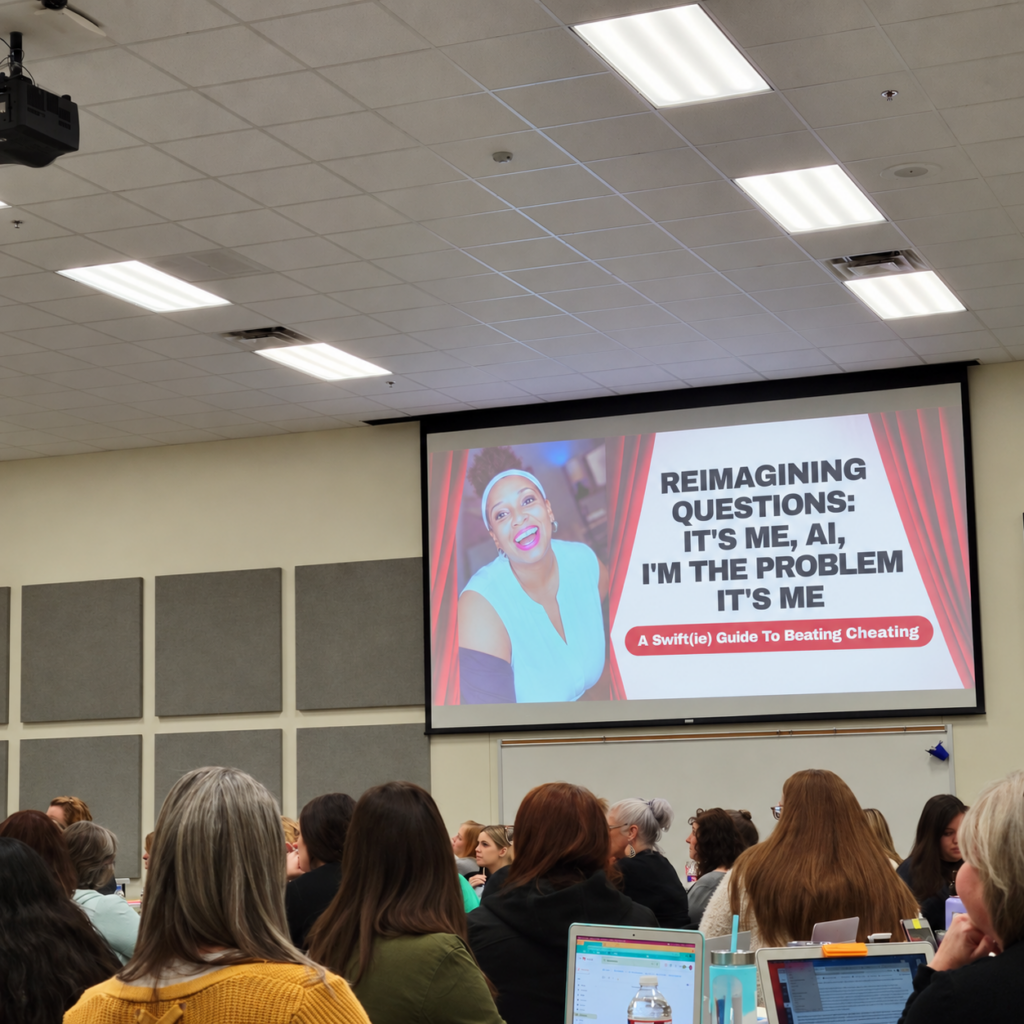
I can’t spell anymore.
That’s a Big Thing. I was a spelling bee winner as a child. I was the kid reading a dictionary after bedtime with a flashlight, internalizing word parts and etymology. And now? I can’t spell “anomaly” without that pesky red line appearing. I know because it just happened, and it’s why I’m writing this blog.
It’s not that spelling is so hugely important in and of itself. But when spellcheck became a thing—and yes, that happened within my lifetime—teachers warned that we would lose our ability to spell.
And here I am, proof in the pudding.
The lesson of spellcheck is not that technology destroys skills. It is that using technology without guidance, boundaries, or intentional practice can weaken the very capabilities it should help us strengthen.
Spellcheck Was Never the Real Problem
Now, if you think this is an AI warning, it is—but not in the way you think.
Using spellcheck did wreck my ability to spell. Now I shoot in the dark, hit “accept,” and never look back. But what if someone had taught me to turn it off for certain tasks? What if I had been taught to keep track of the words I misspelled? What if I had been given some guidance—any guidance—on how to use the tool to further build my capabilities?
The issue was not spellcheck. The issue was unchecked spellcheck. The bigger issue was that we spent a lot of time fighting over something that was already here, something that fundamentally changed the centrality of spelling to education and writing.
I don’t walk to work; I drive. Because of that, I probably can’t walk 15 miles each morning and another 15 each afternoon without consequence. I also can no longer write a whole article without at least one or two red lines popping up. But what is the actual consequence? Proofing tools now augment my ability to write efficiently and without errors while my brain cells are used for more complex tasks. By the way, the squiggly red line just taught me that “brain cells” is two words, not one. Integrated writing assistants will now do the same for this generation of students. Not might. Will.
What Cell Phones Should Have Taught Schools
While we argue in schools about AI or no AI, students are becoming comfortable with these tools. They are also outpacing many of their educators and other caring adults in both the use and abuse of them.
According to Pew Research Center’s 2026 report on teen AI use, 64% of U.S. teens use AI chatbots, and 54% have used them for help with schoolwork. Students are not waiting for us to finish debating.
Case in point: We spent our formative years as a society debating the safety and propriety of cell-phone use instead of learning how to use cell phones and their associated technologies wisely.
Now we’re banning cell phones in schools, largely because we never developed restraint, established boundaries, or taught practical strategies for responsible use.
We focused on debating the arrival of the technology without planning for a future shaped by it.
AI Is Already Part of Education
AI is here. It is already integrated into systems we barely think about, just as the internet quietly became integrated into our phones. While we debate what constitutes appropriate use, we also need to envision—and prepare for—a future in which AI is simply a fact of life. That means paying attention now. Learning now. Teaching now.
Authentic Learning Builds Critical Thinking
If you want students to develop critical-thinking skills, give them authentic tasks that require those skills in real time. Paper assignments have always been a poor substitute for authentic learning.
Teach—and test—patterns, math, and even coding with fruit, buttons, coins, and other real objects instead of relying only on worksheets. Build early writing and ELA skills through oral storytelling, transcripts, and book authoring. Teach science through simple lab work and cooking. Teach social sciences through community and family projects.
And while you ensure that students learn the basic skills you are so certain they will need—because they might not need all of them in the ways we once did—work on your own skills, too.
Take advantage of any number of free AI courses, including the Google AI Educator Series. First, sign in for the Google AI Educator Series and choose Hedreich Nichols when asked how you heard about it. Then begin the free Google AI Educator Series learning.
Tell ’em I sent you. Literally.
Get literate, then practice. Because if you really want to prepare students for their future, you need to be prepared to guide them on their way.
Additional Free AI Courses for Educators
Here are a few more free courses that can help you catch up to your students, get ahead, and ensure that they can move forward safely and successfully in the era of AI.
-
AI for Productivity (Coursera)
The focus: Streamlining your daily administrative workload.
Why take it: This practical course explores ways to use tools like ChatGPT and Gemini to automate administrative tasks, summarize long documents, and draft emails or newsletters in seconds. -
AI 101 for Educators (Code.org, Khan Academy, and ISTE)
The focus: Preparing teachers to guide students through the AI landscape.
Why take it: It provides classroom frameworks, lesson plans, and discussion ideas to help K–12 students understand topics such as algorithmic bias, digital ethics, and responsible AI use. -
Microsoft AI for Educators Learning Path
The focus: Expanding classroom technology use and customized student support.
Why take it: This learning path moves beyond chatbots to explore Microsoft 365 Copilot, specialized Learning Accelerators that support student growth, and gamified approaches to ethics through Minecraft Education. -
Google Machine Learning Crash Course
The focus: Demystifying how AI algorithms “think.”
Why take it: It is fast-paced, highly visual, and filled with interactive exercises. It is a strong choice for educators who want a deeper conceptual understanding of the “magic” behind AI without immediately diving into advanced code. -
Harvard CS50’s Introduction to Artificial Intelligence with Python
The focus: Building artificial intelligence from scratch.
Why take it: This rigorous, university-level curriculum is suited to tech-savvy educators and computer science teachers. It explores the mathematical models, probability, and Python code that drive modern machine learning. I might even use it as curriculum or extension work in a computer science classroom!
Educators, Let’s Learn AI to Guide Students
The days when proofing tools were seen as special technologies are long gone. Most of us now move through the day with a phone, calculator, computer, AI assistant, banking tool, and more in our pockets—often without giving any of them much thought. And yes, those pocket tools can cause mayhem in the classroom. With cell phones, we waited until the stallion had been roaming free for decades before trying to manage it. Let’s not make the same mistake with AI.
Educators, get on board. Get prepared. Then guide students safely into a future that AI will absolutely be a part of, until the next unimaginable thing comes along.