Hedreich Nichols

Uncategorized

A Spoonful of Sugar


Watch on YouTube or listen on Anchor, or wherever podcasts are heard

This week’s Friday Five comes in the form of a chart with activities to help you make a difference.

Trade Guilt for Action

GroupActivity
Littles (preK–grade 3)Have students pair up and make Venn diagrams comparing and contrasting themselves and their partner.  Have them talk about the ways they are the same  and how they are different. Ask students why differences are important and how they enrich a group. Make a class pledge to be kind and inclusive.
Middles (grades 4–7)Have students make the same kind of Venn diagram but extend choices to more complex ones like identity, beliefs, and favorite music genres. Ask students why choices and identities should all be valued equally. Stress the importance of respecting one another and have them create a poster or digital flyer campaign to be a visual reminder of what they learned.
SecondaryHave groups research divergent ideological profiles like Christian and Muslim; Republican and Democrat; socialist and capitalist, etc. Have them examine the similarities between the divergent pairs and discuss why they think there is often such strife between groups. Have students pose solutions and create a “say this, not that” chart to help students respond more respectfully to those with whom they disagree.
StaffHave staff complete the high school activity and discuss how talking about divergent ideologies impacts their teaching. Have educators role play to come up with ways to ensure respectful, civil disagreements in the classroom.
Parents and CommunitySend student exemplars of the various activities home in a newsletter. Offer prizes for students and families who come up with their own activities to become more mindful of biases and “othering”.

When talking about creating more equitable systems in education and beyond, there are so many triggering phrases. “White fragility, White supremacy, White guilt, White privilege…it’s understandable that districts and politicians fight against the propagation of curriculum the feel includes language that makes students feel guilty for being White.

What Do You Hope to Achieve?

What do those phrases achieve? Do they cause good guilt, the kind that moves people to moral action? Or do they just make people feel bad and shut down? My guess is, the latter. When we use language that causes people to turn away before looking critically at why they feel bad, we miss the mark. The goal of talking about systemic inequities is to create more equitable systems. That can only happen when we use persuasion. Yes, guilt works (helLO, how many of us never miss gatherings and events out of a sense of guilt and obligation). But while guilt and obligation sometimes get compliance, they don’t produce change.

In Finding Your Blind Spots, I talk about going for less guilt and more accountability. What can you be accountable for TODAY that will take a small bite out of inequities that you see in the world? What can you learn today that will impact your students positively, especially those who may lack equal access and opportunities? Most of all, what guilt can you let go of? When you look critically at the systems that marginalize and disenfranchise some, what actions can you take to make them better?

Action and Accountability

The best anecdote for guilt is action. Feel bad about not going to the gym? Go to the gym. Feel bad about eating too much junk food? Eat salad. Feel bad that so many stories are missing in current curricula? Find additional stories or teach your kids research and media literacy skills and let them find stories.

I understand that those words and terms have validity, but so does knowing that ‘these jeans really do make my butt look big’. Depending on how I feel about my butt and who tells me that it looks big, that phrase just might make me give up jeans to hide under mumus and big roomy tops. What is our purpose in using terms like White guilt and White fragility? Who is the audience? Where are they on their journey and what action will those words cause them to take? Will using those phrases help or hinder?

Go for the Goal

I don’t advocate tiptoeing around feelings or helping people to keep blinders on. There are inequities baked into our systems that we need to change; and that’s not comfortable to talk about. However, when we talk about the changes that need to take place, let’s do so in a way that makes a positive difference. If that means we use a spoonful of sugar to get the medicine to go down, so be it. Keep the end goal in view.

And if you need some sugar, let me know. I have extra.

A Spoonful of Sugar Read More »

Indigenous Peoples Day vs. Columbus Day

Who are our heroes? What do we celebrate? Why do we celebrate them? And if it’s still Hispanic Heritage month, do we have to deal with it at all? So many questions. I have no answers. Except, decide to look beyond the surface.

It seems Columbus day was not all about Columbus after all. The holiday was always embroiled in turmoil and oppression. Now, this day means “see me” to Native American tribes. An acknowledgement of the decimation, genocide, sexual abuse and other crimes committed against indigenous peoples is what the day is about. As a start. So, let’s start. Read up on the early colonial lack of regard for life of non-Christian, non-western European people. And tomorrow, reflect and remember. And mostly, share this perspective.

Voices that have been silenced should be silenced no more.

Indigenous Peoples Day vs. Columbus Day Read More »

…Do I Fit In?

Watch on YouTube or listen on Anchor, or wherever podcasts are heard.

Small Bites Friday Five 10-8-21:

20-30m – Visit the University of California San Francisco’s Youtube page for a phenomenal selection of videos on belonging, diversity and inclusivity. Start with the “Faces of…” series, featuring diverse student stories in their own words.

15-20m – Listen to this Journey to Belonging podcast with Ilene Winokur entitled “Belonging Before Blooms”. As a matter of fact, bookmark the podcast. She explores the theme of belonging and it’s importance with a variety of inspiring educators from across the globe.

10-15m – Visit the University of California San Francisco’s LGBTQ+ YouTube resource center. The 7 minute introduction video is especially helpful for explaining diverse terms and definitions.

5-10m – Read this “Toolkit for ‘You Belong Here’ article from Learning for Justice” (formerly Teaching Tolerance) on the impact of the student-teacher diversity gap in our nation. Helping diverse students feel a sense of belonging means ensuring that diverse teachers feel a sense of belonging too.

0-5m – The stigma around mental health issues impact how we “other”, so once again, visit the UCSF’s Youtube page to listen to Kristin’s story, a story about anxiety and depression. Reflect on how to better include students struggling with mental health issues, both the readily visible and the invisible ones.

“My Kids”

If you listen to teachers talk about their students, they often refer to “my kids”. I too have often said “my personal kid” to ensure that people know which “my kids” I was talking about. I don’t have any research, but I am willing to bet that not caring if kids fit in or don’t fit in is not common in this profession. Still, when kids are asked whether or not they fit in or not, the answers are all too often less than positive. How can we turn that around?

In Finding Your Blind Spots, the first chapter talks all about how we “other”. “Othering” is what we do when we categorize people as different, as the “them” to our “us”. Othering is not Black or White. It’s not male, female or non-binary. It’s what we do when we come across someone who looks, behaves, thinks or even ‘feels’ different. We other the mom that dresses “too sexy”. We other the guy who doesn’t like sports. We other the person who doesn’t get our jokes. And even though we don’t mean to, we other students in our class who are unlike us (or maybe too much like us) every day.

Be Intentional

I can use all the Big Bad Diversity Words and talk about DEI, the ‘isms”, CRT, race politics, or even a “gay agenda”. Those words usually send people off to rantville in all sorts of political directions. But this space is for educators. And teachers, well, we believe that our kids should feel like they belong, full stop. So when some inflammatory headline threatens to pull you in one direction or another, I am asking you to remember that they are all “your kids”.

Creating classroom and campus spaces that welcome every student every day should be the goal. But like with any goal, reaching it takes intentionality. Besides using the resources above, do the following:

  • Consider taking a few of the Harvard Implicit Bias gamified tests to find your own blind spots.
  • Use the above information to make an action plan based on your personal hidden biases (i.e., refer fewer BIPOC students to the office; learn more about the LGBTQ+ community; make more opportunities for non-male students in STEM courses and clubs, etc.)
  • Look at your roster and pick 2 students with whom your relationship could be better. Have a transparent conversation with them, letting them know that you feel you could get to know each other better. Then, make time to get to know them better. Let them get to know you better as well.
Lead the Way

I am well aware that sometimes, it’s not teachers but students who often make other students feel “othered”. Explicit teaching on kindness and humanity are as necessary as lessons in reading and math. Our kids are watching us. They hear what we say and feel what we don’t say. Your disdain for “the bad kid” becomes theirs. Your barely perceptible annoyance comes across loud and clear to a kid already struggling to fit in. Make it a point to check in with yourself. Admit to yourself how you feel about your kids. Then be intentional about changing anything that might cause a child to feel othered.

When you are intentional about creating a sense of belonging for all your kids, when you teach your kids to do the same for each other, you’ll have a foundational culture shift that changes trajectories for your students. Let’s be intentional about creating a sense of belonging for all our kids.

As Ilene says, belonging before blooms.

…Do I Fit In? Read More »

Redlining, Redistricting and Learning Loss

No Man is an Island

If ‘no man is an island, no man stands alone’, then the same is probably true of schools. A school is not an island, separate from the community it supports. As we look for ways to close ‘learning gaps’ and combat ‘learning loss’, let’s first remember that until the 70s, this country was still legally legally non-White student access to the same education it provided White students. That means that 50-something Gen Xers–especially in the south– were just beginning to go to integrated schools. It also means that many teachers had to teach children they grew up believing were inferior.

Separate was never equal, but integration came with its own problems. The educational gaps we talk about began when it was illegal for my forebears to learn to read. And the great-grandmother who helped raise me was born only one generation out of slavery, so that was not so long ago.The disparities were always there, COVID has not unearthed something new. However, how can we acknowledge what the pandemic has highlighted and use that knowledge to make our educational system better for all students? 

I See, I Wonder…

This week, start with a little research. Archie Bunker, famed protagonist of Norman Lear’s All in the Family,  thought the playing field was level and that “Spics and Spooks” were just too lazy to get their piece of the American Dream. Let’s see if that holds true, or if there is inequity baked into the systems. Do some research on redlining, redistricting and gentrification. Oh, and here is a recent article about redistricting in my home state of Texas. As you read, make a few notes. What do you notice? What do you wonder? How is what you read related to ‘learning gaps’?Feel free to reach out to me on Twitter or IG and let me know your thoughts. Knowledge is power, and learning about the roots of educational gaps will help us become real change makers. 

Additional resources:

The Counter Narrative Podcast on Redlining

All in the Family S1E1

Redlining, Redistricting and Learning Loss Read More »

Don’t Stop Believin’

Watch on YouTube or listen on Anchor, or wherever podcasts are heard.

Small Bites Friday Five 10-1-21:

20-30m – Pull out your college reading skills and read pp. 1-20 of “Academic Discourse and the Formation of an Academic Identity: Minority College Students and the Hidden Curriculum” from John W. White of the University of North Florida and Patrick R. Lowenthal of the University of Colorado at Denver to gain context for and understanding of hidden curriculum.

15-20m – Familiarize yourself with the trauma experienced by community members of the non-dominant culture with this research article, “Challenging Definitions of Psychological Trauma: Connecting Racial Microaggressions and Traumatic Stress” from Kevin Nadal and Tanya Erazo and Rukiya King. Can you empathize?

10-15m – Explore terms and inclusive language in GLAAD’s reference guide, intended for journalists, useful for all. Chances are, if you are not a member of the LGBTQ+ community or someone who keeps up with race and gender linguistic changes, you may not be as sensitive to inclusive language standards as you should be.

5-10m – Use the above link and scroll down to the glossary of terms. An inclusive classroom begins with inclusive, validating language.

0-5m – Read Douglas Starr’s take on scientist Jennifer Eberhardt’s work on implicit bias. As the article’s pullquote says, “She is taking this world that black people have always known about and translating it into the principles and building blocks of universal human psychology”.

Archie Bunker, All American Hero

This week, I watched “All in the Family“, a sitcom from the early 1970’s (start at 8:30 and watch, if you have Amazon). I played a portion of it for my son and he had to ask, what year that was. When I told him, he wanted to know how it could seem so current? As the protagonist used degrading terms towards women, Blacks, Hispanics and liberals, it all sounded so familiar.

Sadly, half a century later, the arguments and issues are the same. The group with power and privilege is trying to hang on to that power and privilege. Before you click away, let me explain. Archie Bunker, a working class White male, really believed that America was for him and those who looked like him. Anyone else was seen as an interloper. Personally, being neither White nor male, this often feels like my world.

Equity and Access

Watching the news of redlining and redistricting reminds me that systems still hinder equitable access to wealth and education. Reading about voter legislation that makes voting harder for disenfranchised populations in many ways feels more like the 1960s than the 2020s. In short, there is still much work to do at the individual, community and systemic levels in and beyond our classrooms. How can we make the American Dream is accessible for all?

Make that Change

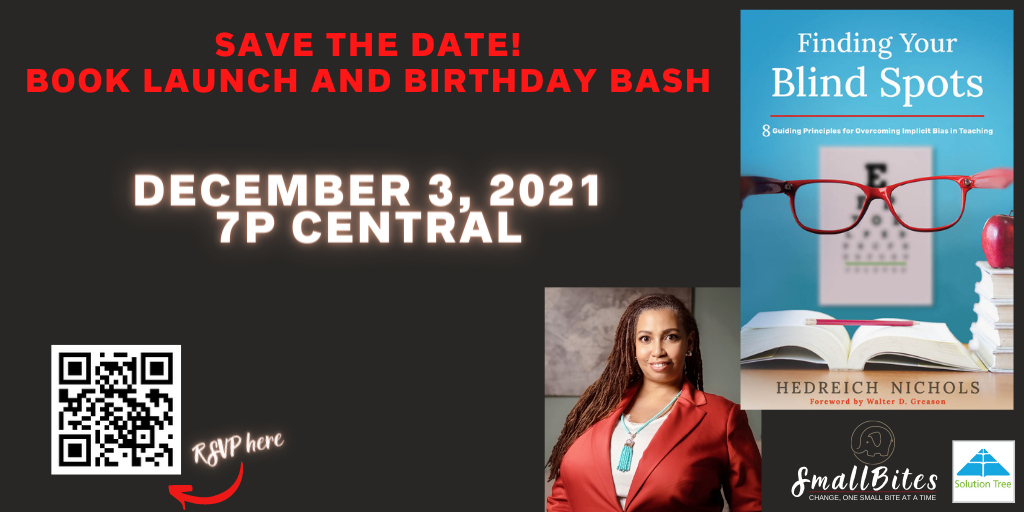
For those still trying to tackle the hard work we do in creating access and equity on our campuses, Finding Your Blind Spots, my upcoming Solution Tree book, can help. Before the December 3rd release, I will be going through each of the book’s guiding principles to help you transform your campus one small bite at a time.

Begin by using the resources above to create a learning environment that welcomes and validates every student. I’ll see you next week with more.

Don’t Stop Believin’ Read More »

I’ll Rise Up

Watch on YouTube or listen on Anchor, or wherever podcasts are heard.

Small Bites Friday Five 9-17-21:

Encouragement from @DorisASantoro – Rise up with strategies and information on burnout vs. teacher demoralization in this Edweek article that helps you understand what you’re dealing with and how to deal with it.

Encouragement from @PlanBookCom – Rise up, if you’ve decided that burnout is where you’re heading, with these strategies from PlanBook and don’t be afraid to reach out for help.

Encouragement from @Angela_Watson – Rise up and Say goodbye to Teacher Tired with this article and resources from Angela Watson. I learned about her 40 hour work week resources from Cult of Pedagogy. Some resources are paid, but even the free ones will revolutionize the way you spend your time.

Encouragement from @weareteachers – Rise up and giggle. Sometimes, laughter is the best medicine, and we teachers are a funny lot! Start here then follow them on Twitter and Instagram. Cause, when you run out of tears, sometimes all you can do is laugh.

Encouragement from M.L. Brown – If laughter and strategies no longer work, rise up with this Medium article from an educator who decided that enough was enough. For those who have made that decision, let’s be supportive, knowing that sometimes, enough really is enough.

Ever have one of those weeks where it seemed nothing you did made an impact? Welcome to my week.

Moving from guiding student learning in the classroom to impacting student learning district wide are two very different situations. The joy of watching students learn, achieve, grow, fail, fail again, then succeed; the joy that fuels you when the exhaustion kicks in, was missing. I felt it acutely.

I was not prepared for the long game that working at the district level is. Oh, I knew it, understood how it would be intellectually. But I was not prepared for a close up, personal view of the unyielding underbelly of this albatross we call an educational system. You’d think teaching about systemic inequities would have given me a clue, and it has –which only serves to add to the feeling of futility.

This week, I am humbled at how incremental the change is in the grand scheme of things. That humility makes me want to cry into a glass of milk. That humble place is also a place of remembering: “Define Your Why“, as author and educator Barbara Bray says. Either I believe that I can be an agent of change one small bite at a time, or I don’t. The system needs to change, that’s why I do what I do. And so, I’ll dry my tears and start over. Because futility and hopelessness are just not an option.

Note: This episode is dedicated to educator Sha’Lon Campbell, an inspiring administrator who this week, by sheer force of will, launched two virtual school options for our district. Mr. Rogers always said, look for the helpers. She was that heroic helper this week!

I’ll Rise Up Read More »

SmallBites Lagniappe: Are We Asking Schools to Do Too Much?

Also available on Apple Podcasts, Google Podcasts and wherever fine podcasts are heard.

This Monday’s Lagniappe episode continues to explore “learning loss” through an Education Week article by Mark Lieberman in which he cites instances of all the wraparound services provided, often as mandates without funding. He writes, “All the while, we’re asking schools to accomplish more than what their funding allows and their employees to do far more than they’ve been trained to do. And we’ve been doing it for a long time.”

Truer words have never been spoken.

How do we advocate for ourselves, our students and our schools in order to get what we need so that we, as educators can concentrate on teaching and learning? How do we look for more sensible ways to check for understanding (read: less time and money intensive) so that we can concentrate on teaching and learning? How do we ensure that students get “wraparound services” through appropriate channels so that we can concentrate on teaching and learning?

Beyond Buying Breakfast Bars

I am only just beginning my research on “learning gaps” as a societal problem rather than an educational one, and I look forward to your accompanying me on this journey. At this stage, I know that activism (advocacy + action) as well as community and industry partnerships need to be a part of the equation.Vote. Vote every time the polls open. The smaller the election, the better your chances are that the candidates have something to do with your community directly. That’s activism and it’s easy. If you’re feeling fancy, run for school board.

Let’s Do More Than #Clear the Lists

Go beyond #clearthelists. We support each other while buying supplies for our own classrooms. We ask and offer each other for favors and help. That’s community, but let’s tap into our local communities. Make parents a welcome part of campus life (once COVID is under control). Ask them to donate a dollar, a book, a bag of treats. Have them help with hall and carline monitoring. Parents are not the enemy and strong parental involvement is one metric that positively impacts student outcomes. Here are some examples of strong community programs. Build relationships with business owners. As it turns out, I’m late to the game, being aware of college industry partnerships but not K-12 partnerships. Here’s a start, with worksheets and resources you can adapt to help you get set up.

I will never let a student go hungry, and I do not know a teacher who would, even to support the longterm goal of not “propping up the system”. And yet, I am sure that schools are being asked to do too much. 

SmallBites Lagniappe: Are We Asking Schools to Do Too Much? Read More »

Mi Forma de Sentir

Watch on YouTube or listen on Anchor, or wherever podcasts are heard.

Small Bites Friday Five 9-17-21:

Musicians – Check out this blog post from All Classical Portland to learn about well known classical composers of Hispanic heritage.

Mathematicians – Want to highlight Hispanic mathematical perspectives? Lathisms has a great collection of resources and podcasts– great for this month and next month. And the next…

Historians – There is an African proverb that says, “until the lion has his own scribe, he will always be the villain in the story”. The American Historical Association’s Perspectives on History online magazine offers an alternative to the perspectives we often see with articles about Hispanic and Latinx people by Hispanic and Latinx people.

Scientists – Postdoc fellow Christina Termini gets the win for her Cell Mentor article featuring 100 diverse Hispanic scientists. The article gets bonus points because they are all living! Alive means they can lead seminars or maybe that your students can follow them on social media. And maybe a couple of them would even have time to speak to your class.

Writers – The Palabras archive at the Library of Congress has a stellar collection of interview recordings and podcasts, as well as useful links like the Hispanic Reading Room. The Hispanic Reading Room provides resources from individual Afro Latinx countries. Diversity is better when it values and validates specificity.

Before the Pandemic, I was working intensively on my Spanish. Serving my student population well meant communicating directly with my families and that meant being able to talk to them. I already speak 2 languages and butcher a couple more, but this would be my first time learning a language outside of an immersion situation.

Learning Spanish made me see my students differently. It changed how they viewed me as well. When I responded to side conversations about “mi novio” or stopped to sing the chorus of a song they played at lunch, I was building a bridge, one that connected their home culture to the school culture. In me, they saw a teacher who cared enough to try–and fail.

Building that bridge allowed me to critically re-examine inclusion in my classroom. A 7 hour school day’s to do list holds a limited amount of time for good differentiation, even for the best teachers. Seeing ‘boys and girls’ or ‘Black and Brown’ kids helps teachers to file kids into groups in order to make academic and social sense of concepts like ‘differentiation’, ‘inclusion’, ‘diversity’ and ‘culturally responsive’. Teaching in a school with ‘Black and Brown’ kids is one thing. Teaching Black kids, Pakistani kids, Kenyan kids, Peruvian Kids, Mexican kids, etc., is different. That kind of “seeing” kids, means the difference between celebrating diversity and creating an inclusive learning environment.

Including monthly highlights is good. Integrating cultural differences and diverse stories all year is better. Remember the ‘all about me’ you did last month? How can you use that information to highlight diverse stories that are relevant to the kids you teach? How can you promote diverse heroes, scientists, mathematicians, writers, musicians, etc.? Hopefully the resources above will help.

I am glad that we highlight diverse contributions during #HispanicHeritageMonth and I will always be here for the resources. I will be, however, happy when the diverse greats are a part of our daily lessons so that the need to celebrate months slowly melts into the pot.

Mi Forma de Sentir Read More »

If I Ever Lose My Faith in You

Watch on YouTube or listen on Anchor, or wherever podcasts are heard.

Small Bites Friday Five 9-10-21:

20-30m – Skim the 51 page Learning Loss handbook from the Human Restoration Project. If you have more time, read it in its entirety over the next few days and make an action plan for implementing your new knowledge.

15-20m – Read and reflect on the information and questions on pages 11-17 of the above mentioned Learning Loss Handbook. Consider whether or not your answers to the questions on page 17 are in alignment with your daily practice.

10-15m – Comb through the Brown Center report on American testing trends. Use the information to inform your practice–and your activism.

5-10m – Read this article from Augsburg professors Jennifer Diaz, Ph.D. and Joaquin Muñoz, Ph.D quoted in the blog below and follow the hyperlinks.

0-5m – Read this article from Americorp’s City Year on why “learning loss” is not the best term.

The Data Monster

This school year, and every one after it, comes down to what you believe. Either you believe that children are our future and that they will make their way in spite of , or maybe because of all that they have endured; of you believe the Data Monster who tells you that the ‘years of loss’ they have experienced during the pandemic must be caught up, or all will be lost. If you believe that, than you’ve lost faith in your kids. Worse, you’ve lost faith in humanity.

First, I assure you, I am not a naive optimist who believes that “learning loss” has no impact. I just know that norms on standardized tests is not the only measure of learning. The flexibility and life skills this generation has learned are unparalleled. And the skills they’ve learned surviving wildfires, insurrections, hurricanes and tundra like freezes without power will help them through life’s challenges like no amount of Algebra II would. Although, surprisingly, the pandemic even gave us some math gains.

Yes, there is impact, and yes, in some populations the numbers are terrifying. But how valid and reliable are the numbers?

Testing Reliability and Validity

Standardized tests designed for the learning achieved in 2019 are today neither reliable nor valid. Reliability refers to how dependably or consistently a test measures a characteristic. If a person takes the test again, will he or she get a similar test score, or a much different score? So, if a student from a similar demographic and a similar home and school environment with a similar IQ, with the same grades were to be taught by the same teacher today, chances are, that student would not score similarly on the test.

Further, test validity is the extent to which a test accurately measures what it is supposed to measure. SInce every educational testing instrument currently measures knowledge acquired during 187ish routine filled days balanced by consistent–or at least predictably inconsistent–home environments, they are not designed for measuring pandemic era learning. Why are we measuring what would have been as though we are measuring what is?

Look at it like a ruler with two sides. We are no longer measuring inches, it’s time to turn the ruler around and use another unit of measure. For educators and administrators that means pushing back against the narrative that says our students have lost something.

Augsburg professors Jennifer Diaz, Ph.D. and Joaquin Muñoz, Ph.D., put it this way, “Perhaps unintentionally, “learning loss” demonizes some family and community experiences, while maintaining oppressive, dominant race and class-based views of education. Could something other than school-based, oppressive structures (like testing, in particular) become indicative of students’ learning?”

New Measures for a New Day

It’s time to fight back. Think less about getting kids caught up to the 2019 standard and think more about giving them rich learning experiences today. I understand that our most vulnerable populations will not be where we expected them to be at graduation. But that expectation is from another time and the college and job market will be flooded with a global population in the same situation. We don’t need to catch our kids up, we need our testing developers to catch up. Or we need to find new measures altogether. And as we catch up and realize that there will be a new standard; that there is a new standard, we can begin to teach from the place where we realize how much our kids have gained. After all, they are surviving a Pandemic and I have faith that they will be ok.

Sources:

https://en.wikipedia.org/wiki/Test_validity

https://hr-guide.com/Testing_and_Assessment/Reliability_and_Validity.htm

Enjoy your coffee!

If I Ever Lose My Faith in You Read More »

New Day

Remember back in May when you were exhausted after a year of COVID-era pivoting? Remember watching life returning to some new normal that resembled the old normal just enough? Remember how you began to look forward to a new school year? Well, this isn’t quite what we were expecting.

This year, we are starting off the school year watching in disbelief as parents attack school board members and governors sue cities and districts. We’re starting the year trying to explain why we’re no longer helping in Afghanistan or why we were there in the first place. In the midst of ongoing anxiety about the rampant Delta variant we’re welcoming our kids back to school and trying to teach 2nd graders kindergarten routines. With some schools shuttering to stop COVID spread and most schools employing limited mitigation measures, it feels a lot like last year.

This Year Is NOT Last Year

In 2020, COVID was new. Students didn’t have devices. We did not know how to feed students experiencing food insecurity. We couldn’t fathom teaching online because we never had. This year is different. Stop, breathe, remember. We’ve learned so much in the last 18 months. Clearly not enough to make this year a walk in the park or keep us from pivoting. But, oft, self care begins with finding the upside. You will thrive this year by reminding yourself how much you learned last year.

Many more students have devices and can access virtual learning.

We now have experience in virtual teaching.

We know how to get students fed in case schools close.

Many more people are vaccinated and unlikely to die if infected.

This year will not be easy, and the statements above probably don’t make you any less exhausted or any more motivated. After hospital staff, I think educators are probably the group most traumatised after last year. But, since most of us are doing our best to pull it together for our students, here are a couple of things that might help:

Streamline Your Systems

Be intentional about teaching POWER standards and consider working across curriculum to reduce everyone’s load. Assigning science projects that have a process journal component? Share them with the ELA teacher and have her provide writing feedback while you assess science content.

Automate learning assessments. Utilize apps like Quizizz, Plickers and Edpuzzle that grade automatically and integrate with multiple LMSs. If you have to create your own checks for learning, use your school’s LMS integrated assessments or set up a self grading Google form like this one from Alice Keeler. Consider going gradeless and using growth portfolios. Whatever you do, find an alternative to grading for hours at the end of the school day.

Make socio-emotional learning a priority. Not an emoji check-in, not a new curriculum, but socio-emotional learning that comes from mutual respect and real relationships.

Reject the need to be the teacher you were in 2019. That time is gone and comparing what you did then to what you did now will only end in frustration. Build solid relationships with your students. Teach in a way that brings you and your students joy THIS year. Make it a priority. We are at a different place than we would have been and that means we have a new standard. Let the testers and data nerds catch up. Even if students graduate having completed pre-algebra instead of algebra 2 or calculus, they will be just fine, thank you very much.

Accept that things are different.

The pandemic has changed us all. Everything about education has–or needs to–change. Students are traumatized, educators burnt out. Students and teachers alike have left the physical classroom for good. For students who stay, we have a duty to make a difference and that may include letting our voices be heard in political arenas where decisions are too often made by non-educators.

For educators who stay, it’s essential to find a healthy self-care strategy that allows us to take care of ourselves, our families, our students and our teaching duties. (By healthy, I mean not diving all weekend into a bag of chips and a bottle–or 3–of wine.)Try to get some movement in, but if curling up with a good book is what rejuvenates you, do that. Binge watching old episodes of Grey’s or Naked and Afraid? Go for it. Axe throwing or hammering something incessantly? Go ahead, get the aggression out. Mostly, GIVE YOURSELF PERMISSION to do what works for you. Yes, there are some silver linings, but if you don’t keep yourself healthy and happy you won’t see the good stuff.

And I promise, even this year, there will be good stuff.

New Day Read More »