If you have ever spoken to me, you will know that I discovered Grey’s Anatomy way late, but I fell HARD! Just Breathe, one of the episode themes, comes to mind this year. I will not give you much to think about, reflect on or learn, other than this:
How can you be better? Not what can you do, not who can you serve with increasing data based efficacy, but how can you be better? Do you need to do less? Ask for more help? Be more self aware and intentional? What will bring you more joy? Being better should bring you more joy and hopefully you’ll have one of those end of year epiphanies about what brings you more joy.
Here are a couple of fun things I’ve discovered that bring me joy–I play Among Us. My students and personal kid love it, and playing with them is a great way to bond. If you like plain old silliness, this is my new fave, https://findtheinvisiblecow.com/. Of course, if you need a bit of philanthropy, Free Rice is a great go to. It’s great for those SDG fans!
If, however, your mind is too clogged because you worry about your kids, here are some answers and resources, reposted from March:
Finally for some, no matter how great your virtual teaching is, this time will be a nightmare. Consider using your resources to help those who may need more than just an internet connection. Here are some national links that connect you to resources in local communities, I’m sure there are many others.
You may be the first person to sense that something is wrong and that’s a big responsibility. But I think most of us signed up because we genuinely care so let’s move from empathy to action when we see students in need.
Now, once you’ve done all you can do, just breathe. Take care of you so you can pour from a full cup. Stay safe and I will see you in the new year.
15-20m – Read this HuffPost article on the “depressing truth about names and racial bias” then head down the rabbit hole with the hyperlinks.
10-15m – Read the story of enslaved rape victim Celia who was hanged for killing her master and rapist because according to the courts “a slave woman had no virtue that the law would protect against a master’s lust” .
5-10m – Keep challenging your thinking and biases. Here are a few more examples of biases from Practical Psychology to guard against.
0-5m –Use this form to let me know what issues of racism and bias you are struggling with as you work to become a more inclusive educator and let’s start a dialogue. I will be opening up a cohort in January so that we can talk more in depth about HOW to make small changes with big impact.
Sometimes, the smallest, most insignificant thing can be filled with such great humanity. Mr. C., this is for you:
As with many employee groups, my grade level team has a group chat. We trade important information throughout the day, send each other reminders and engage in witticism that only an educator would find funny. Two weeks ago, one text came through, unremarkable, yet significant. A teacher, White, male, needed to communicate about a student. He wrote her first name only, also not remarkable. What was remarkable, for me anyway, was that her name was spelled perfectly. I will call her Sha’ Niqua. As I write this, my computer underlines it in red, denoting an error. But there is no error. The apostrophe, spacing and capitalization all meant something to parents who were excited about the birth of their child. They mean something to the creative, smart 7th grader whose name I see displayed on my screen each class because her camera doesn’t work.
This teacher didn’t write “Shaniqua” or “ShaNiqua”. He didn’t write “S.P.”, convincing himself that it was better for FERPA, but really writing it because he couldn’t be bothered to remember where all the spaces and apostrophes go.
Her name is Sha’Niqua and this teacher, in the midst of all the 2020 craziness, took time to write it correctly. He doesn’t know that it moved me to tears. He just did his job. But I have been in rooms in which teachers roll their eyes or say some not-even-close moniker because they forget that addressing a student correctly by name is basic to connection, which influences learning outcomes.
I have been in rooms in which the refusal to learn a name sprang from glaring biases that associate “Black sounding” names with low socio-economic status and other negative stereotypes. Did you know that students with Black sounding names are more likely to be labeled troublemakers? Did you know that Black jobseekers and Asians who “whiten” their resumes get more interviews? Names play a big part in who we are and who we become. It’s time to examine some of the unconscious biases we carry when encountering names that are unfamiliar, “non-traditional” or “foreign-sounding”. This article on name bias might be a good starting point.
Bias often plays a part in our reluctance to embrace the unfamiliar. But sometimes, we may be unsure of how to be less than the all-knowing authority. If that’s the case, here are some words you can use, especially when encountering a name unfamiliar to you for the first (or second or third) time:
“I have never come across that name. Can you help me pronounce it please?”
“I am not very good with languages, you may need to help me say your name correctly more than once.
“Hey class, if I mispronounce your name, make sure you correct me. Your name is an important part of who you are and I want to get it right.”
A name is an important part of someone’s identity and children deserve to feel seen and valued. Mr. C. will probably read this, and I hope he knows how a little thing he doesn’t know he did made a big difference. And I hope you’ll make that same difference in your classrooms, on your school boards, when hiring babysitters or employees for your side businesses or when running into someone new in your community.
True, a rose by any other name may be just as sweet, but roll over and call your partner by any other name, see how far it’ll get ya.
20-30m – Watch the election episode of ABC’s Blackish, it’s chock full of context for this year’s election. Did you know that Black people were not officially given the right to vote until 1965?
15-20m – Spend some time reflecting on what has changed since the death of George Floyd and Brionna Taylor, and what still needs to change. Think about who in your community has the power to make that change and join me for #TeacherTurnout Tuesday. Use your Twitter, IG, fb, email or phone to let them know what you, your students and your district need, especially now.
10-15m – Move. Like…stop the video and move. Check out this TikTok video from Dr. Burt (and the one on Small Bites) for inspiration!
5-10m – Look at the graphic in this article on confirmation bias and other types of bias. See if you can find yourself. Reflect on how you form your opinions on the world around you and whether or not you need to make some changes.
0-5m –Use this form to let me know what you are struggling with as you work to become a more inclusive educator and let’s start a dialogue. I will be opening up a cohort in 2021 so that we can talk more in depth about HOW to make small changes with big impact.
Much of what I talk and write about is deeply intertwined with identity. Our thoughts and preferences are often a part of our armor, the thought walls we put up between us and them. Think you’re ‘woke’? Mebbe…but even if you are, your us, them and everything in between is held together by some kind of bias. Bias for things that validate us, bias against things that make us feel insecure or threatened.
When we begin to reflect on how we can create more equitable classrooms and campuses, we often begin with divorcing ourselves from some train of thought and espousing another.
What is your process? How do you know what to leave in and what to leave out? My humble advice is to have you begin by examining your own preferences, and as author Barbara Bray says, define your why. Why do you want to help these students? Do they remind you of your younger self, untarnished by life’s rough spots? Do they remind you of the bits about yourself that you still struggle with? Does helping to level the playing field in education make you feel noble or help you atone for some middle school gym class evils?
Are you doing right because it’s right to do? The answer probably is, partially. Even when we have the purest motives, there is always something self-serving in our ways (Terry Heick has about 180 ways our thinking can go wrong in his article on bias). That’s no indictment, it’s just humanity. But realizing that as fact can help us to make sure that there is nothing odoriferous in our well intended deeds.
Is there a likert scale to help you figure this out? A weighted scale? A chart with four color coded quadrants? Nope. There is only you, a pen, some paper, maybe some sun and fresh air, or perhaps a cuppa in your favorite spot.
As you make changes, look not only outward for new stories to provide context for your students, but look inside yourself as well. The best answers are always there. Find your blind spots, your biases, maybe even turn on a new light or heal a few old wounds with Traci Nicole Smith.
I am excited for you and your willingness to learn how to be a more culturally responsive teacher, but I am even more excited about the opportunity this gives you to be an even better human being.
Who are you? What are your biases? It's one of the things we will explore as we talk about how to implement change in our classrooms and on our campuses. Join us for the #SmallBites cohort next year. Fill out this form and let's start a conversation!
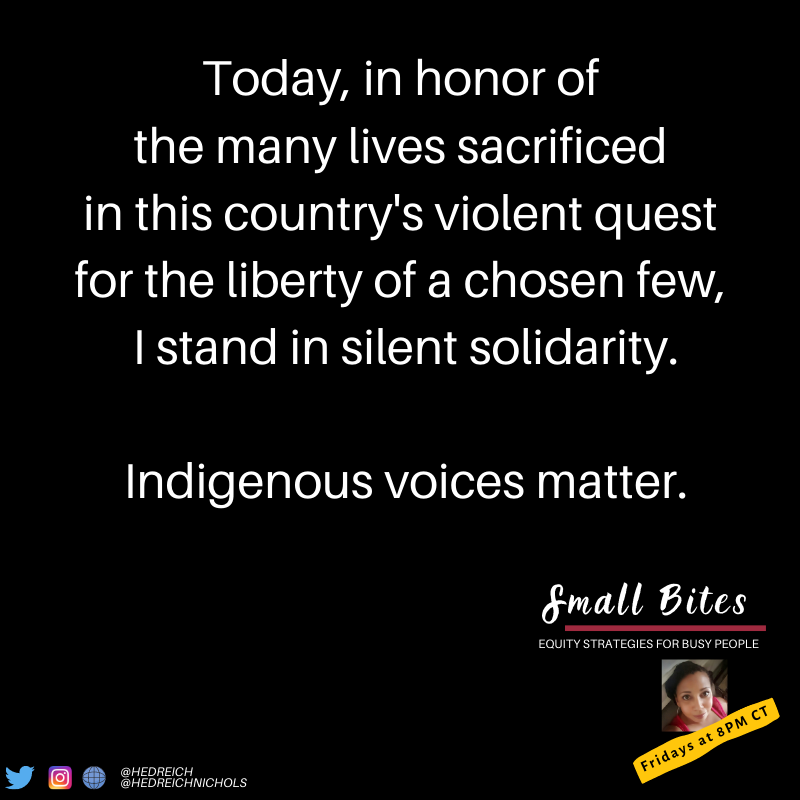
“Seven generations, they say, it takes to heal, to rise above the sadness move forward…” –Rhonda Head, “500 Years”
Thanksgiving was never attached to Plymouth Rock in my house, the women who raised me knew too much truth to celebrate what was the beginning of the end for so many. We cooked, we were thankful. Yesterday, I cooked, I am thankful. I am also in solidarity with those who mourn this month.
This week, I will leave you to find your own truth; about Thanksgiving, about our nation’s origin story. Try to find one new truth or one new voice to amplify. See you next week.
Here is my most recent article from Edutopia featuring Indigenous narratives and stories, many from Indigenous people. These stories are helpful for teachers and learners seeking historical accuracy.
Below are links to explore and stories to be heard about the over 60 million people who were here long before Europeans came; and this week’s Small Bites features the names of indigenous voices to learn from on social media, plus a groovy Spotify playlist to help you decolonize your drive-time.
NOTE: Special Thanks to Rhonda Head, the award winning Cree mezzo soprano on this week’s #SmallBites. You can find out more about her on rhondahead.com, @Rhonda_Head on Twitter, or RhondaVHead on Instagram. Her music, including her latest Christmas single, can be purchased on iTunes.
20-30m –Spend some time exploring the NPS indigenous stories and reflecting over the old cowboy and “Indian” movies. Do it with your families, with your students.
15-20m – Put yourself in timeout, the world will not stop turning. Use that time to do whatever recharges you.
10-15m – Look at your lesson plans and reflect on how your students can show mastery in fewer steps. Don’t teach less, don’t question less, but reduce testing stress. In populations that are struggling educationally and because of COVID more than others, a little ‘air’ is helpful.
5-10m – Look up the most recent CDC and WHO guidelines and share them with your students and families. Do everything you can to mitigate COVID spread over the holidays.
This year I had really all but decided that I was NOT buying a turkey. I barely like turkey. And for my small family, that’s a WHOOOOOOLE lotta leftovers that I don’t like. But the pull was so strong that I not only bought one, I created a whole Small Bites about it.
Thing is, I grew up in a house where none of us really liked turkey. I remember this same conversation with my grandmom who made THE best fried chicken. It would have been a much better choice, but, we always went with turkey. Here I am, generations later, a whole grown up, and I have a turkey alarm set on my phone so I don’t forget to defrost starting Sunday.
That’s the pull of traditions. I can say that the confederate flag is a symbol of hate because it is flown by Americans who who fought for human trafficking, kept citizens from voting and education and is today carried by people who lynch (domestic terrorists). However, in my life as a Texan, I have met some mostly benevolent people who did not see that flag as egregious, it was simply a symbol of Southern pride. It was the flag that had been in grandpa’s truck, the same grandpa that taught them to fish and hunt. It was the flag touted in history books as a symbol of heroism, a flag revered without consideration of the definition of treason.
If I am honest, I was 16 before I realized that my Southern pride and patriotic education left little room for honest discourse about what we were really proud of.
This Thanksgiving, let’s look honestly at what we have been taught to internalize as fact and ask ourselves, ‘who else was there’, ‘what might have been their experiences?’
Do we consider that the Sioux and Cheyenne were protecting their land and that it was the settlers who were the interlopers since the land was already settled?
Do we consider that although Thomas Jefferson had a longstanding dalliance of some kind, that Sally Hemings was his property, a girl of 14 who he impregnated, whether or not it was her choice?
Do we consider that there are traditions that may or may not be steeped in false narratives or shaded versions of truths that, like a mountain range, may have many views and vantage points?
Do we consider that many songs like Turkey in the Straw or the Eyes of Texas may be traditional songs better left to their racist pasts?
I know that traditions connect us to our past and our world at large, like me buying that turkey I don’t really want to eat. But I also know that setting aside traditions that have out-served their usefulness makes room for growth. As we prepare for our holiday traditions this year, let’s reflect on them and broaden our viewpoint to include the stories of others who share our journey, but not our path.
20-30m – This ain’t our first time at the rodeo. Read this History.com article about contentious elections of yesteryear.
15-20m – Spend 10 minutes writing down everything you are feeling about the pandemic, online learning, the election, life in 2020 in general. Now spend 10 minutes writing down all the things you have to be grateful for. If your first list is longer, dig a little deeper. Still having trouble? Start with the sentence stem, “even though…”
10-15m – Go stand outside. Really, don’t even watch until the end. Look up at the night sky. Whether it’s velvety blackness or a cascade of stars, realize, you can see it. (Circle back to your list above.
5-10m – Don’t watch the news for the whole weekend. I dare ya!
Do you ever watch zombie movies? Or pandemic ones? Especially the ones that start out in some grassy suburban yard with an idyllic family in the sunshine just before bedlam breaks out? Once the destruction hits, it’s the recurring flashback moment and most probably the moment everyone wonders about; could I have done something differently that would have changed the outcome?
Even in real life, whenever tragedy strikes, we always go back over events, wondering if we had taken another road, chosen another course of action at some magic moment in time, if we would have ended up in the same situation.
I believe, for our country, we are at that ‘fantasy point in time’, that magical moment in which everything can change in an instant. Where do we go from here, as a nation, as ONE nation? How do we go from all black and all white to palatable shades of gray?
We can talk less and listen more.
We can refuse to go down the demonization road.
We can assure ourselves that we have more that binds us than divides us.
Or, we can continue with our Facebook tirades, our finger pointing, our self-righteous conversations with like-minded saints who know what’s best, if only the other side weren’t so cretinous.
This is the moment in which we choose to move forward, to make the best of what we have, no matter how odious we feel that choice might be. Yes, this country is deeply divided. Yes, I have my feelings about it. But I will not waste energy on any of it. I have a son to raise, roses and relationships to tend, a future generation to educate and a corner of the world to brighten. I have a book to write and groups to speak for. I have a new niece to bewundern. In short, I have a life to live beyond politics and anger about politics.
This is that magic moment in time in which we decide to dedicate our energies to the things that we can change and accept the things we can’t. If there is evidence of fraud it will be found. If there is none to find, facebook posts and heated conversations will not magically produce any.
Civil unrest can turn to civil war and no election outcome is worth that, not at this point in time. Winning really isn’t everything and I am afraid, if we don’t make some hard choices, life as we know it might be over.
Choose to agree to disagree.
Choose to walk away from arguments.
Choose to educate your children and not your neighbors and coworkers.
Choose peace over contention, even with those you consider evil.
My question is, as you express your moral outrage at the turn this country is taking, just what are you holding on to and what’s the worst thing that could happen if you let it go?
This is that magic moment in time, the one that we can hold on to, or wistfully look back on while unrest escalates into something permanently destructive. Dramatic? Maybe. Possible, definitely. And although we may not all agree on how this country should be run, we’d all agree that we do hope there is a country to be run; so instead of standing back and standing by, let’s all just stand down.
And just in case you wonder why I’m talking about the election in a blog about equity strategies, to be sure, 50% of us are likely to be teaching students who come from households in which parents do not espouse our politics. If you really want change, make sure you are modeling peace and acceptance, even if it seems that their parents aren’t. Your students are watching you, let them see the best in you, even throughout this difficult time.
When the election is called, your reality will not drastically change. But how you handle your reality can drastically change everything around you. If you react with levity and calm, those around you just might do the same. –Hedreich Nichols
Y’all know I viewed life from the church bench from right behind the piano where my mama, grandmama and great-grandmom before me all played for the choir. Although I know faith is not everybody’s thing, it has taught me some valuable lessons that are universally useful.
The line from an old hymn–be not dismayed whate’er betide is perfect for this moment. Will who is in the White House really change what happens to you and your family tomorrow morning? Will you cease to eat, drink, sleep, breathe, love because your candidate does or does not move in/out on January 20th?
Yes, you wanted to make America great again and erase the havoc that 8 years of the Obama presidency and ensuing accusations of radical ‘cancel culture’ attitudes have wreaked.
Yes you wanted to show the world that America is an inclusive place that does not control people’s bodies, judge who they love or how they look; a place that acknowledges, and seeks to right, historical wrongs.
Maybe you get what you want. Maybe you don’t. One way or another, a favorite saying of parents and teachers of littles is, “you git what you git and you don’t throw a fit”. We have a democracy. When it speaks, we adhere to the proclamation and get in line to forgive, or at least move past, the evils of the other side to become one nation indivisible again. There are wrongs, there are attacks, there are selfish moves that I do not understand, however, I know that the “other side” thinks the same about my side.
I cannot change everyone’s opinion and I have ceased to waste energy trying. I suggest you do the same. Don’t throw good money after bad, as the folks saying goes. Don’t spend your time on social media, or at the table arguing with friends, co-workers and relatives. Unless you are very lucky, this won’t be the first time you have to forgive and extend grace without your pain being acknowledged. So extend and model grace and levity for the good of everyone.
When the election is called, your reality will not drastically change. But how you handle your reality can drastically change everything around you. If you react with levity and calm, those around you just might do the same.
Be not dismayed, whate’er betide, God will take care of you. Whether you believe all the words Sis. Mamie Lee Lott used to sing on Sundays, the first part remains true. Be not dismayed. Don’t worry. Remember the lessons of your youth on the quotidianness of opinions and the wisdom of saying nothing more often than saying something. And if you need to voice your opinion about the evils and ills of the world, write your congressional representative, call your school board member or better yet, run for office yourself.
Be not dismayed. Yes, I know there is a lot at stake. I have some big feelings too. But, I know that when the election is called, all I can do is keep being the best person I know how to be. I hope you’ll join me.
K-3 – Here are fully fleshed out election day lesson plans from Colorful Pages.
K-12 – No time to devote to a full-blown plan? Use this sample ballot, also from Colorful Pages, to host your own election. Vote for candidates or something fun like vanilla or chocolate ice cream. Talk about why there are only two choices. (No time to copy? Put it on the screen and let kids make their own.)
3-8 – Ask your students if they know that women could not always vote. Watch this 3-minute video that helps explain why.
K-12 – When you think about your classes, which of your students isn’t connected to the group? Make a point to connect with them one on one. Exchange some personal fun fact and really listen when you ask how they are.
Educators – Make it a point to have a bedtime, preferably no later than 10:30, no exceptions.
Earlier this week, I did a session for Rethinking Learning with Barbara Bray. We talked about strategies on how to have empathy with ‘others’. Others are people who think or look different than us and our friends. Once we stopped recording, talk turned more specifically to the upcoming election and how every ‘we’ in the country is sure that every ‘they’ in the country is destroying the American way of life.
The problem with that way of thinking is, we and they are us. This isn’t our team against the other team. This is one team, one nation indivisible.
What happens Wednesday? How do we heal the bitter divide and seek to understand that, in this case, there really are very fine people on both sides?
Tuesday night, one side will cheer, one side will hang their heads. But on Wednesday, after the best man wins, even if we don’t all agree that he is the best man, we have to shake hands and move forward. I personally will have a difficult time losing. I will be like the woman I mentioned in this week’s episode of #SmallBites. I may cry, and even if I don’t I will wonder what will become of our country. Because, while there are, at least in this case, some fine people on both sides, some is a long way off from all or even many.
If my side loses, I will wonder what will become of my country because those who are not fine people terrify me with their vision for our country that excludes so many and divides us all. And yet…
…I will log into my Zoom on Wednesday and tell my students that we will be OK. I will pull up a list of controversial elections all over the world and show them how many of those countries survived and even thrived in the wake of change, sometimes even bad change.
I will remind my kiddos that an election does not make or break a country, its citizens do. I will remind them that we are the only fine people who really decide the fate of a nation.
If you missed the live session, you missed me running 3 platforms at once and not doing a very good job of it. It was not my best work. But instead of editing out the quirks, I posted it as is. This is 2020, the year of making it up as we go along, of learning new things and of having an abundance of grace for ourselves and our students.
In the episode I discussed the links on this site and the importance of learning in order to be more culturally responsive educators. If, in any way, I implied that you need to do more, I take it back. I do want you to use the links BUT, I also know that we are all overworked, overextended and oft overwhelmed. Doing everything on our to do list is barely possible. Being asked to do more, well, that’s just not possible for most of the teachers I know, many of who are working until 2AM and still can’t get caught up.
So, after an amazing Q&A session with some wonderful human beings, I decided to give you a little something different for the next 10 episodes: something you can use immediately. Look for either plug and play lesson plans, shorts to share with your class or other tools that will hopefully make your day run a little smoother or help out in an emergency.
Meanwhile, just in case, here are a few of my favorite links from the last 5 episodes in one place.
Small Bites Friday Five 10-16-20:
15-20m – Watch this TEDx Talk as Dr. Michelle Chatman explains the difference restorative justice practices can make in a child’s life, and how black children are perceived as older, angrier and less in need of nurturing than their white peers.
5-10m – Read this We Are Teachers article about the difference between zero tolerance and restorative practice schools.
0-5m – Watch restorative circles at work in this Oakland Unified school video.
Small Bites Friday Five 10-09-20:
20-30m – Do some academic reading with this UCLA Haas Institute article. Learn vocabulary like racial anxiety and stereotype threat. Reflect on how those phrases can play out in the lives of folks like me.
15-20m –Take this quiz, answer the se questions from Bias Busters, then ask yourself how much of this was in the history books you were taught from.
0-5m – Read about how inoculation was introduced to the US by Onesimus, an African who told of the traditional African practice in use for centuries. Then use the same article to learn something new about the omitted contributions of melanated Americans.
Small Bites Friday Five 10-02-20:
15-20m – Enrich your students’ learning with resources from Voices of a People’s History that include videos, lesson plans and a full teacher’s curriculum guide.
0-5m – Read this Time Magazine article about the denouncing of the 1619 curriculum and the push for patriotic education. As Joanne Freeman says, studying all perspectives is only dangerous if you have something to hide.
Math – Listen to my 2 of my favorite neighbors to the north, Chey and Pav as they explore Math through an SEL lens on the Staff Room Podcast. SEL is ALWAYS at the heart of any culturally responsive teaching.
Film/Photography or Fine Arts – Explore the beautifully crafted visual stories from the Global Oneness Project.org. Thanks to Jennifer Gonzales and Cult of Pedagogy for this one.
Generalist – Look no further than Ki Gross’ Woke Kindergarten site. They specialize in teaching big concepts to little people.
ELA – Watch this Ted video from the passionate, ‘articulate’, spoken word “tri-tongued” Jamila Lyiscott to get perspective on the different ways we English. Then reflect with your students on the different ways we talk to different audiences.
Dedicated to; Barbara, Hal, Mervil, Tara, Kecia, Laura, and Jen.
20-30m – Here’s a little more academic reading with this PNAS article on bias and racial disparities in school discipline. If you have some extra time, read some of the cited sources as well.
15-20m – Watch this TEDx Talk as Dr. Michelle Chatman explains the difference restorative justice practices can make in a child’s life, and how black children are perceived as older, angrier and less in need of nurturing than their white peers.
10-15m – Comb through these Oakland Unified resources to find some that fit your classroom or campus. If you have extra time, watch the webinars on community building and restorative justice practices for virtual learning.
5-10m – Read this We Are Teachers article about the difference between zero tolerance and restorative practice schools.
As I watched Kamala Harris in the vice presidential debate, in addition to enjoying watching her —-I was struck by how polite she was. I have seen her on the congressional floor. It’s not that she is not polite, but the courtroom lawyer edge is more readily apparent. As I wondered why she didn’t bulldoze over the moderator as her opponent was wont to do, I remembered–
she didn’t have the luxury.
Anyone who is a woman knows that any forceful, type A personality maneuvering can all too often be met with less than stellar reviews. If you’re melanated, the chances that you will be cast in the role of The Angry Black Woman goes up exponentially.
Had Kamala Harris behaved as her opponent did, she would have been called unlikeable, a shrew, a nasty woman, or worse. As it stands, the one time she did draw a line in the sand–smiling all the while–it became the biggest takeaway from the debate. All of the issues she tackled, her hours of preparation reduced to one line in a meme (epic, though it was), “I’m speaking”.
I wonder if Kamala regretted that moment? I wonder if she lost sleep over the tarnishing of her debate image, if she braced for attacks from her detractors, “how dare she speak to a sitting vice president in that way”?
I wonder if Kamala felt the weight of all the times she had to smile to ensure that her message was heard, knowing that, had she been born male or White, her lack of restraint could have been the very thing that made her seem presidential, rather than a liability?
If you think that I am venturing too far off into politics, I promise you, I that’s not what this is about. I mulled over Kamala’s almost demure debate debut. I reckoned with my own angst at my dive into a more passionate presentation last week on SmallBites. Then I thought about how little Black girls are over 5 times more likely to be suspended than little White girls and how the disparity is larger than that between White and Black boys. That sobering statistic makes black girls the most at-risk student group in the country.
Whether the little girl in your class is “feisty”, “spiritied”, “high-strung” or has a “strong personality”, think before you label. First of all, you would never use those terms to describe a male student. But as stated, girls should be smiley, not too assertive. And if you’re Black, you have to be twice as “nice” to suit those who have power over you, lest you be thought of as (insert negatively tainted teacher workroom label here).
Women like Kamala and I have something in common with Black women all across the country. We know showing strength too overtly will be met with criticism so loud that our message could be immediately obscured. In classrooms, that criticism is seen in the number of disciplinary actions against little Black girls.
That criticism and those actions form them in ways that have lasting consequences.
This week, I have an ask. In some quiet moment, reflect on your thoughts about “Blackness”. Reflect on the friends you choose who are Black. (If you don’t have any, that is a subject for another day.) Are they more similar to you than dissimilar? Are they Carlton Banks Black but Not Will Smith Black? No judgment if they are. Black is Black, and there are no degrees of Blackness based on mannerisms, dress or music choices. Your own choices may be more Will Smith, not stereotyping here. We are individuals and that as it should be. But if you are more Carlton and you more easily relate to Carltons but not Wills, ask yourself why. It may be that you are simply spending with people with whom you share social or work circles. Or might it be that you shy away from the teacher who expresses her culture in a way that you may find foreign or even threatening, without even noticing?
This is not a test. I won’t be asking for your answers or your thoughts. I just want you to reflect on how you think about and react to Black cultural expressions and how it might affect your teaching.
If you find certain expressions of culture foreign or even a little threatening, that’s ok, it might even be a good thing: Now that you have realized it, you know you have some work to do. Once you are aware of your own biases, you can help others.
The next time someone talks about cultural expression in a way that puts children in a negative light, be the voice in the room to give perspective.
Be the advocate.
Be the ally.
Instructional time is too important and the souls and futures of little Black girls are depending on your commitment to making a difference.